

Lesser horseshoe bat - Rhinolophus hipposideros
The lesser horseshoe bat -

The characteristic shape of its nose, which is reminiscent of a horseshoe, is the feature that gave this bat species its name.
The sonogram of the lesser horseshoe bat's call shows a distinctive frequency structure.
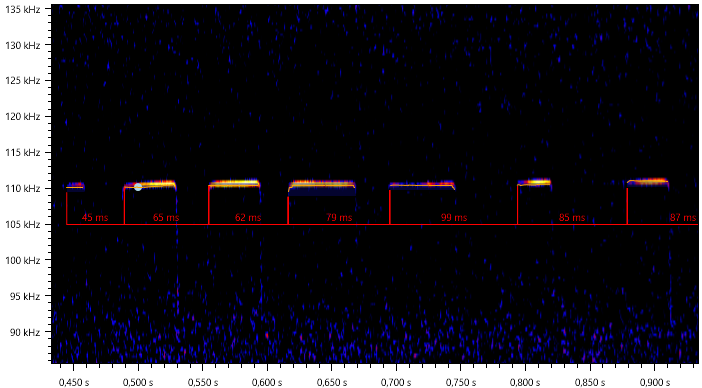
The echolocation calls of the lesser horseshoe bat have a frequency of around 100 kHz, making it one of the bat species with the highest call frequencies. The calls are produced through the nose, a feature that distinguishes them from most other bat species that emit their calls through the mouth.
Lesser horseshoe bat - Rhinolophus hipposideros
Results
The species has only been recorded on Giglio in individual records at Allume, i.e. in the cliff habitat. The species has not yet been documented for Giglio.
The lesser horseshoe bat is a small bat species that is widespread in Europe, North Africa and as far as the Caucasus. It is known for its horseshoe-shaped nose appendages, which it uses for echolocation. The lesser horseshoe bat prefers warm, humid habitats and hunts near vegetation, often at low altitudes.
At a glance:
Appearance:
Body length: | 3.5 - 4.5 cm |
Wingspan: | 19 - 25 cm |
Weight: | 5 - 9 g |
Fur: | Grey-brown to reddish-brown, with light underside |
Special features: | Horseshoe-shaped nose tips, large ears |
Distribution, habitat and behaviour:
Distribution area: | Europe, from the British Isles to the Caucasus, North Africa |
Habitat: | Forests, fields, caves; prefers warm, humid environments. Roosts in caves, old buildings and tunnels. |
Localisation call: | Characteristic frequency-modulated sounds produced by the special nose structure. |
Hunting behaviour: | Hunts near vegetation for small insects, often close to the ground. Uses acrobatic flight manoeuvres to catch prey |
Migration: | No known seasonal migration |