

DinoSAURian




DinoSAURian
We were there: Children's Campus at the University of Oldenburg
-

Dr Mark-Tilo Schmitt and Laura Haarhus -
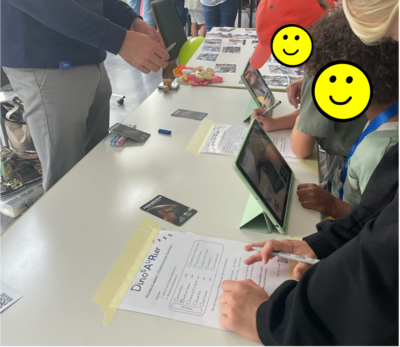
Distinguish between carnivores and herbivores with AR cards


Use of augmented reality using the example of dinosaurs
As part of theDinoSAURierproject, Year 3 and Year 4 classes can work together as a whole class with their teachers to expand their knowledge of dinosaurs. At various stations, pupils work in pairs to learn about different aspects of dinosaur life and how our understanding of dinosaurs has evolved. They learn using augmented reality cards on the topic of dinosaurs, which allow pupils to project dinosaurs into their surroundings and examine them.
TheDinoSAURierproject is a PhD project led by Laura Haarhus (Department of General Studies at the University of Oldenburg). The accompanying research focuses on fostering scientific modelling skills.


What does a day in the DinoSAURier project look like?
The project took place both in the SULab at the University of Oldenburg (see first pictures in the review) and at a school.
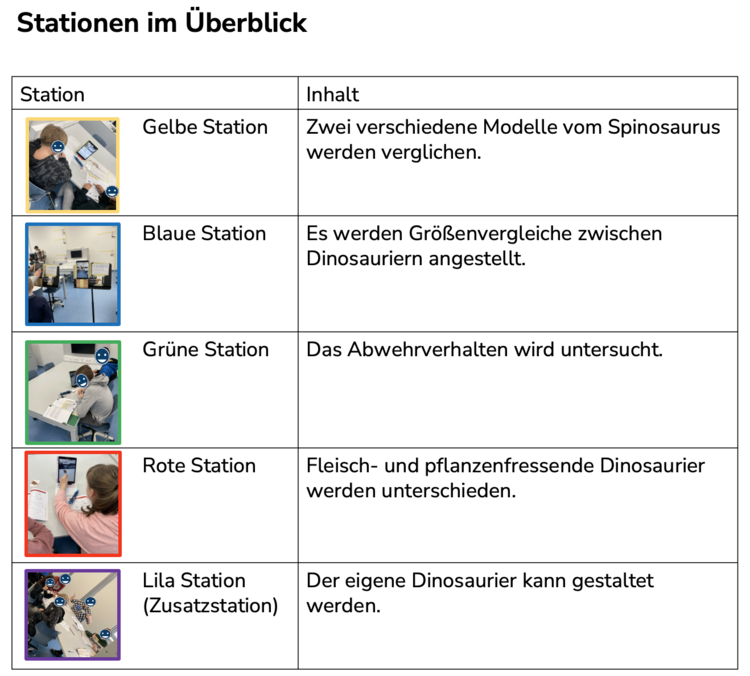
The children worked either with augmented reality models on the topic of dinosaurs or with analogue dinosaur models. Which class received which variant was decided at random. At the beginning, the pupils filled out a questionnaire (see Research tab). The classes were then introduced to the topic of dinosaurs and models. They were then divided into teams of two and worked through four stations with the help of a research booklet (see left). A brief overview of the content of the stations can be found in the table on the left. Afterwards, the pupils received a final questionnaire and were able to give brief feedback. All participants received a certificate in recognition of their work on the project.
Research
Significance of the PhD project
TheDinoSAURierproject is a PhD project. This means that a research project is linked to the visit to the SULab and the implementation of the project.
Questionnaire
At the start of the visit, the pupils complete a questionnaire
- on their interests (in models, dinosaurs, General Studies) (e.g. ‘I find the topic of dinosaurs interesting’),
- on the pupils’ understanding of models (e.g. ‘What should Robin bear in mind during the selection process for a model?’) and
- their specialist knowledge of dinosaurs (e.g. ‘Robin would like to learn about the T-Rex. Tick Yes or No.’).
These questions are asked again at the end of the project.
Digital or analogue?
The project was carried out either using augmented reality models on the topic of dinosaurs or using analogue dinosaur models. The classes were assigned at random. One of the aims of this research is to investigate whether pupils benefit more from digital models (AR models) or analogue models (e.g. Schleich models).
Research booklet
The research booklet contains the tasks for the four stations. At the start, the pupils were given a code, which they wrote on their questionnaires and also in their research booklets. As the entries in the research booklets are also being analysed, the booklets will be collected and sent back to the respective schools once the analysis is complete.
Aim of the research
The aim of the research is to find out whether, and to what extent, the answers given by pupils who worked with the augmented reality models differ from those given by pupils who worked with the analogue dinosaur models.
It might, for example, be found that the children working with the AR models learn more than the other children. On the other hand, it might also be found that the children working with the analogue dinosaur models learn more than the other children.