
VRiS
VRiS
Learning with immersive virtual reality in General Studies
The VRiS project focuses on the use of immersive virtual reality in General Studies.
Even very young children should be introduced to learning with and about digital media. By complementing Computing Science education, this aspect has been integrated into primary school General Studies.
Digital learning opportunities are no longer limited to videos or educational games, but also include complex learning environments designed using the latest technologies such as VR (virtual reality) and AR (augmented reality). This rightly raises the question of whether, and if so, how such learning environments can be integrated into General Studies.
In addition to addressing these questions, the VRiS project also focuses on the issue of feasibility. To ensure sustainable learning with and through digital media, it is essential to create learning opportunities tailored to pupils’ needs. To this end, (prospective) teachers must be able to independently design digital learning opportunities and adapt them for educational use. This includes, in particular, developing pupil-centred learning opportunities that build on pupils’ preconceptions and prior experiences.
To this end, research was conducted into the attitudes and values of students studying general studies regarding pupils’ perceptions in general, their approach to AR and VR in particular, and their views on their own competence in relation to AR and VR. In addition, based on the M-iVR-L model (Meaningful-immersive Virtual Reality-Learning Framework) by Mulders, Buchner and Kerres (2020), examples were provided to illustrate how an iVR learning opportunity for General Studies might be implemented.
As a next step, students will be introduced to the technology and pedagogy as part of their university studies. In doing so, they will create exemplary learning environments using iVR for General Studies.
In future, research will be conducted at the SULab into how pupils interact with these developed learning environments.
Questions regarding the VRiS project can be addressed to Nicolas Arndt, Dr Silke Bakenhus, Prof. Dr Maja Brückmann and Dr Marisa Alena Holzapfel.
Project duration
since 2021
financing
The Institute’s own funds
Publications
Holzapfel, M. A., Bakenhus, S., Arndt, N. & Brückmann, M. (2023). What attitudes and values do students of general studies hold regarding the use of and learning with AR and VR? In: D. Schmeinck, K. Michalik & T. Goll (Eds.). Challenges and Future Prospects (pp. 71–78). Bad Heilbrunn: Julius Klinkhardt.
Holzapfel, M., Bakenhus, S., Arndt, N. & Brückmann, M. (2023). Attitudes and values of primary school teacher training students towards learning with augmented reality (AR) and virtual reality (VR) in General Studies. MedienPädagogik: Journal of Theory and Practice in Media Education, 48 (AR/VR – Part 2), pp. 151–169. doi.org/10.21240/mpaed/51/2023.01.16.X
Bakenhus, S., Holzapfel, M., Arndt, N. & Brückmann, M. (2022). The creation of a learning environment using immersive virtual reality for General Studies based on the M-iVR-L model. MedienPädagogik: Journal of Theory and Practice in Media Education, 47(AR/VR – Part 1), pp. 76–93. doi.org/10.21240/mpaed/47/2022.04.04.X
Conference papers
Bakenhus, S. (2024). General Studies 2.0 – A seminar concept for creating virtual learning environments, using Evenburg Castle (East Frisia) as an example. Poster at the conference organised by the ‘lernen:digital’ competence network, entitled ‘Shaping Digital Transformation for Schools and Teachers’, Potsdam, Griebnitzsee campus, 30 September–2 October 2024.
Brückmann, M., Tempelmann, S., Arndt, N., Bakenhus, S., Dubach, J., Haarhus, L., & Holzapfel, M. (2024). Isn’t the (real) world enough? Findings on the use of augmented and virtual reality in General Studies. Symposium at the 33rd Annual Conference of the Society for the Didactics of General Studies (GDSU) in Hanover, ‘Shaping the future through General Studies?! – Challenges and potential in the context of complexity and uncertainty’, 7–9 March 2024.
Bakenhus, S., Arndt, N., Holzapfel, M. & Brückmann, M. (2023). Evenburg Castle as an extracurricular virtual learning venue?! – Testing a seminar concept. ’spresentation at the 32nd Annual Conference of the Society for the Didactics of General Studies (GDSU) in Salzburg, “Thinking in Alternatives – Critique, Reflection and Transformation in General Studies”, 22–25 February 2023.
Bakenhus, S., Arndt, N., Holzapfel, M. & Brückmann, M. (2023). Evenburg Castle as an extracurricular virtual learning space?! – Testing a seminar concept. ’spresentation at the 32nd Annual Conference of the Society for the Didactics of General Studies (GDSU) in Salzburg, ‘Thinking in Alternatives – Critique, Reflection and Transformation in General Studies’, 22–25 February 2023.
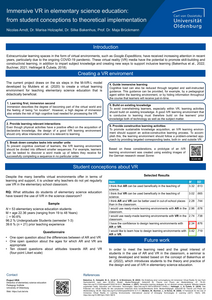
Arndt, N., Holzapfel, M., Bakenhus, S. and Brückmann, M. (June 2022). Immersive VR in primary science education: from student conceptions to theoretical implementation. Poster presented at the conference of the European Association for Research on Learning and Instruction (EARLI) SIG 11, Oldenburg.
Holzapfel, M., Bakenhus, S., Arndt, N. & Brückmann, M. (March 2022). Attitudes and values of primary school teacher training students regarding pupils’ conceptions and prior experiences of learning with iVR. Presentation at the 31st Annual Conference of the Society for the Didactics of General Studies (GDSU), Cologne (online).