
Independent measuring point
Independent measuring point
H. Helmers, J. Pade
(from: Köhnlein, W., Nussbaum, R. H. (ed.): "Die Wirkung niedriger Strahlendosen", Gesellschaft für Strahlenschutz, Bremen, 2001, pp. 396-406)
Summary
The Department of Physics at the University of Oldenburg has been operating a laboratory for environmental radioactivity for almost 20 years, in which students are familiarised with methods of nuclear radiation measurement technology and dosimetry from an environmental analysis perspective.
After the reactor accident in Chernobyl on 26 April 1986, the Department of Physics also used the laboratory to measure the radioactive contamination resulting from the accident. By organising a large number of public information events and with the support of the local media, it was possible to inform the population in the region comprehensively about the existing contamination. This was particularly well received because the official measurement centres were either reluctant or unwilling to make their measurement data available to the public. Experience showed that factual information about the existing pollution and ways of dealing with it in practice allayed some unfounded fears - and did not fuel panic, as the department was accused of by the state government and some authorities at the time.
In addition to the presentation of the measurement programme at that time and today, the public relations work and the public response to it, some current results of selected measurement campaigns are presented, in particular on the radioactive contamination of the soil. The response to the publication and evaluation of these results, even outside scientific journals, clearly shows the great importance that independent measuring centres still have today in informing the public.
Abstract
For a time period of little less than 20 years the Physics Department of the Carl von Ossietzky University at Oldenburg has been running a laboratory for environmental radioactivity, where students are familiarised with the methods of radiation measurement and dosimetry with an environmental approach.
After the disaster of Chernobyl on 26 April 1986 the Physics Department used the laboratory for measuring the radioactive load resulting from the reactor accident. Organising a lot of public information events and with the support of the local media we succeeded in informing the regional population extensively about the existing load. This met with a special response mainly because the official measurement stations did not publish or only very hesitantly published their data. Our experience has shown that objective information about the existing load as well as about the way of how to deal with it took away unfounded fears instead of stirring up panic for which the Physics Department was reproached by the former Land Government and some authorities.
In addition to the representation of the previous and current measuring programme, the public relations work as well as the public response, some current results of selected measurement campaigns, especially concerning soil pollution, are presented. The response on the publication and assessment of those results also outside scientific journals demonstrates how important independent measurement stations still are today for informing the population.
1 Introduction
The University of Oldenburg emerged from the former Oldenburg University of Education in 1974. The founding phase was characterised by the motto of Nobel Peace Prize winner Carl von Ossietzky, who later gave the university its name: "Science and technology were primarily there to help. They created tools of destruction, tools of atrocious murder. We must make science human again." The Department of Physics also felt committed to this motto when it was planning the expansion of the physics department around 20 years ago. At that time, there was a broad public debate about the benefits and risks of nuclear energy, which was also heatedly debated in Oldenburg with the Unterweser nuclear power plant in the immediate vicinity and, of course, carried over into the university. The department therefore decided to set up a laboratory for environmental radioactivity in its new premises. Among other things, it was to be available to the population in the region as an independent contact point for the field of environmental radioactivity and thus make a small contribution to "human science".
The establishment of the laboratory began in 1984.g-spectrometers (HP-Ge, NaJ), gas counters and dosimeters were initially available. Later, a further g-spectrometer (HP-Ge), a a-spectrometer, a low-levelb-measuring station, additional dosimeters, contamination monitors and a step filter system for continuous air monitoring.
In addition to providing services for people in the region, the laboratory has been involved in teaching at the Department of Physics from the very beginning. Students learn the basics of applied nuclear physics, nuclear radiation measurement technology and dosimetry here in advanced practical courses. Current questions and problems in measurement technology are dealt with as part of physics theses of various durations (6-week student research projects, 6-month state examination theses, 12-month Diplom theses). This ensures that the laboratory is kept at the cutting edge of science and technology, an essential prerequisite for an independent measuring centre whose results are subject to particularly critical scrutiny in the public debate. In addition, interdisciplinary projects are carried out together with other departments. These include, for example, investigations into the behaviour of radionuclides in soil with the Biology department or questions of measurement data processing with the Computing Science department.
2 Chernobyl - a first test
The Chernobyl reactor accident on 26 April 1986 was the first tough test for the laboratory, which from then on was only known to the public as the "radioactivity measuring station". A morning glance at the weather map on 2 May 1986 made it clear that the radioactive cloud would also reach Oldenburg in the course of the day. The objective of the monitoring centre was therefore to continuously measure the radioactive contamination of the surrounding area and to inform the public objectively about the measured data and its evaluation. The assessment was based on the following guidelines, which were also mentioned with every public recommendation:
- the minimisation requirement of the Radiation Protection Ordinance, according to which radiation exposure "shall be kept as low as possible even below the limits laid down in this Ordinance" (/8/, § 28);
- the recommendation of the Radiation Protection Commission of 2 May 1986, according to which "for reasons of precaution, any radiation exposure that can be avoided by simple means should nevertheless be avoided by suitable and practicable means" /2/;
- the fact that "there is no threshold dose below which stochastic radiation damage does not occur" /1/;
- the limit value recommendations derived from these rules and facts by the radiation commission set up by the nature conservation organisation BUND.
On this basis, the Radioactivity Monitoring Centre has continuously published its many thousands of measurement data on radioactivity in air, rainwater, soil and food since May 1986. It met with a great deal of public resonance, as the official bodies did not disclose their measurement data at all or only very hesitantly and generally provided them with such appeasing assessments that they appeared untrustworthy from the outset. Statements such as "The Federal Government states that there is no danger to the Federal Republic of Germany and that there will be none" (Norbert Schäfer, Federal Government spokesman on 30 April 1986) or "Although we have no precise information, the situation here is under control" (Federal Minister of the Interior Zimmermann on 7 May 1986) meant that any credibility vis-à-vis the population was squandered. With this kind of disinformation policy, people were dependent on information from independent measuring centres and received it with great interest. Some figures:
- more than 55,000 people used the telephone announcement service of the radioactivity monitoring centre, through which current data and assessments were disseminated (the Federal Post Office had made its service number 1166 available);
- more than 4,500 people took advantage of the individual telephone counselling service;
- the most important questions and concerns of the population were addressed at more than 200 public information events;
- the regional press continuously published the monitoring centre's data and recommendations.
These services provided by the radioactivity monitoring centre to the public could only be provided because many members of the Physics Department were willing to commit themselves to informing the public about the actual exposure in the prevailing exceptional situation. In addition, donations from companies and individuals totalling around 100,000 DM made it possible to pay staff in particular to keep the laboratory running around the clock for many months. The public relations work of the radioactivity measuring centre has shown that it is quite possible, with a reasonable amount of time and patience, to educate lay people about the consequences of radioactive contamination to such an extent that they are able to assess the risks themselves /5/. This was precisely the aim of the monitoring centre, which it achieved with its open and therefore credible information policy. This is precisely what governments and authorities have failed to do. It was their inadequate information policy that caused people to feel insecure and sometimes even panic - factual information could have prevented this. Here are two examples from the large number of measurements carried out. Parents of small children were particularly concerned at the time about the possible radioactive contamination of breast milk and baby food (dry milk and porridge, ready-made food). However, the analysis of over 250 samples taken by the radioactivity monitoring centre between May 1986 and May 1987 showed that the majority of the samples were only very slightly contaminated (Fig. 1). The factual information provided to the public about these results, combined with the "all-clear", subsequently contributed significantly to reassuring those affected. - At this point it should be remembered that in 1997 in the immediate vicinity of Chernobyl, only 11% of breastfeeding mothers had breast milk contamination with Cs-137 below 37 Bq/l, all others above /7/.
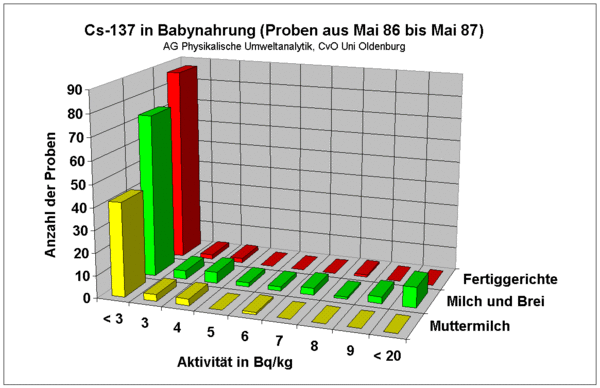
Fig. 1: Caesium contamination of infant formula in the period from May 1986 to May 1987
Information on the existing soil contamination in the region in comparison to the radioactive contamination from the above-ground nuclear weapons tests in the 1950s and 1960s also served to provide factual information and thus to enable people to assess their own risk. In 1986, many people could still remember the time when data on air, rain and food pollution appeared regularly in the newspapers. A comparative look at the soil contamination from Chernobyl (Fig. 2) made it clear that for the Oldenburg region, the total input of Cs-137 from all above-ground nuclear bomb tests together was of roughly the same order of magnitude as the one-off input from the Chernobyl accident. This meant that the contamination, although not acutely threatening, was serious. As the press slowly withdrew from the regular publication of measurement data, many people were still interested in information about current radioactive contamination. So the option of subscribing to measurement lists was created. Up to 500 individuals, initiatives, municipalities, offices, associations, clubs, political parties, doctors, etc. wanted to receive regular information from the monitoring centre - further proof of its roots in the region. The income from the subscription fees (DM 30 per quarter) could be used for the financing of personnel, so that this service could be maintained for several years.
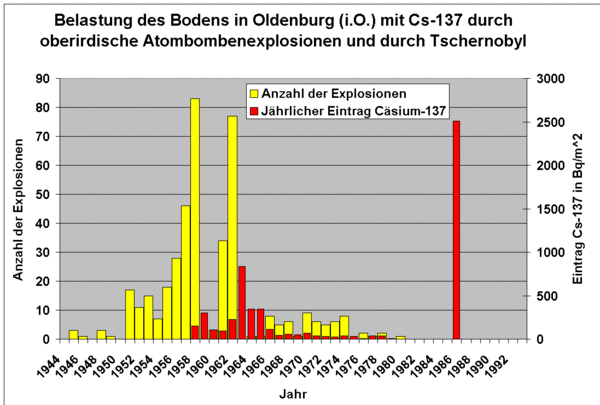
Fig. 2: Soil contamination from above-ground nuclear bomb tests and Chernobyl (Oldenburg i.O. region)
3 The conflict with official bodies
Thanks to the open, objective and responsible public relations work of the radioactivity measuring centre, there was not only good contact with the press, but also with Public Health Departments, companies, associations, doctors etc. as well as with the city of Oldenburg as a whole, which made a submission to the state government of Lower Saxony in favour of expanding the measuring centre. There, however, the physics department was not well received, as its information policy massively disrupted the state's disinformation policy. The minister responsible at the time, Hasselmann, criticised that the measuring station had "contributed significantly to unsettling the population, particularly in the Oldenburg area" and his successor, Minister Remmers, later added: "The department's measurement results were not called into question. However, its advisory and information activities, as well as its recommendations on consumption and lifestyle behaviour, must be criticised. They contradict those of the state and federal governments." - In fact, many of the monitoring centre's recommendations were later adopted by the state government; here are a few examples: temporarily not allowing dairy cows to graze, not consuming sheep's milk, not eating fresh vegetables if they had been exposed to radioactive rain, temporarily not allowing children to play in green spaces, etc.
This controversy continued with the application for ABM positions for the radioactivity measuring centre. In order to assess the proposal, opinions were obtained from the state government and the official measuring centre of the Agricultural Testing and Research Institute (LUFA) based in Oldenburg. While the state government saw "no need for the implementation of a measurement programme by non-official measuring bodies", the head of the LUFA measuring body even insisted on the statement: "From this point of view, what they are doing is against the law" - and: "It is not true that all radiation is harmful" - with reference to the Precautionary Radiation Protection Act, which has since been passed and regulates the tasks of official measuring bodies. Against this background, it is clear that the Federal Employment Agency in Oldenburg rejected the proposal, stating that "the project is not in the public interest", a notoriously important prerequisite for the funding of AB measures.
4 Promotion of the radioactivity monitoring centre
After the CDU government was replaced by a red/green coalition in 1990, a proposal for funding for the radioactivity monitoring centre was approved by the state government of Lower Saxony in 1992. This funding, initially limited to four years, gave the centre a boost. For the first time, a physicist and a chemical-technical assistant could be employed exclusively for tasks in the area of the measuring centre. In addition, it was possible to expand the area of radioactivity (second HP grant).g-spectrometer, PCs, analysis software) and, above all, to add the area of air pollutants (ozone, nitrogen oxides, benzene, dust).
After another change of government in 1994 from red/green to an SPD all-party government, it was not possible to continue the financing of the measuring centre beyond 1996 despite massive, cross-party support from all parties represented in the Lower Saxony state parliament, from the president of the state parliament, from the city of Oldenburg and many others. The measurement programme in the area of radioactivity therefore had to be reduced to a minimum. In the area of air pollutants, only ozone measurements can be continued continuously in the summer months; the costs for this are borne by the City of Oldenburg.
5 The importance of independent measuring points for citizens' initiatives
Since its inception, the radioactivity monitoring centre has worked with citizens' initiatives from different regions and countries in a variety of ways. These initiatives have often had bad experiences with official monitoring centres. Either their concerns and requests for measurements were not taken seriously, or measurement data was withheld from them, or they simply did not trust the official announcements.
For all these reasons, some initiatives felt the need to develop their own measurement capacities (especially g-spectrometers). This required competent advice, which the radioactivity measuring centre was able to provide as a university institution: in the selection and purchase of the devices, their installation and calibration, staff training and ongoing operation. The focus here was on ensuring that reliable data was measured. On the other hand, it was also important to achieve as much as possible with the most economical use of hard-won donations. For example, a simple air monitoring system for aerosol-bound activity was designed on the basis of an ordinary household hoover and a gas meter. Its efficiency was calibrated using an existing professional system and it proved to be similarly effective in this respect. Another example was the production of calibration solutions from caesium-contaminated grass samples and KCl, which were used to calibrate the detection probability of the gamma spectrometers for Cs-137 and K-40.
In addition to this support in building up its own measurement capacities, the Radioactivity Monitoring Centre has carried out a large number of measurements and measurement campaigns at the request of citizens' initiatives and communities, associations and individuals. The following are just a few examples:
5.1 Soil contamination on the territory of the former GDR
After the opening of the border to the former GDR, the radioactivity measurement centre measured the soil contamination with caesium in co-operation with the local citizens' movement "Neues Forum" and compiled it in a map (Fig. 3, from /6/). People were particularly interested in the question of whether there was excessive contamination of the soil in the vicinity of the former GDR nuclear facilities. For this reason, the measurement points in the vicinity of Greifswald and Rheinsberg were particularly densely populated during the measurement campaign. However, no increased ambient radiation was detected there compared to the rest of the area.
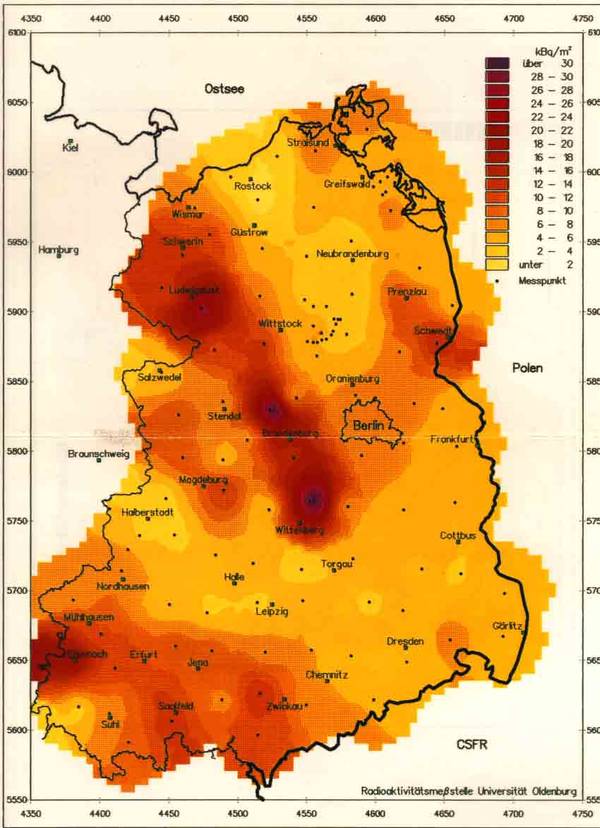
Fig. 3: Soil contamination of the area of the former GDR with Cs-134 and Cs-137 (as of May 1986; from /6/)
5.2 Caesium depth profiles
After the Chernobyl accident, allotment gardeners and vegetable growers in particular were advised to remove the top layer of soil a few centimetres thick in order to keep the radiation exposure of the garden vegetables grown as low as possible in line with the highest principle of radiation protection. In this context, many of those affected have expressed the wish to measure the depth profile of caesium in typical soils in northern Germany. In co-operation with the Department of Biology, a corresponding measurement campaign was started in 1986 and repeated in 1996 for comparison purposes (Fig. 4). Overall, the measurements confirm the slow migration behaviour of caesium in the soil, which depends on the soil type; further details on the interpretation of the data can be found in /3, 4/.
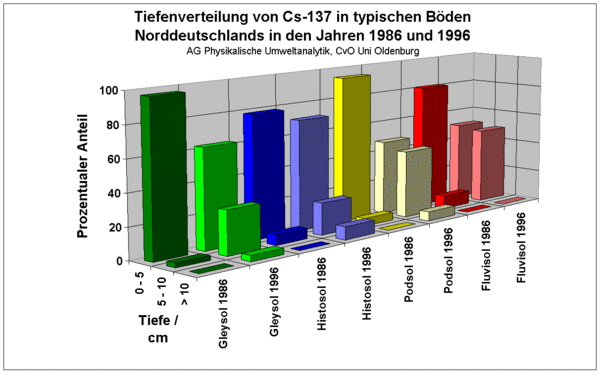
Fig. 4: Depth distribution of Cs-137 in typical soils of northern Germany
A similar depth distribution was also found in soil samples from Belarus. Fig. 5 shows the results of a study carried out at the request of an initiative from Lelchitsy, a small town about 130 kilometres west of Chernobyl. However, the absolute contamination data of up to 156,000 Bq/m² of Cs-137 once again emphasise the dramatic difference to the situation in northern Germany, where the contamination with Cs-137 was around 1 to 2 % of this value.
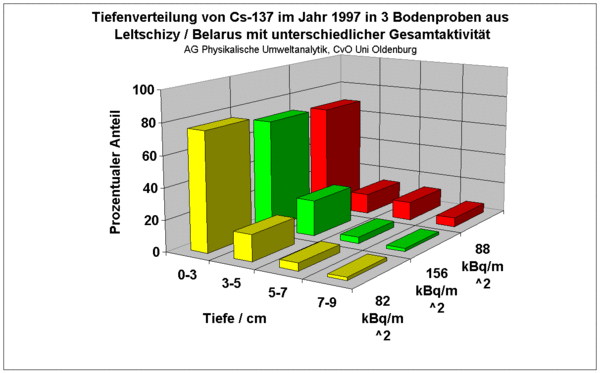
Fig. 5: Depth distribution of Cs-137 in 1997 in three soil samples from Belarus with different total contamination (82 kBq/m² - 156 kBq/m²)
5.3 Environmental monitoring of the Krümmel nuclear power plant
The cause of the increased leukaemia rate in the vicinity of the Krümmel nuclear power plant is still unclear. A connection with emissions from the power plant cannot be ruled out. An analysis of around 30 soil samples taken along the Elbe in the vicinity of the power plant at the request of a citizens' initiative revealed a possible indication of Ce-141, but no clear findings. Continuous immission monitoring in the vicinity of the power plant could possibly provide more clarity about emissions from the plant. The radioactivity monitoring centre is attempting to make a contribution to this. Together with a local citizens' initiative, three rainwater collectors, each with a collection area of approx. 0.7 m², were set up at a distance of 1.5 to 2.5 km around the power plant in a 120° geometry ( ). The rainwater is collected in canisters with a volume of 20 litres, reduced to approx. 1 litre by evaporation on site by members of the citizens' initiative and then sent to the measuring point for final treatment and analysis. - The measurements have been running continuously since the beginning of May 1997 and so far no increased artificial activity has been detected.
5.4 Environmental monitoring Oldenburg
Regular environmental monitoring is also carried out by the radioactivity monitoring centre in Oldenburg, just under 50 km south-west of the Unterweser nuclear power plant. In addition to precipitation monitoring, continuous monitoring of aerosol-bound, long-lived air activity is carried out. For cost reasons, however, the existing step filter system is not used for this purpose. Instead, air with a throughput rate of approx. 3 m³/h is sucked through a glass fibre filter with a diameter of approx. 13 cm, which is analysed by gamma spectrometry after a dusting period of 2 to 3 days. In the event of increased artificial activity, the step filter system can then be put into operation immediately and provide data on the total b and total a activity every 10 minutes.
6 The need for independent measuring centres against the background of the Precautionary Radiation Protection Act
The Precautionary Radiation Protection Act /9/ enacted on 19 December 1986 had and still has one main objective: in the event of a nuclear disaster, it is intended to ensure that information about existing radioactive contamination and its assessment only comes from one source, namely the federal government. To this end, all federal (§ 2) and state (§ 3) monitoring centres are obliged to forward their measurement data to the federal government. There they will be evaluated centrally by the Federal Minister for the Environment, Nature Conservation and Nuclear Safety (§ 5). However, this evaluation will not be based exclusively on the greatest possible protection of the population, but also on what the Federal Government considers "appropriate", as Section 1 of the Act states: "In order to protect the population, the radiation exposure of people...shall be minimised as far as possible by taking appropriate measures, taking all circumstances into account".
Experience with the Chernobyl accident gives rise to fears that the information policy of official bodies in an accident situation will be even more cautious after this law has been passed. With reference to the legal regulations, official measuring centres will probably neither release data nor be prepared to assess and evaluate the situation on site. It will therefore be all the more important for the public to be able to turn to independent measuring centres in their vicinity, from which factual information about the situation can be obtained.
7 Literature
- Federal Minister of the Interior [ed.]: "Umweltradioaktivität und Strahlenbelastung - Jahresbericht 1977", Bonn
- Federal Minister for the Environment, Nature Conservation and Nuclear Safety [ed.]: "Auswirkungen des Reaktorunfalls in Tschernobyl in der Bundesrepublik Deutschland - Empfehlungen der Strahlenschutzkommission", (Veröffentlichungen der Strahlenschutzkommission, Band 5), Gustav Fischer Verlag, Stuttgart u.a., 1986
- Giani, L.; Gebhardt, H.; Gusy, W.; Helmers, H.: "Verhalten einiger radioaktiver Nuklide (freigesetzt durch den Reaktorunfall in Tschernobyl) in typischen Böden Norddeutschlands", Z. Pflanzenern. Bodenk. 150 (1987) 103-107
- Giani, L.; Helmers, H.: "Migration of Cesium-137 in typical soils of North Germany ten years after the Chernobyl accident", Z. Pflanzenern. Bodenk. 160 (1997) 81-83
- Jaeckel, K.; Pade, J.: "Zur Bedeutung naturwissenschaftlichen Wissens im Alltag - Untersuchung des Abonnentenkreises der Radioaktivitätsmessstelle der University of Oldenburg", Agis-Texte Band 8, Oldenburg, 1995
- Lengfelder, E.: "Strahlenwirkung - Strahlenrisiko - Daten, Bewertung und Folgerungen aus ärztlicher Sicht", Ecomed Verlagsgesellschaft mbH, Landsberg, 1990
- Nesterenko, W. B.: "Radiation monitoring of the population and food in the Chernobyl zone of Belarus", Pravo i economica publishing house, Minsk, 1997
- Radiation Protection Ordinance, in: Eder, E. [ed.]: "Vorschriftensammlung zum Vollzug des Strahlenschutzes - Stand 1.8.1990", R. König Verlags-GmbH, Munich, 1990
- Precautionary Radiation Protection Act, in: Eder, E. [ed.]: "Vorschriftensammlung zum Vollzug des Strahlenschutzes - Stand 1.8.1990", R. König Verlags-GmbH, Munich, 1990