
Robonatives


Robonatives
Robonatives
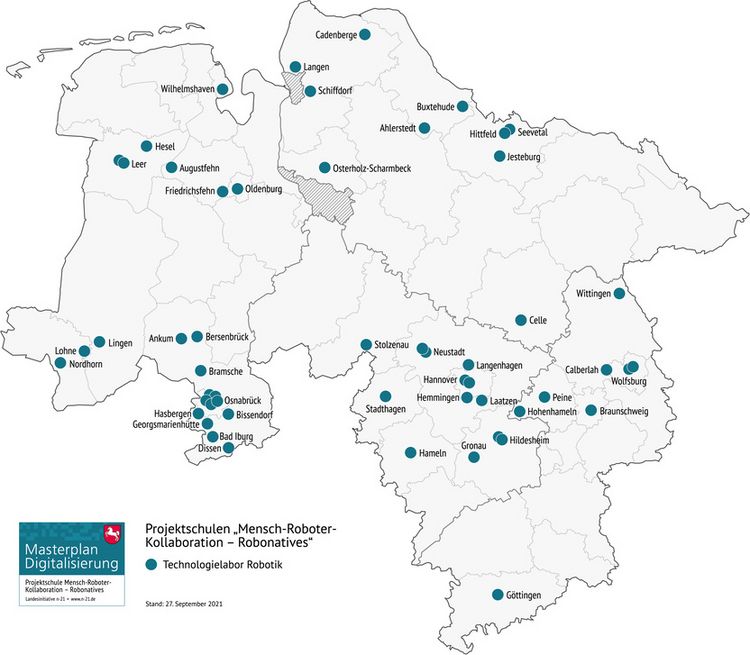
Digitalisation is affecting more and more areas of social and economic life. In addition to the Internet of Things, ubiquitous computing, the use of virtual and augmented reality (VR/AR), big data and artificial intelligence, robotics is also playing an increasingly important role. This social development should now also be taken into account in schools. The educational project "Human-Robot Collaboration - Robonatives" is therefore being carried out as part of the state of Lower Saxony's digitalisation master plan. To this end, general education schools will be equipped with robotics technology laboratories and innovation and future centres on the topic of "robotics and care" will be set up at vocational schools.
As part of this overall project, measures for teacher training in the field of robotics are being carried out throughout the state by the three locations of the University of Hanover, Oldenburg (Jade University of Applied Sciences and Arts and the University of Osnabrück are cooperating here) and Osnabrück University of Applied Sciences and Arts. The Technical Education working group is responsible for some of the training courses and advises Jade University on the didactic realisation of the robotics topic. The project started in September and will run until 2023.
The content focuses on connecting and programming the robotic systems, learning how to operate them and categorising them in social contexts, e.g. the history of robotics and its impact on production. However, the training courses will also cover topics that are relevant to pupils' everyday lives, such as the portrayal of robots in the media (films, literature, video games).
If you have any questions or comments, please contact us at the following email address:
Compendium: "Robots in the classroom"
One of the results of the project is the compendium entitled "Robots in the classroom". In addition to didactic impulses, there are extensive instructions for handling robotic systems that were purchased by the project schools in the course of the project (from robots that were purchased at the general education schools to systems that are used at the vocational schools). The compendium can be downloaded here:

Robonatives graduation ceremony
The closing ceremony of the Robonatives project took place in the atrium of Leibniz Universität Hannover on 1 June 2023. In addition to the presentation of individual learning situations developed by the project schools, the compendium "Robots in the classroom" created at the end of the project was presented. The compendium is the result of the cross-location collaboration (Leibniz Universität Hannover, Osnabrück University of Applied Sciences and Arts, Jade University of Applied Sciences and Oldenburg University) in the project and offers teachers a good overview of the technical aspects of robotics as well as didactic and curricular issues in robotics. A copy of the compendium was presented to the Minister of Education, Julia Willie Hamburg, who was also on site and recognised the achievements of all participating schools, institutions and stakeholders. Here is the press report and more pictures.
However, with the end of the project approaching on 31 July, the work/deeper examination of robots at the ATB of the University of Oldenburg (Centre of Excellence Robotics Oldenburg) will by no means come to an end. Robotics will become an integral part of teaching and research activities. A new RoboLab (financed from the project funds) is currently being set up at our location to support the professionalisation process of students in the field of robotics. In connection with the professionalisation of students, the new RoboLab will enable the continuation of robotics courses in the school laboratory with the involvement of student teachers in the subject of technology.
Content structure and status of the training courses
To date, around 20 full-day training sessions have been organised for the project teachers and other interested stakeholders as part of the project. The training programme included various basic and in-depth training courses on the hardware (Dobot Magician) purchased by the project schools.
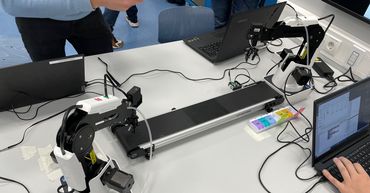
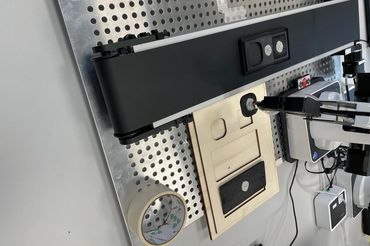
The first basic training sessions included instructions on how to set up the robots for the first time and how to programme the robot arms using Teaching&Playback. In further basic training courses, the peripherals were then integrated and the block-based programming of the Dobot was introduced. These peripherals of the basic training courses include, for example, colour sensors, light barriers, conveyor belts and the linear axis.
More in-depth training was provided on object recognition with the vision kit, the AI (artificial intelligence) kit and networked production. Networked production focussed on networking via digital ports and Industry 4.0 (MQTT). Thanks to the support of colleagues at Jade University of Applied Sciences, we were able to develop our own Python programming interface for the Dobot, which significantly simplified the implementation of text-based programming in the classroom. Teachers received separate, full-day training courses on the Python programming procedure, so that further training on the topic of "Smart Factory" could be introduced.
The process of integrating robotics into lessons at the project schools is constantly monitored within the project and support is offered in the event of problems (technical or contextual). In addition, the hardware we purchased was made a permanent part of the teacher training programme. For the past three semesters, prospective technology teachers have been trained to handle the hardware and programming as part of a robotics module. In addition, students are prepared to deal critically and sensitively with pupils' perceptions and media representations of robotics topics. Building on this knowledge, students develop and test learning situations in the school laboratory for technical education.
Outlook:
During the remainder of the project, the foundations and in-depth knowledge gained during the training courses will be used to work together with the project schools on the development of learning situations.
School lab meets robotics
On 24 January 2023, pupils from Herbartgymnasium visited the "ATB-Werkstatt" school laboratory. Master's students of technical education organised a workshop on robotics in which various tasks could be solved in different contexts with the help of the Dobot Magician robot arm. Whether it was sorting medication in care homes, recycling smartphones or smart home solutions, there was something for everyone! Coordinate by coordinate, the students developed great solutions and mastered the tasks with flying colours!
Robonatives at the AHOI MINT Festival Oldenburg
The big AHOI MINT Festival took place on 9 September 2022 in Oldenburg's Schloßplatz. A wide variety of extracurricular learning centres were represented with exciting hands-on activities! In total, there were over 40! hands-on activities for tinkering, experimenting, constructing or simply trying things out.
The ATB was also represented there with an exciting hands-on programme and was delighted with the large number of visitors interested in robotics. In addition to the ATB, many of the project schools were also represented with the robots and the pupils organised exciting hands-on activities with the DOBOTs.

Publications at the end of project
- Hamade, Dani (2022): Development of a quantitative survey instrument to capture students' perceptions of robots. Master's thesis, University of Oldenburg. Available online at:http://oops.uni-oldenburg.de/5459/
- In brief: Landherr, J., Hamade, D. (2023): The Robonatives project - The Dobot as a teaching object and medium. DGTB Annual Conference 2022