From nuclear energy to renewable energies
From nuclear energy to renewable energies
From nuclear energy to renewable energies
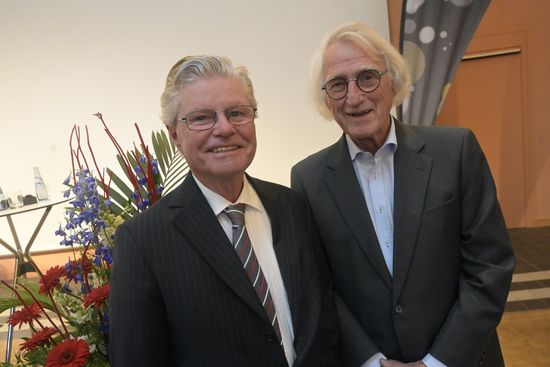
Prof. Joachim Luther and Prof. Hartmut Graßl, two highly renowned professors, took part in the Oldenburg Climate Symposium and made a great impression with their presentations.
Prof. Joachim Luther was appointed to the university in 1973 and rendered outstanding service in establishing the energy laboratory. He recalled that the period around 1973–1974 was marked by the oil crisis, which led to car-free Sundays. Nuclear energy was regarded as the guarantee of a secure energy supply.
In this respect, Prof. Luther’s approach of conducting research into a solar-based energy supply was a minority view at the time.
With the publication of his 1977 book *Solar Energy – An Alternative to Nuclear Energy*, he took a major step into the public eye.
The aim of the research group working with him was defined as follows: ‘A long-term, secure energy supply system that is not based on fossil fuels and is free of nuclear energy.’
The energy laboratory planned in this context was a central component of the research. In 1982, it was regarded as a novelty in the Federal Republic of Germany. In this respect, the commitment by the university’s president, Prof. Ralph Bruder, to ensure that the energy laboratory would definitely be retained met with widespread approval. Debates regarding structural alterations or even demolition were thus brought to an end.
The meteorologist Prof. Hartmut Graßl played a key role in developing reliable energy weather forecasts. What sounds so self-evident today – and is of particular importance for the use of renewable energy sources – was not possible in this form just a few decades ago.
In 2003, he presented a report which even the then Green Party Environment Minister, Jürgen Trittin, felt went too far in some respects. “We enshrined the principles in that report that every person has an equal right to CO₂ emissions and that, above all, it is essential to offset overproduction in industrialised countries,” said Graßl.
Looking back on a very successful and long career in research, the two professors were in complete agreement in their conclusion and in one key demand: scientific findings must be put into practice more quickly.