
Special seminars & projects
Diversity of the study programme!
Every semester, the lecturers of the M.A. Integrated Media programme prepare a wide range of seminars and exercises that constantly present new perspectives and areas of work in auditory and visual media in theory and practice.
The review shown here cannot show all the exercises and seminars, but is intended to provide an insight into the various areas of the programme.
Special seminars & projects
Digital Curation
Summer semester 2025
The seminar on ‘Digital Curating’, led by Prof. Dr Petra Löffler, examined the use of digital media in and for exhibitions. The term ‘digital curating’ encompasses curatorial concepts in art education that aim to engage and involve visitors through apps, websites and online portals. During the seminar, the possibilities of digital curating were linked to media studies approaches to the digital realm and digital culture, and were realised in the form of an online exhibition as part of co-operation with the Landesmuseum Natur und Mensch . Through joint research in small groups and in plenary sessions, and the development of an exhibition concept, the students created the digital exhibition Photography as Colonial Memory – Photographs by Eduard von der Hellen at the Landesmuseum Natur und Mensch, Oldenburg.
“The State Museum of Nature and Mankind (LMNM) in Oldenburg houses not only natural history and ethnographic collections but also historical photographs from a colonial context. These are stored in boxes in a remote archive room that is not open to the public. During a visit, the curator in charge, Ivonne Kaiser, drew my attention to two boxes containing photographs on glass. This first encounter in the archive raised many questions: Where do these images come from? Who took them and how did they end up in the museum? And why are there no records relating to them? Bachelor’s and Master’s students of Art and Media Studies were able to identify the photographers behind these sensitive images and examine the colonial context to which they owe their existence. In this exhibition, we present the results of our research, readings and discussions with experts on the interconnections between photography, medicine and colonialism in Togo, which was a German colony on the African continent from 1884 to 1916.”
- Petra Löffler
Curating short films
Summer semester 2025
During the course, students are regularly involved in producing their own short films as part of practical sessions or analysing them in seminars. Dr Felix Hasebrink’s seminar on curating short films expanded on these core competencies by addressing the question: How does one actually curate one’s own short film programme?
In collaboration with organisers of the Hamburg Short Film Festival and drawing on Felix Hasebrink’s expertise, the students were able to go through the entire process of creating and screening a short film programme: selecting themes, screening the short films, contacting the filmmakers, arranging the selected films, choosing a title for the programme, designing the poster and hosting the short film evening.
During a field trip to the Hamburg Short Film Festival, the students were able to gather inspiration for their own working process and gain professional input through discussions with one of the festival’s curators.
The short film programme was screened Between Borders and Resistance as part of the Showtime programme at the Institute for Art and Visual Culture at the Unikino Gegenlicht.

Moving Image Journaling Workshop at the House for Media Art Oldenburg
Winter semester 2024/2025

In this workshop, the students worked together with the artist Kaensan Rattanasomrerk and gained a practical insight into the areas of storytelling, storyboard development, filming, editing and colour grading.
The students worked in small groups over the course of a weekend to design, shoot, edit and complete their own short film. Prior to this, the artist Kaensan Rattanasomrerk taught them in a seminar session what steps are necessary to create a short film.
The screenshots show excerpts from the short film One Last Game. The small group was allowed to spend a day at the Oldenburg Computer Museum to shoot their short film.
| Event name | Block seminar: 3.06.306. Moving Image Journaling Workshop |
| Lecturer | Kaensan Rattanasomrerk |
| Time | Block seminar in November 2024 |
| Room | House for Media Art Oldenburg |
Postdigital Instruments Lab
Winter semester 2024/2025
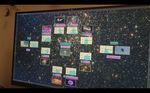

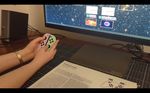
Programme your own instrument? Create your own sounds? And do all that using a gaming controller?
In this workshop, participants developed individual instruments, sound installations and other ‘music-making things’. To achieve this, the students experimented with various control systems and interfaces for music software: Dr Jan Torge Claussen worked with students to explore the possibilities of the Max for Live programme and visualise sound. Among other things, this resulted in an audiovisual journey through space, controlled by controllers.
| Event name | Seminar: 3.05.509 Postdigital Instruments Lab |
| Lecturer | Dr Jan Torge Claussen |
| Time | Wednesday 10 am–12 noon |
| Room | A11 1-109 |
American Soundscapes
Winter semester 2023/2024
German Society for American Studies | 70th Annual Meeting | 23–25 May 2024
Oldenburg, IN | Amerika
Sound Installation
Near Oldenburg lies a tiny village called ‘Amerika’, named after America as a place of longing – as it notably was for many Germans in the late 18th century. On a cold and rainy Saturday in November 2023, a group of students taking part in the course ‘American Soundscape Production – ‘Telling the Story of “Amerika” Through Sound Design’ visited the village to make field recordings. Equipped with various recorders and microphones, they made the most of the site, which consisted of little more than a playground and a handful of houses. Spontaneous encounters with
local residents and sportspeople contributed to an instructive and enjoyable experience. Meanwhile, in Oldenburg, Indiana, Brian Knueven, a dedicated teacher of Music and German at the local Oldenburg Academy, sets out on a search for sounds of his own. Over the course of several weeks, he gathers dozens of recordings of sounds he considers characteristic of the town where he lives. From a basketball match to church bells and the headteacher’s morning announcement, right through to the soundscape of Washington Street, his recordings paint a vivid picture of
everyday life in a small American town.
The sound installation presents soundscapes composed of recordings from both Amerika and Oldenburg, arranged and edited together to create soundscapes of places that do not exist in the real world, yet which tell stories of two places that are somehow connected: through the stories of those who once left their homes to seek their fortunes in America, and through the longing – for distant places in one case and for the homeland in the other – expressed by names such as ‘Amerika’ and ‘Oldenburg’.
Concept and Implementation: Sarah-Indriyati Hardjowirogo
Oldenburg, IN Field Recordings: Brian Knueven
Amerika Field Recordings and Soundscape Production: Viktoria Achtelik, Saskia Katharina
Altenschmidt, Finja Baum, Milena Heitmann, Svenja Marschall, Vico Rosenberg, Jonas Roustai,
Amelie Schierenbeck, Philipp Stiller, Timon Wiese


Found Footage Video Exercises (regular)
Found footage refers to the conceptual use and montage of found film material from every conceivable film genre. The (re)combination of existing media content defines a kind of ‘remix’ that utilises, for example, film clips from feature films, documentary formats or private film recordings. As a form of recycling film, video and audio, found footage is understood as an artistic method of montage, involving the reuse and appropriation of existing audio and visual material.
When creating new mixes, so-called ‘mash-ups’ or ‘cut-ups’, source material can be filmed, and participants’ own performative sequences can be staged in front of the camera. Alongside the composition of individual video clips, the course reflects on concepts of media art education and films that engage with film itself.
Following a joint viewing of film and video examples, participants develop their own concepts for videos, which may be based on external and personal video material/archives, choreographic and staged works, and texts.
Some of the videos are produced within the collaborative circle as miniatures and video sketches. The theme and form of the final film are freely chosen.
What is being explored?
- Interactions between: text – image / image – sound / text – sound
- Spatio-temporal logic, matter and material in various representations and relationships.
- Borrowing – Finding – Contextualising
- the aesthetic, formal and thematic organisation of presentations
- The modes of effect of contemplative, experimental or informative content in the remix
- Analogue and digital media practice