
Basic types
Basic types
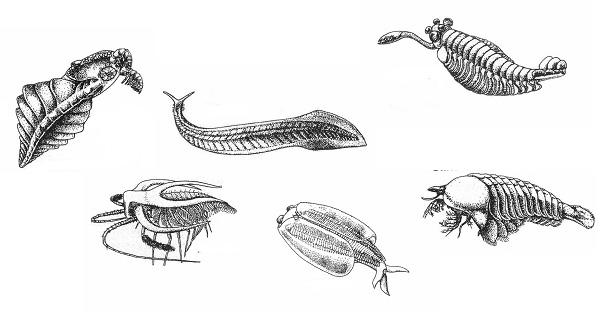
In the Cambrian there was a rich fauna of "types" that are not found today, including our ancestor and the ancestor of all vertebrates: Pikaia (centre).
Biologos: No reason for basic types
Since its publication, Darwin's theory of evolution has been opposed to a view according to which living beings were created as types that have existed unchanged ever since. In the creation text, this even includes domestic animals ("beasts of the field").
Those groups who understand the creation narratives of the Bible to mean that living beings were created individually and according to plan in a unique historical act of creation are unwilling to abandon this view: Traditionally, this view is called creationism.
Recently, creationists in Germany have taken a more moderate stance. In return, however, they claim to be recognised as scientists. We are not talking about belief in creation, but creation science.
Moderate creationism. Since Darwin, the evidence for the variability and variability of species has been so convincing that this fact is hardly disputed any more. For "modern" creationists, however, it should only apply within the originally created types, i.e. for species and closely related groups of forms: the basic types. A flawless biological criterion should apply to the delimitation of basic types, namely the crossability or at least rudiments of the same: the development of fertile or infertile offspring or at least the development of the zygote and the creation of germs (embryos). These basic types are therefore considered to be "duck-bird" type, "chicken-bird" type, "monkey" type. And of course the "human" type, because it can be assumed that the last basic type is of particular interest to creationists: humans must have been created separately as a basic type. Otherwise the endeavour to create types would make no sense at all. The special status of the creature "human" would otherwise also be jeopardised by the doctrine of basic types.
The basis for establishing basic types is the distinction between micro- and macroevolution. Macroevolution is rejected by the new creationists because it is unproven. Microevolution, on the other hand, is accepted: Basic types vary and change into closely related types. Previous evidence of evolution is thus claimed as proof of the basic type hypothesis: The mutants of the birch moth, the breeding breeds of the domestic dog and the emergence of different species of Darwin's finches are summarily declared to be equally micro-evolutionary processes within the basic type theory.
In this view, typological thinking clearly prevails over population thinking, which is crucial for understanding evolution. For the typologist, the types are real and the variants are irrelevant. For the population thinker, the individual is real and variation is the decisive factor. The difference between micro- and macroevolution is hypostatised into an essential difference in the theory of types. The acts of creation are inserted into the gaps thus created.
Micro- and macroevolution. In terms of evolutionary theory, however, the postulated essential difference between micro- and macroevolution does not exist. Differences exist at most in the quantity and extent of unresolved questions and possible additional evolutionary causes, but not in quality. The realisation that for the time being there are no reasons to limit the variation of individuals to an assumed species level was one of the great achievements of Darwin and Wallace in the development of the theory of evolution.
In terms of evolutionary biology, there is only one comprehensive evolutionary process. Wherever our textbooks give the impression of an essential difference between micro- and macroevolution, they should be rewritten.
In fact, there is no empirical basis for separating basic types from the lines of phylogenetic relationships. When reconstructing phylogenetic trees on the basis of DNA analyses, for example, there is no molecular jump or chemical hiatus between assumed basic types and more distant groups of forms. On the contrary, all analyses indicate a general relationship between all living organisms. (The auxiliary argument introduced by the creationists in view of this fact, that the Creator worked with "blueprints" and used constructs once invented several times, cannot of course support the thesis of basic types either, as it can be varied at will and thus explains everything and nothing).
Convergence and divergence. The fact that very closely related organisms can belong to completely different "types" contradicts the basic type concept even more. Thus, without further consideration, one would consider the New World and Old World bearded birds to be one and the same "basic type" (and perhaps they are also interbreedable?). The toucans, on the other hand, look quite different. In fact, bearded birds and toucans have also been distinguished as different families of the same order. However, DNA comparisons clearly show that New World bearded birds are more closely related to toucans than to Old World bearded birds. Darwin already emphasised the phenomenon of species divergence as a principle of evolution. Typological thinking must confuse it. Should all bearded birds and toucans now represent a basic type, even if they (most certainly) do not interbreed? And here, finally, the most fundamental interest of the basic type theory is refuted: According to DNA studies, humans and chimpanzees are more closely related to each other than either is to gorillas or even orangutans. Chimpanzees and humans are no more different in their DNA than is usually found in twin species. According to this theory, humans are by no means a separate "basic type", but merely a divergently developed African ape.
However, the basic type theory is also supported by biologists. However, the biologically verifiable results, such as the different interbreedability of individuals from closely related groups, can be interpreted and utilised in terms of evolutionary theory. The assumption of acts of creation lies outside of scientific methodology.
Is it even worth seriously addressing theories that are actually aimed at non-scientific views? The evolutionary-biological yield is visible: the unsuitability of typological thinking to explain evolutionary processes points to population-biological thinking as the actual basis of evolutionary biology (see focus on evolution). And the phenomenon of divergence proves to be just as interesting and fruitful in terms of evolutionary biology as the phenomenon of convergence, which is often considered alone in our textbooks.
So let us consider both sides in future: Convergence and divergence, similarity and deviation. Types only exist in our heads: the divergence of phylogenetically closest related forms is an important argument against deriving biological laws from types.
Read more:
Kattmann, U. (2019). Natural History of Vertebrates (New Paths in Biology series). Seelze: Friedrich.
Hörsch, C. (2004). How did the world come into being? Creationism and the theory of evolution in American schools. In: H. Gropengießer, A. Janßen-Bartels & E. Sander (Eds.). Lessons for life (pp. 180-189). Cologne: Aulis
Kattmann, U.: Dealing with creationist ideas. 7 guidelines for biology lessons.
Kattmann, U. (2008). Evolution & Creation. Compact. Teaching Biology 333
Kattmann, U. (1998). Creation and evolution (teaching unit). In: R. Hedewig, U. Kattmann & D. Rodi (Eds.), Evolution. Handbuch des Biologieunterrichts Sekundarbereich 1 (pp. 33-53). Cologne: Aulis
Kattmann, U., Janßen-Bartels, A., Müller, M. (2005). Why are there mammals? Teaching model for grades 6 and 7. Unterricht Biologie 28 (307/308), 18-23
Kattmann, U. (2007). Progress and direction in evolution? In U. H. J. Körtner & M. Popp (Eds.),Creation and evolution - between being and design (pp. 89-112). Vienna, Cologne, Weimar: Böhlau.