
Relationship boxes
Relationship boxes
The headline of a German Research Foundation report read:
"The woodworm likes to gnaw in ecological niches".
Obviously, the author wants to address the galleries of beetle larvae and thus falls into the same error as many students, laymen and even biologists who consider the "ecological niche" to be a (narrow) space. A palaeontologist writes about a fossilised creature: "This animal lived in such a hidden ecological niche that its fossil remains are very difficult to find". In textbooks, the ecological niche is "occupied" and "taken" as if it were a territory. The word "niche" tempts us to think of a (protective or harbouring) space. However, it refers to an abstract system of interactions between living beings and their environment. The term "hides" a completely different concept: the ecological niche is the system of environmental relationships of a biological species, in short: the "species-environment". Logically, the interrelationships only exist if the species in question exists. Ecological niches therefore do not exist without the living organisms, but are "developed" or "formed" and then "maintained" by the organism species based on the conditions and offerings in a habitat.
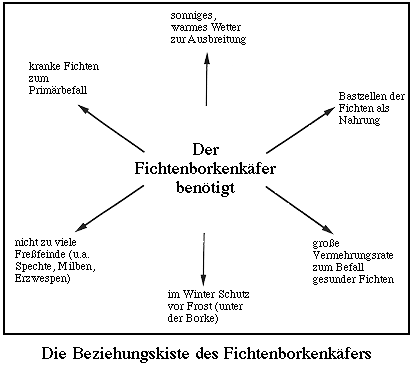
Do you remember what a nursery box is? This metaphorical description was used some time ago for (sometimes complicated) human relationships. Perhaps the suggestive effect of the word "niche" can be overcome by using this metaphor to take the spatial niche concept ad absurdum:
"The ecological niche is the relationship box of a species".
Because ecological niches are characterised by relationships, they can be vividly represented as arrow diagrams:
To read more:
Kattmann, U. (2015). Understanding pupils better. Everyday ideas in biology lessons. Hallbergmoos: Aulis.