
Elves
Elves

Observe and identify living insects!
There is often an important decision step in an insect identification key: transparent wings, number of wings: 2 or 4? Depending on the answer, the user is directed to diptera (flies and mosquitoes) or hymenoptera (bees, wasps, ants). But how can you determine the number of wings if the animal has them folded over its body? The authors probably think that only dead insects are easy to identify, preferably pinned and with their wings spread out, as demonstrated in identification exercises. Unfortunately, this is also how they are depicted in many books, as if flies and bees were not encountered buzzing and humming quite differently on every walk in summer and even in the house.
"Fairies" have glass wings in fairy tales. We have also named insects with transparent wings: Then there are slender and graceful fairies like dragonflies, and fat plump ones like bumblebees . The fairies also include bees and flies. As some hoverflies mimic bees, it is not easy to distinguish between the two. In flight, these flies buzz very much like bees and even pretend to be bees by the position of their legs. And when they are sitting on a flower or crawling around, the number of wings is impossible to recognise. To recognise elves as bees or flies, you should not kill them. There is a simple way to recognise them:
Bees have medium-length, many-limbed antennae, which are constantly in motion in the active animal (as in all hymenoptera); flies, on the other hand, usually only have short, stubby antennae, which are always held rigidly motionless. Flies also have very large eyes. So if you want to know what kind of fairy you have just met at the window or on a flower, just look at the head with the antennae and the eyes and you will no longer confuse bees and flies. He doesn't even have to be able to count to 4, just look properly.
Which elf is it? | |
|---|---|
|
|
| Fly or bee? | Fly or bee? |
|
|
| Fly or bumblebee? | Fly or bumblebee? |
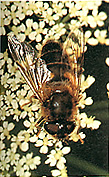
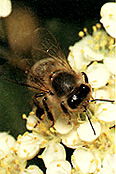
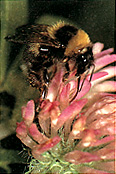
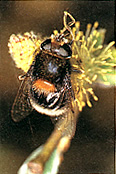
Answers:see below
With this book, other insects can also be easily identified by the characteristics of their wings and antennae:Fairies have membranous, transparent wings,
Jugglers have membranous wings, densely covered with scales or hairs so that they are opaque: e.g. butterflies,
Knights have at least partially solid, opaque upper wings, e.g. beetles and bugs.
Based on the idea of the book, two attractive educational CD-roms "Anenteuer kleine Tiere" were produced.
As the book is out of print and will not be reissued, in 2018 I wrote the book
"Die Insekten" in the NBBjunior series (VerlagsKG Wolf, Magdeburg) with some new sections and photos for children and young people.
Top left: Bee decoy fly, right: honeybee
bottom left: species bumblebee, right: bumblebee decoy fly