
Education in the digital world
Contact
The workrooms of the Department of Didactics of Computing Science are located on the central Haarentor campus, at Uhlhornsweg 84, in building A2 (Brückengebäude), 2nd level. (currently largely home office)
[Location map][Directions by car][Directions by public transport]]
Education in the digital world
What is digital education?
Education in the digital world, often referred to as digital education for short, is a broad term that describes both the use of digital media and technologies in educational contexts as well as education about the underlying principles of the digital world and its media and their potential uses, with the aim of empowering pupils and, in the long term, all citizens to use them in a self-determined, responsible and productive way.
The so-called "House of Digital Education" is a model that serves as a basis for discussion and an analysis tool to help schools and other educational institutions, e.g. when creating curricula, to determine the status quo and identify any gaps (online tool for this at the bottom of this page).

It was developed during the discussion on the strategy of the Conference of Education Ministers for education in the digital world in the summer of 2016, on which the Gesellschaft für Computing Science e.V. wrote a statement.
It is now used by us for analysis purposes and curriculum development as well as in the scientific support of various projects.
The House of Digital Education was developed on the theoretical basis of two other models:
- from the various roles of ICT systems (information and communication systems) in teaching, which are subdivided into (Hartmann, Näf, Reichert, 2006, p.4f), and
- Teaching and organisational resources (roof),
- tools (1st floor) and
- subject matter (ground floor)
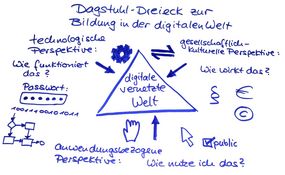
- from the so-called Dagstuhl triangle, which requires phenomena of the digital world to be viewed from at least three perspectives in the classroom:
- the application-related perspective (light blue), which asks about the principles and handling of the tools used (How and when do I use this?),
- the technological perspective (old pink), which asks about the basic principles and design possibilities of digital systems (How and why does it work? How do I design something that works?) and
- the socio-cultural perspective (green), which asks how and why this works and how digital media and interaction processes can be designed so that they work.
The first step in analysing these three perspectives is to answer the question of how the phenomena are perceived, the media perspective (How do I encounter this?).
School analysis with the help of the House of Digital Education
We provide an online tool for voting with sticky dots for work in the teaching staff. You can use it, for example, in school development processes to determine how your school is already positioned in the various areas of the House of Digital Education from the perspective of your colleagues. You have two options for this:
- Test: Click here to test in Mural
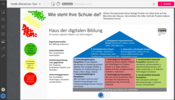
- Create your own version: Click here to access the Mural template