Mathematics preparation course


 Awareness
 Preliminary course (maths)
 Mentoring programme (e-maths)
 Orientation week
 Freshman trip
 Learning Centre
Mathematics preparation course

To ease the transition from school to university, we offer the preliminary course every year before the winter semester.
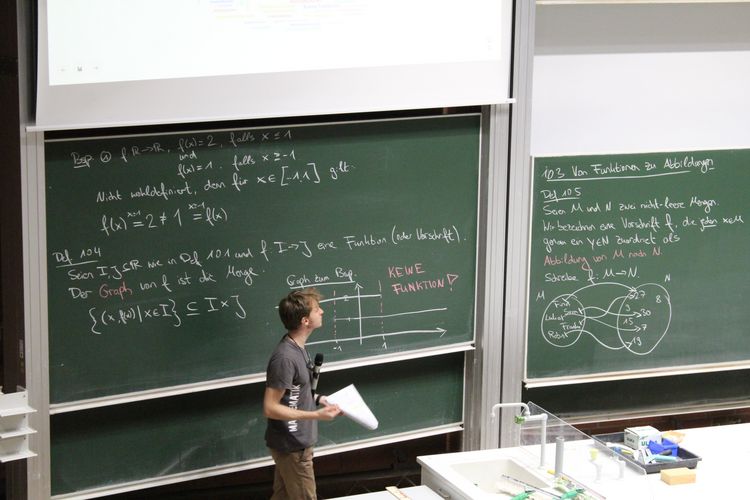
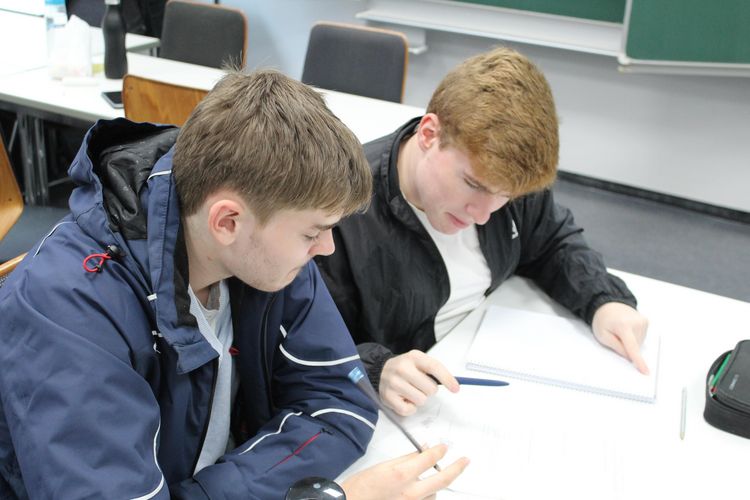
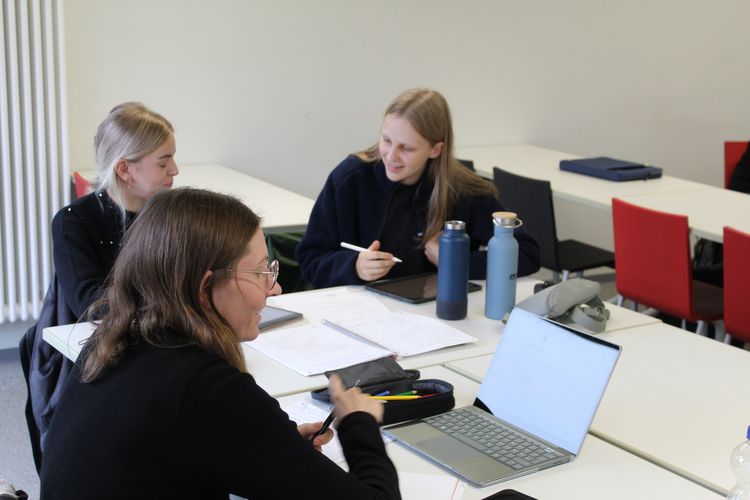
As well as preparing students for the academic challenges ahead, the preliminary course is also an ideal opportunity to make new friends who will accompany you throughout your degree. To this end, lecture-style sessions cover the fundamentals of selected topics in university-level mathematics, and small groups work through exercises relating to the relevant content.
The knowledge acquired in the preparatory course is not a prerequisite for the introductory courses of the mathematics degree programme, but it does make the start of your studies considerably easier.

Why should I attend the preliminary course?
Aims and target groups of the preliminary course
The preliminary course is for the degree programmes
- Bachelor's degree programme in Mathematics
- Two-subject Bachelor’s degree in Mathematics and
- the Bachelor’s degree in Physics
and thus provides an ideal introduction to studying mathematics or physics.
First-year students of mathematics often find it very difficult to adapt to the demands of university life. This is mainly because university-level mathematics differs fundamentally from school mathematics: the level of abstraction and the pace of lectures are higher, and students must prove mathematical statements independently on exercise sheets.
This preliminary course in Mathematics is not suitable for first-year students of other degree programmes that include a mathematics component. There are separate preliminary courses for natural sciences and Computing Science! Further information on other preparatory courses at the University of Oldenburg can be found further down this page. However, there will be a co-operation with the Computing Science department, meaning that the first six days of the preparatory course will be spent together; registration for first-year Computing Science students is organised by the Computing Science student body itself.
How does a preliminary course day work?
Get to know everyday university life in the preliminary course!
What are the contents of the preliminary course?
An overview of the 16 topics of the preliminary course
The preliminary course covers the following sixteen topics over a total of eight days:
- What is mathematics? and propositional logic
- Set theory and quantifier logic
- Proof techniques I and proof techniques II
- School mathematics I and complete induction
- Functions and mappings I and functions and mappings II
- School Mathematics II and Linear Algebra
- Number Systems and Functions and Mappings III
- Problem-Solving, Sequences and Limits
There are several preliminary maths courses at the University of Oldenburg.
Which one is suitable for me?
If you are planning to study Mathematics or a Bachelor's degree programme in Physics
Bachelor's degree programme in a single subject or dual-subject Bachelor's degree programme
...then you should attend the preliminary course in mathematics organised by the student body for mathematics and elementary mathematics , regardless of your second or minor subject. In this preliminary course, you will get to know your fellow students and be ideally prepared for studying mathematics at the University of Oldenburg!
The other preliminary courses are not suitable for you, even if you want to study physics or Computing Science as a second or minor subject, for example, because our mathematics preliminary course also covers the relevant content, but focuses more clearly on the study of mathematics.
If you would also like to refresh your maths school knowledge, then we can highly recommend the online maths bridge course OMB+ ! Here you have the opportunity to work through all the maths content from school online and flexibly, so that you can feel well prepared for your studies!
If you do not plan to study mathematics or physics (Bachelor's degree programme)
Elementary Maths, Natural Sciences, Computing Science, ...
Then the mathematics preliminary course offered by the mathematics and elementary mathematics student body is not suitable for you.
- Are you planning to study elementary maths?
Unfortunately, there is no preliminary course for elementary maths students. However, a preparatory course is not required for your degree programme. With your maths knowledge from school, you are well prepared! If you still feel unsure, you can find another way to brush up on your school maths knowledge in the last paragraph!
You should also take a look at the mentoring programme! Here you have the opportunity to network with fellow students and get support for the start of your studies!
- Are you planning to study a (different) natural science?
If so, the Institute of Physics organises a preliminary course in Mathematics that may be of interest to you! We would particularly recommend participation to all prospective physics students in the 2-subject Bachelor's programme!
- Are you planning to study Computing Science?
Then you are in good hands in the preparatory course in mathematics organised by the student body for Computing Science!
- Would you like to brush up on your maths skills in general?
Then we can highly recommend the co-operation project Online Mathematics Bridge Course OMB+ ! Here you have the opportunity to work through all the maths content from school online and flexibly, so that you can feel well prepared for your studies!
How can I register for the preliminary course?
How do I get to the preliminary course?
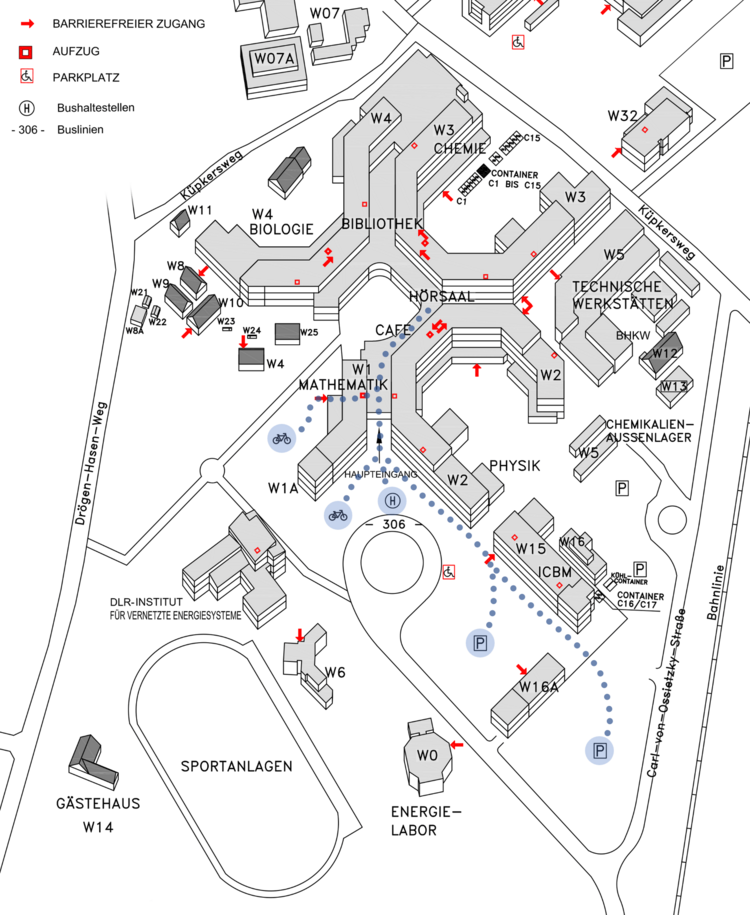
The mathematics preliminary course takes place at the university's Wechloy campus.
When you arrive there on the first day of the preliminary course, tutors will welcome you in the entrance area and show you the way to the lecture theatre where the introductory lecture will take place.
I am unable to attend some days of the preliminary course. Can I still take part?
Yes, participation is still possible.
Scripts, exercise sheets and solutions will be uploaded during a pre-course day. This allows you to catch up on what you have missed at home. Although this is not a prerequisite, we can only recommend that you work on your own so that you are not hindered by gaps when learning the other topics.