
Student body Philosophy - News
Contact
On Facebook, Instagram or by ,
sporadically by telephone at:
0441 / 798 2839
in person in the student council room:
Mon (14-16)/Fri (12-14)
M0-035
and in STUD.IP via the student body's event:
Simply enter "Fachschaft Philosophie" in the event search.
Our mailbox is located on the 1st floor of building V03.
Student body Philosophy - News
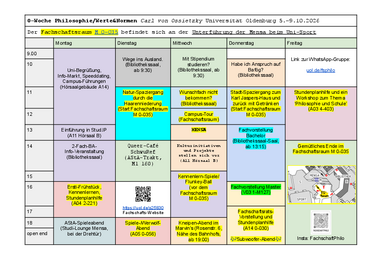
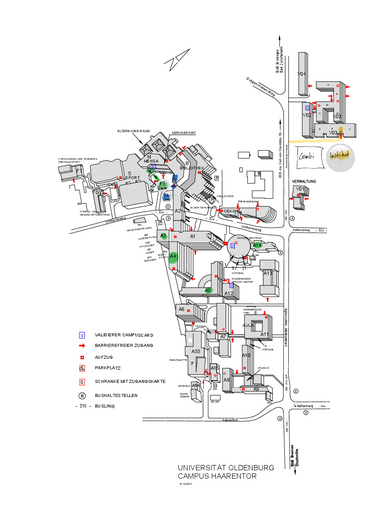
Induction Week 2026 (5 to 9 October 2026)
Dear students,
Here is the programme for the orientation week for first-year Philosophy and Values & Norms students. There will be a varied programme – lasting a whole week.
Please feel free to join our WhatsApp group: chat.whatsapp.com/GKT5k2dREkyFyDfB0ihaDr
Philosophy and Film – Summer Semester 2026

We are delighted to be able to present a selection of films to you again this term.
As always, there will be a discussion after each film, to which everyone is warmly invited.
Admission is free for students.
This time, the series is financially supported by the AStA, the KulturTicket, the University’s Gender Equality Office and the Institute of Philosophy.
All other screenings take place at the CineK, every Tuesday at 6.30 pm.
Series of events on philosophical career guidance in summer semester 26

Dear WeNo and philosophy students,
Oldenburg Philosophy has always had the problem that it trains a lot of teacher training students, but also a lot of specialised master's students compared to other universities. As a degree in philosophy does not directly confer a professional qualification (it is not a 'bread and butter' degree) and because in Oldenburg, in addition to the teaching profession (and perhaps even more than that!), careers in the hopelessly overcrowded academic university sector are also being forged (to put it bluntly: far too many doctoral theses), it has always been difficult for master's students to gain a foothold outside the university. This is now set to change. As the Student council, we have campaigned for the long neglected topic of extracurricular career orientation - which is also an accreditation requirement - to finally be addressed. In the coming semester, a series of lectures will be held in which academic appointments from the cultural sector, education management, political consulting, etc. will present their career paths and open up perspectives. The event is of course also open to all student teachers, regardless of whether their own teaching career goal is becoming increasingly questionable (for understandable reasons) or not.
Best regards
FSR Philo/We&No
General meeting and mulled punch/mulled wine evening, 26/11/2025, 18:00

Dear Philosophy students,
This year’s Student Council General Assembly will take place on 26 November 2025 from 6 . 00 pm in room A01 0-009. All students studying Philosophy and Values and Norms are invited to attend. The new Student council will also be elected at this meeting. The Student Council is responsible for representing students’ interests vis-à-vis the university, providing student advisory services and fostering networking amongst students. Anyone enrolled on one of the seven philosophy degree programmes in Oldenburg is eligible for election to the Student Council, regardless of their semester, prior knowledge, abilities or skills.
If you would like to stand for election to the Student council, please email us () by 25 November at the latest so that we can organise the election. You must bring or send us a current enrolment certificate so that we can verify your right to vote and stand for election. You can download this certificate from StudIP in just a few clicks (due to system restrictions, this must be done by 24 November 25) – we’ll be happy to help if needed! It is possible to stand for election in your absence. In this case, a brief written introduction explaining your motivation would be helpful.
Agenda:
1. Welcome
2. Report from the outgoing Student council
3. Election of the new Student council
4. Any other business
Kind regards,
The Philosophy Student Council, Oldenburg, 7 November 2025
Workshop announcement: "The nature of offence in the educational process"
Workshop by Dr Enrico Pfau on 18.11.2025 in the library's Learning Lab

How can I deal with damage to my self-image in my studies and teaching? –
Outline of the problem
Who hasn’t fallen short of their own expectations at some point in their educational journey? Yet experiences of humiliation are a necessary part of the educational process, as both one’s own self-image and external demands are contradictory. But what is the essence, the nature, of these setbacks? Is it something external, or is it part of our own being? What does this have to do with self-love, fear and repression? Using various short texts from myths, legends and fairy tales, which will be read and discussed in the workshop, we aim to come closer to answering this question
Aim of the workshop
The workshop is intended to provide an opportunity to reflect on one’s own and others’ expectations. Reflecting on one’s own self-image allows for the appreciation, critique and consensual prioritisation or de-prioritisation of these expectations.
Time and venue
Time: 18 November 2025, 10.15 am
90-minute workshop
Venue: Learning Lab, University Library ZW4 (The Learning Lab is next to the media library lending desk, by the large screens)
Register via StudIP in the study group ‘Kränkungen im Bildungsprozess’ or by emailing enrico.pfau1[at]uol.de
Image credits: Images on the front page 1. Oedipus and the Sphinx, left-hand painting by Jean Auguste Dominique Ingres, 1827; painting on the right by Gustave Moreau, 1864, mirrored 2. Jacob Wrestling with the Angel, painting by Rembrandt van Rijn, c. 1659, quote from the Bible, Gen 32:28–29 LUT; ‘Israel’ can mean ‘he wrestles with God’, ‘God wrestles’ and ‘God reigns’ 3. Pandora, painting by John William Waterhouse, 1896, mirrored 4. Saturn Devouring His Son, painting by Francisco de Goya, c. 1820–1823 5. Christ and Mary, painting by Cranach the Elder, c. early 16th century, quotation from the Bible, Matthew 12:46–50 (LUT) 6. Narcissus and Echo, painting by John William Waterhouse, 1903, based on the myth of Narcissus and Echo in Ovid’s *Metamorphoses*, c. 8 AD 7. *The Nightmare*, painting by Johann Heinrich Füssli, 1781 8. *Cupid and Psyche*, painting by Giuseppe Maria Crespi, 1707
Philosophy and Film – Winter Semester 2025/26

We are delighted to be able to present a selection of films to you again this term.
As always, there will be a discussion after each film, to which everyone is warmly invited.
Admission is free for students.
This time, the series is financially supported by the AStA, the KulturTicket, the University’s Gender Equality Office and the Institute of Philosophy.
All other screenings take place at the CineK, every Tuesday at 6.30 pm.
Programme for the Orientation Week in the 2025/2026 winter semester


Dear first semester students,
Our programme for this year's orientation week is now online. We look forward to welcoming you to the games evening, the freshers' breakfast, several timetable and StudIP help sessions, the pub evening, the walk to the Karl Jaspers House, the flunkeyball evening and the workshop on 'Why should a teacher (not) be authentic?
Best regards, --
Ronja, Marina and Niklas
Philosophy and Film – Summer Semester 2025
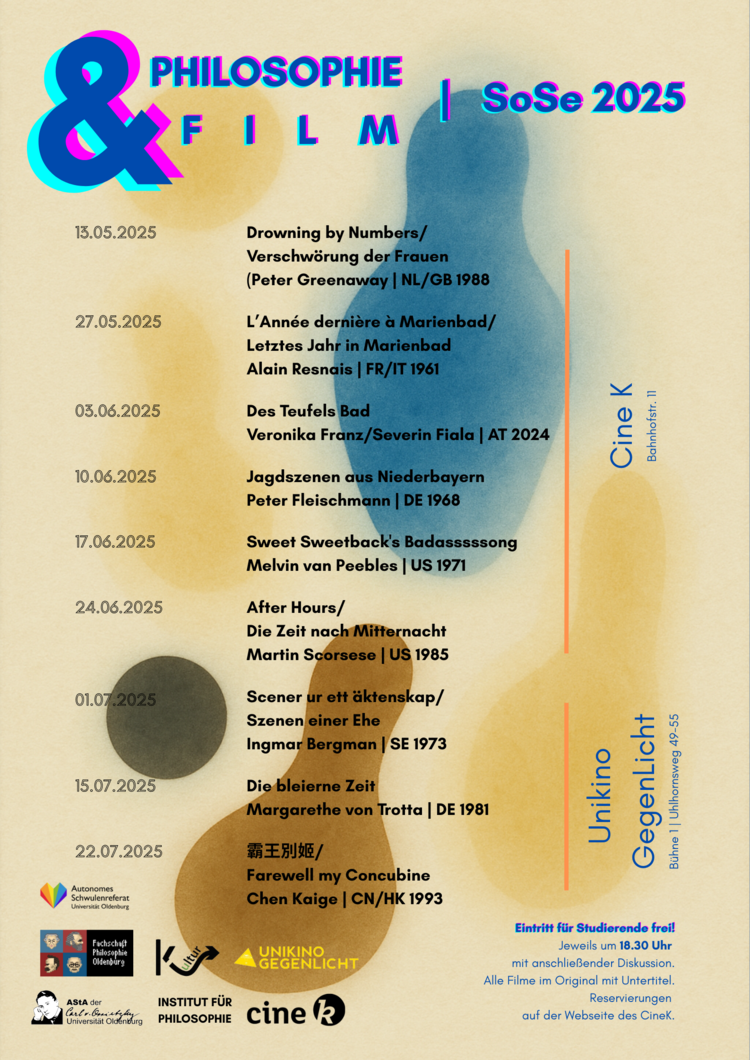
This semester, somewhat belatedly but with no less pleasure, we are once again presenting a small selection of films.
As always, there is a discussion after each film, to which everyone is cordially invited.
Admission is free for students.
This time, the series is financially supported by the AStA, SchwuRef, KulturTicket and the Institute of Philosophy. It is also supported by Unikino Gegenlicht, which will show three films in July.
All other screenings will take place at CineK on Tuesdays at 6.30 pm.
Lecture announcement: ""Appearance of competition" (Marx) or "universal context of delusion" (Adorno)? On the critique of Hegel-Marxism"
Lecture by PD Dr Frank Kuhne
28.04.2025, 18:00 c.t. | Karl-Jaspers-Haus (Unter den Eichen 22)
Georg Lukács' work History and Class Consciousness (1923) is rightly regarded as the founding document of what later became known as Hegelian Marxism. In it, Lukács attempts to defend Marxist theory against its flattening in official party Marxism by recourse to Hegel. "Orthodoxy in questions of Marxism" does not mean a belief in certain theses or holy books, but refers "exclusively to the method". However, the "essence of method", which Marx "took over from Hegel and originally remodelled to form the basis of a completely new science", was the "category of totality, the all-round, determining dominance of the whole over the parts". Lukács thus also provided Adorno with the decisive keyword for his variant of critical theory.
The lecture outlines the way in which "the category of totality" comes into play in Hegel's philosophy, Marx's theory of capital and Adorno's negative dialectics and asks whether and to what extent the totalising character of these theories can be justified in each case.
PD. Dr Frank Kuhne is a lecturer at the Institute of Philosophy at Leibniz Universität Hannover. His research areas are classical German philosophy, critical theory and Marxian theory. He studied philosophy, political science and German studies in Hanover and Braunschweig and received his doctorate with a thesis on Marx and his habilitation with a thesis on self-consciousness in Kant and Fichte. In 2022, he published the monograph "Marx and Kant. The normative foundations of capital".
An event organised by the Institute of Philosophy in co-operation with the Karl-Jaspers-Haus and the student body of Philosophy.
Monday, 28 April 2025, 18:00 c.t. | Karl-Jaspers-Haus (Unter den Eichen 22)
"Critique of Desire and the Desire of Critique. Adorno, Horkheimer and Lacan on Kant and de Sade", 19.02.2025, 19:00, A01 0-004
Lecture by Hanno Hinrichs
Much, perhaps everything, has been said about so-called 'French theory' from the perspective of critical theory - often polemical, sometimes even clairvoyant. While the relationship was initially characterised by mutual ignorance, today, when the intellectual zenith of post-structuralism has long since passed, it seems that it is almost impossible to refrain from taking a position. To take up a metaphor from Deleuze and Guattari's "Anti-Oedipus", the 'discourse' resembles the psychological model of the double bind. There are only two contradictory options for action: either practising abstract negation and subjecting postmodern philosophy to a devastating critique without seriously wanting to understand it, or falling into egalitarianism and subsuming Parisian and Frankfurt thinking under the indiscriminate umbrella term 'critical theory'. Both paths lead astray. On the other hand, what Adorno understood by Hegel's concept of definite negation should be upheld: a mode of critique that takes its object seriously and at the same time reflects on its social conditions of possibility. In the case of French theory, this is particularly obvious, not only because its background of experience is the same - economic crises, world wars, fascism - but also because it shares an interest in knowledge with the Institute for Social Research.
It is therefore fitting that the second excursus of the "Dialectic of Enlightenment", entitled "Juliette or Enlightenment and Morality", has a counterpart in the writings of Jacques Lacan. 15 years after Horkheimer and Adorno confronted Kant's transcendental philosophy with the prose of the Marquis de Sade, the psychoanalyst devoted himself to the same constellation without any knowledge of their previous work. The initially associative discussion in his seminars culminated in the écrit "Kant avec Sade", published in 1963, which is now regarded as a key text in his theory. The common subject matter of their investigations offers the rare opportunity to bring Adorno, Horkheimer and Lacan into dialogue with each other. In doing so, they follow the same intuition, namely that de Sade's violent excesses would bring a latent truth of Kantian reason to consciousness. However, their answers to the question of what exactly this truth consists of differ widely; they provide information about the relationship between their forms of thought as a whole.
Hanno Hinrichs studies philosophy and history. He specialises in German idealism, critical theory and the history and theory of the gay movement.
The lecture will take place on 19.02.2025 at 19:00 in room A01 0-004
Organised by the Student council Philosophy
Open letter on the planned introduction of LfbA positions at the Institute of Philosophy
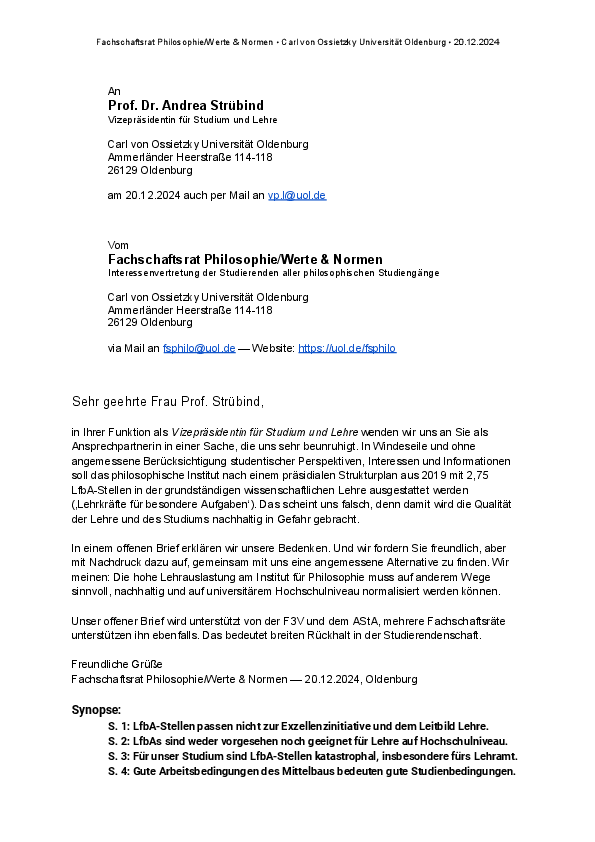
With this open letter, we are reacting to the planned introduction of LfbA positions at the Institute of Philosophy. We would like to thank you for your broad support and will keep you informed about the progress of our work in this regard in the future.
General Assembly, 27.112024, 18:00
Dear Philosophy students,
This year’s Student Association General Assembly will take place on 27 November 2024 at 6 . 00 pm in room A01 0-005. All students of the subjects Philosophy and Values and Norms are invited to attend. The new Student council will also be elected at this meeting. The Student Council is responsible for representing students’ interests, including in dealings with the university. If you would like to stand for election to the Student Council, please email us () by 24 November at the latest so that we can organise the election. Please bring along or send us a current enrolment certificate so that we can verify your eligibility to vote and stand for election. It is possible to stand for election in your absence. In this case, a brief written introduction explaining your motivation would be helpful.
Agenda:
1. Welcome
2. Report from the outgoing Student council
3. Election of the new Student council
4. Any other business
Best regards,
The Philosophy Student Council
Philosophy and Film – Winter Semester 2024/2025

We are pleased to be able to present a small selection of films again this semester.
As always, there will be a discussion after each film, to which everyone is cordially invited.
Admission is free for students.
We would like to thank the AStA, the Institute of Philosophy and the Presidential Board for their financial support.
The screenings take place on Tuesdays at 6.30 pm in the CineK.
Orientation week 2024
First things first
What exactly is the story behind compulsory attendance, active participation and attendance certificates ? You can find further information on the organisation and administration of your degree programme under ‘Information on your studies’.
At the start of the winter semester, the Philosophy Student Council organises an information session where you can get answers to questions about your degree programme, the university and timetable planning. In addition, this year there will be a games evening, a campus tour and a pub night at Marvin’s (Rosenstraße 6), a reading workshop, a visit to the Karl Jaspers House and a book launch. More on these below.
Furthermore, for many years now, we have been organising an event during the winter semester entitled “Philosophy and Film” at the Cine K . In Stud.IP , it can be found under the event name “Philosophy & Film” or the event number “4.03.997”. The film series takes place on Tuesdays from 6.30 pm to around 10.00 pm (including a discussion). The series begins on the Tuesday of Orientation Week with the first film.
Dates during Orientation Week Winter Term 24/25
Dear Philosophy students,
We are delighted to invite you to the following programme this term as part of Orientation Week:
Monday 7 October from 6.30 pm:
Games evening in (A1 0-007)
Tuesday 8 October:
From 2.00 pm , we’ll be introducing ourselves as the Student council (A 14, Lecture Theatre 3)
3.00 pm: Information session (A 14, Lecture Theatre 3); here we’ll be offering help with timetables, where we can answer any individual questions you may have. It’s best to bring your laptops or similar with you.
5.00 pm: Asta barbecue (barbecue area Haarentor A07/A11)
At 6.30 pm, there’s ascreening at Cine K, “All of Us Strangers”, the first film in our “Philosophy & Film” series. Admission is free for students! You can book “concession” tickets online directly via Cine K.
Wednesday 9 October
11.00 am: Campus tour (meeting point in front of the Student Union room Philosophy, ending in front of the canteen)
3.00 – 6.00 : Reading workshop: Max Horkheimer – ‘Akademisches Studium’ (A 1, 0-007), please register with .
From 7 pm – 1 am: Pub night at Marvins (Rosenstraße 6)
Thursday, 10 October
approx. 3 (following the academic presentation): Walk to the Karl Jaspers House (meeting point in front of the Bis Hall)
4–7 pm: Visit to the Karl Jaspers House (Unter den Eichen 22)
Friday 11 October
From 6.00 pm: Lecture and discussion: ‘Education, School, Philosophy’ (A 1, 0-006)
We look forward to seeing you there!
There’s also a WhatsApp group for first-year philosophy students: https://chat.whatsapp.com/HcXulazEnfnLFg4JIx7VCq
You can find further information on events taking place as part of Orientation Week and tips for starting your studies on the central Orientation Week website.
Workshop with Michael Heidemann as part of the O-Week: Max Horkheimer - "academic study"
09.10.2024, 3-6 pm, A01 0-007
"Academic studies" - Welcome speech by Max Horkheimer to the students in 1952
To mark the start of the semester and the beginning of your studies, we would like to read with you a welcoming speech by Max Horkheimer, which he addressed to the new students in 1952 in his capacity as Rector of Goethe University in Frankfurt am Main. For many years, Horkheimer was director of the Institute for Social Researchwhere critical theory was developed in the spirit of Kant, Hegel, Marx and Freud. In his speech to the students, he insists, against the objective tendency of the time, on an educational process that "preserves the memory of the human" and refuses to adapt to the heteronomous purposes of the state and capital. Together we want to discuss the extent to which the basic theses of the text are still valid for today's society and university and what might follow from this for the study of philosophy.
"The university is the place where the memory of the human is to be preserved and the human is to be kept alive with all its possibilities. It is the place where the individuals are educated who will shape the process can reflect on and contribute to the process, that that it nevertheless leads to the good. By voluntarily bringing it upon yourselves as students to do justice to the scientific cause, to follow it in all its shades, to be devoted and open-minded as researchers, you form yourselves into thinking, active people who can resist the world as it is." (Collected Writings, vol. 8, p. 381 ff.)
Please register in advance by email to . The text will be made available by email and at the beginning of the workshop.
Non-first semester students are also welcome.
Talk about "Education, school, philosophy" with Enrico Pfau
18:00, A 01, 0-006
What is meant by general education changes in public opinion every day. At the traditional grammar school, this fact seems to bounce off the walls; after all, the title 'general education school' is unchallenged and the curricula are only changed very hesitantly. Nevertheless, even there you will get different answers, from teachers and pupils alike: Is tax returns, basic knowledge of human psychology, environmental awareness, poetry or stock market analysis part of the general education curriculum?
In a joint discussion, we can use the problem of general education to try to develop the outlines of an (in)meaningful critique of the education system and, if interested, address some questions such as the following:
What role does general education play in teacher education programmes?
What are the major positions on general education in classical philosophy? What is involved in the concept of general education and why is there still no getting round it?
Non-first-year students are also welcome.
Enrolment is not necessary.
Philosophy and Film – Summer Semester 2024

We are pleased to be able to present a small selection of films again this semester.
As always, there will be a discussion after each film, to which everyone is cordially invited.
Admission is free for students.
We would like to thank the AStA, the F3V and the Institute of Philosophy for their financial support.
The screenings take place on Tuesdays at 6.30 pm in the CineK.
General Assembly, 17.11, 16:00-18:00
Dear Philosophy students,
This year’s Student Council General Assembly will take place on 17 November from 4 pm to 6 pm in room A01 0-007. All students studying Philosophy and Values and Norms are invited to attend. The new Student Council will also be elected at this meeting. The Student Council is responsible for representing students’ interests, including in dealings with the university. If you would like to stand for election to the Student Council, please email us () by 14 November at the latest so that we can organise the election. Please bring along or send us a current enrolment certificate so that we can verify your eligibility to vote and stand for election. It is possible to stand for election in your absence. In this case, a brief written introduction explaining your motivation would be helpful.
Agenda:
1. Welcome
2. Report from the outgoing Student council
3. Election of the new Student council
4. Any other business
Best regards,
The Philosophy Student Council
Philosophy and Film – Winter Semester 2023/24

We are pleased to be able to present a small selection of films again this semester.
As always, there will be a discussion after each film, to which everyone is cordially invited. Admission is free for students.
We would like to thank the AStA, the F3V and the Institute of Philosophy for their financial support.
The screenings take place on Tuesdays at 6.30 pm in the CineK.
ATTENTION: For the first date in the O-week (10 October), the start will be postponed to 7 pm.
Orientation week 2023
Dear first-year philosophy students,
We are pleased to invite you to the following programme for the O-Week this semester:
Tuesday 10 October
14:00-16:00, Campus tour
Meeting point: Student council(M 0-035), M building, subway
We will go for a walk in groups on the Haarentor campus. There will be information about buildings and institutions as well as opportunities for questions and discussions.
18:30, [!Änderung!] 19.00 Philosophy and film: Don't Worry Darling
Meeting point: CineK, Bahnhofstraße 11 in Oldenburg
We will watch the film "Don't Worry Darling" by Olivia Wilde and then discuss impressions, the subject of the film and the aesthetic realisation in the foyer. Admission is free for students. Reservations and information about the film can be found at www.cine-k.de
Wednesday, 11 October
14:00-15:00, Presentation of the Student Council
Meeting point: A01, Room 0-007
The Student Council presents the student and academic self-administration. The focus here is on the work and self-image of the current Student Council.
15:00-17:00, timetable help
Meeting point: A01, room 0-007
In a 1-to-1 consultation, questions about the timetable and all aspects of studying can be asked here.
From 19:00, pub evening
Meeting point: Marvins, Rosenstraße 6 in Oldenburg
Registration is not necessary for any of the events - just come along!
You can find more information about events during the O-Week and tips for starting your studies on the central O-Week homepage.
We look forward to seeing you!
the FSR Philosophy
Summer party of the FSR Philosophy
Wed 12.07.2023, 18:30
You’re warmly invited to the student summer party on the roof terrace of the canteen building
On Wednesday 12 July, we’d love to celebrate with you from 6.30 pm. The Philosophy Student Association has prepared the Asta roof terrace for you and organised plenty of cold drinks, beer and snacks. Everything is available for a donation.
Do come along in large numbers and in good spirits. Please let us know on Instagram or by email (fsphilo@uol.de) by 12.00 on Tuesday if you’d like to come.
Directions: In the canteen building, head to the back right into the AStA wing.
Reading group: Kant's "Critique of Pure Reason"
from Fri 19 May, 13-15 in A06 5-531 - fortnightly
Since November 2022, we have been reading Immanuel Kant's "Critique of Pure Reason" together. As we are now starting a new section, we would like to invite you to join us again. We start with the section on transcendental logic
The reading group is intended for students who are studying philosophy but have not yet had any direct reading experience with Kant. The reading group is also initiated by newcomers to Kant. This means that the aim is to familiarise oneself with the text for the first time. Those who already have more experience with Kant are of course also welcome.
The reading group takes place every fortnight. Please contact us if you have any questions!
Philosophy and Film – Summer Semester 2023

We are pleased to be able to present a small selection of films again this semester.
As always, there will be a discussion after each film, to which everyone is cordially invited. Admission is free for students.
We would like to thank the AStA, the F3V and the Institute of Philosophy for their financial support.
The screenings take place on Tuesdays at 6.30 pm in the CineK.
Workshop - "Sentimentality is the first mask of the murderer"? Euthanasia and
Euthanasia - Differences and Continuities
Mon. 06.02.23 - 14-19 h - A06 1-106
Occasion: On 07.02.23 at 18:30, the cinek will be showing the cinema play "Ich klage an" from
1941 by Wolfgang Liebeneiner in co-operation with the student body of philosophy
as part of the ongoing series "Philosophy and Film". Ich klage an" is a
reserved film by the Friedrich Wilhelm Murnau Foundation on the subject of euthanasia. This workshop is offered in order to ensure
critical support, among other things. However,
is not only aimed at cinema-goers, but at anyone interested in the topic of euthanasia.
Workshop: The workshop will take a critical look at both the possibilities of argumentative and aesthetic
continuity in the cinematic treatment of the topic, but without
equating the political systems through this comparison. In Robert
Spaemann's "Vom guten Sterben" (On Dying Well), the following is said about "Ich klage an": "The film is not
cruel at all, but sentimental, and it works with the same rhetoric that can currently be seen - unintentionally, of course
- among proponents of physician-assisted suicide. In this
film too, a doctor 'wrestles' with the question of whether he should allow his wife a 'dignified death'. He
acts solely out of love and demands that the legal system does not stand in the way of progress
and does not allow people to suffer agonisingly. As is well known, the Nazis did not 'invent'
euthanasia, but it was psychiatrists and
lawyers at the beginning of the 1920s who were concerned about 'public health' and recommended that the disabled and
other suffering people be given a 'good death'."
In order to allow a contemporary comparison, the popular success "Ein
ganzes halbes Jahr" is used here. Individual sections of the film with argumentative
weight will be analysed.
Last but not least, the historical and legal development
will be traced in the workshop and ultimately the current legal situation will be addressed. According to
the judgement of the second University Senate of the Federal Constitutional Court announced on 26 February 2020,
medical criteria no longer need to be cited for physician-assisted suicide. The expression of will is sufficient
. For this reason, care facilities are currently discussing
whether they wish to admit physician-assisted suicide.
However, the workshop should also enable participants to categorise the direction of ethical discussions
. Here, for example, the focus should be on the question of whether a
consistently conceived right to euthanasia is compatible with the right to self-determination.
We have been able to secure the cooperation of Dr Christine Zunke from the "Research Centre for
Critical Natural Philosophy". She will lead the workshop.
The workshop is supported by the Research Centre for Critical Natural Philosophy and the
autonomous disability department of the CvO University of Oldenburg.
If you are interested, please register at fs.philosophie@uni-oldenburg.de
General Assembly, 25.01.2023, 14:30-15:30
Dear students,
On 25 January, the Philosophy student body will hold its general meeting from 2.30 pm to 3.30 pm in the student body room (M 0-035); all students studying Philosophy are invited to attend. The main agenda item is the by-election for the Student council, which other students would like to join. The Student council is responsible for representing students’ interests, including in dealings with the University. Anyone interested in serving on the Student council is welcome to contact us (fsphilo@uol.de). It is possible to stand for election in your absence. Please bring along or send a current enrolment certificate. If you are unable to attend, a brief written introduction explaining your motivation would be helpful.
Agenda:
1. Welcome
2. Report from the Student council
3. By-election
4. Any other business
Best regards,
Philosophy Student council
CONTINUATION
Workshop with Michael Städtler: Peter Bulthaup: Critical Science and Critique of Science
Fri 16 December - 12pm-6pm - A01 0-006
Peter Bulthaup, a student of Adorno and Horkheimer and Professor of Philosophy in Hanover from 1975-2004, gave his inaugural lecture entitled "Critical Science and Criticism of Science" at the TU Hanover on 13 May 1976. According to an anecdote, Oskar Negt accused him at the time of representing the Jehovah's Witnesses' concept of truth.
Bulthaup's point in the lecture is that the appropriate theoretical form of criticism is indeed dialectical, but that dialectics, understood as materialistic, does not abolish the distinction between true and false. Rather, it is about not merely formally justifying the objectivity of scientific truth, but also including the historical conditions of scientific truth. However, this does not result in relativism, but in the finding that objective truth and the historical (political-social) purposes of a science are in conflict in its knowledge of the subject: They are mutually dependent and at the same time mutually exclusive. From this, political tasks can also be derived for supposedly value-neutral sciences.
In the workshop, the inaugural lecture will be read and discussed further together. Prior registration by email to michael.heidemann[at]uni-oldenburg.de is not necessary, but welcome. The text will be made available by email and at the beginning of the workshop, but can also be purchased as a book at michael.heidemann[at]uni-oldenburg.de. The text will be read from: Bulthaup, Peter. The Law of Liberation and other texts. Edited by the Gesellschaftswissenschaftliches Institut Hannover. zu Klampen, 1998.
In the first workshop, the first three pages of the text were read. After a short repetition, we continue on page 22 of the above-mentioned edition.
Funded by the Institute of Philosophy.
New publication: Subject and Liberation. Contributions to Critical Theory, Volume 1

In December this year, some of the contributions from our "Lectures on Critical Theory" series will be published in an anthology entitled "Subject and Liberation":
The tradition of critical theory is barely able to assert itself in the public sphere. At universities in particular, it is being displaced by an irrationalist counter-enlightenment that places reason, truth and the subject under general suspicion, thereby making the prospect of social liberation impossible. Anyone who wants to resist this attack on critical thinking must, however, examine its foundations themselves so that criticism does not degenerate into prejudice, into theoretical glasses that can be put on and taken off at will.
The texts collected in this volume primarily reflect on the problems of critical social theory in terms of subject and revolutionary theory.
Further information can be found on the Verbrecherverlag website: https://www.verbrecherverlag.de/book/detail/1100
A book presentation in the vicinity (unfortunately cancelled online) will take place on 8 December in Bremen at kukoon: https://kukoon.de/de/events/2022-12-08-das-subjekt-der-befreiung
Further broadcasts online: 6 Dec. at 7.30 pm(LINK) and 13 Dec. at 7.15 pm(LINK)
Reading group: Kant's "Critique of Pure Reason"
from Thursday, 10 November, 6 - 8 p.m. in A05 0-055 - fortnightly
From 10 November, the Student council for Philosophy is organising a reading group on Kant's "Critique of Pure Reason", a classic of philosophy and the basis for understanding many of the thinkers who followed him.
The reading group is intended for students who are studying philosophy but have not yet had any direct reading experience with Kant. The reading group is also initiated by newcomers to Kant. This means that the aim is to familiarise yourself with the text for the first time. Those who already have more experience with Kant are of course also welcome.
The reading group takes place every fortnight, in room A05 0-055 from 6 - 8 pm. It starts on 10 November.

Workshop with Michael Städtler: Peter Bulthaup: Critical science and science criticism
Fri 28 October - 12pm-6pm - A01 0-008
Peter Bulthaup, a student of Adorno and Horkheimer and Professor of Philosophy in Hanover from 1975-2004, gave his inaugural lecture entitled "Critical Science and Criticism of Science" at the TU Hanover on 13 May 1976. According to an anecdote, Oskar Negt accused him at the time of representing the Jehovah's Witnesses' concept of truth.
Bulthaup's point in the lecture is that the appropriate theoretical form of criticism is indeed dialectical, but that dialectics, understood as materialistic, does not abolish the distinction between true and false. Rather, it is a matter of not merely formally justifying the objectivity of scientific truth, but also including the historical conditions of scientific truth. However, this does not result in relativism, but in the finding that objective truth and the historical (political-social) purposes of a science are in conflict in its knowledge of the subject: They are mutually dependent and at the same time mutually exclusive. From this, political tasks can also be derived for supposedly value-neutral sciences.
In the workshop, the inaugural lecture will be read and discussed together. Prior registration by email to michael.heidemann[at]uni-oldenburg.de is not necessary, but welcome. The text will be made available by email and at the beginning of the workshop.
Funded by the Adorno Research Centre.

Congress on climate change and social criticism
Fri. 20.05.22 - Sun. 22.05.22
"what is at stake?
In terms of their complexity, scale and scope, the dangers of climate change dwarf other social problems of our time. The dynamics of global warming require urgent action. Otherwise we will reach a point of no return, beyond which (expected) tipping points and feedback effects of the climate system will make human intervention against further global warming impossible. However, 55 years after the development of the first global climate model, 50 years after the first environmental conference in Stockholm and 25 years after the adoption of the Kyoto Protocol, the question arises as to whether existing society is ultimately capable of coping with such a task. Given the omnipresence of the issue in both the private and political spheres, the extent of global protest movements and the existence of binding multilateral resolutions on climate protection, how can the steady rise in annual global emissions be explained? In view of this global failure, can we speak of the systemic nature of climate change?
The congress "Climate Change and Social Criticism" organised by the AStA, the Research Centre for Critical Natural Philosophy Oldenburg and the Rosa Salon will get to the bottom of this question over three days at the University of Oldenburg. The congress will include 13 panels with different focuses, more than 30 lectures, several panel discussions, a workshop, a book presentation and a cultural programme. In addition to established researchers, politicians, journalists, activists and numerous young scientists are also involved in the events."
Lecture series: "Remembering as the highest form of forgetting? The Holocaust in the discourse of the 21st century"
The series of events will take place between November 2021 and May 2022 and is organised by the Arbeitskreis Erinnerung der Großregion, the AStA Oldenburg, the Initiative Interdisziplinäre Antisemitismusforschung Trier, the Referat für Antirassismus und Antifaschismus Trier and the Rosa Salon in cooperation with the AStA Trier, the Bündnis gegen Antisemitismus Köln, Demokratie und Information (DEIN e. V.) and the Veranstaltungen zur Ideologiekritik Münster. The series of events is funded by the Rhineland-Palatinate Ministry for Family Affairs, Women, Culture and Integration as part of the "Together for Equality" programme. The lecture is sponsored by the Rosa-Luxemburg-Stiftung Rhineland-Palatinate.
All information at: linktr.ee/erinnern2021
All events in the series at a glance:
9 November 2021
The core of the Holocaust: Belzec, Sobibór, Treblinka and the "Aktion Reinhardt"
Speaker: Prof. Dr Stephan Lehnstaedt
Moderator: Volker Beck
23 November 2021
Normality and mass murder. On the social psychology of Nazi perpetrators
Speaker: Prof Dr Rolf Pohl
Moderator: Prof Dr Julia König
7 December 2021
The Holocaust as an open secret
Speaker: Felix Berge
Moderator: Andreas Borsch
6 January 2022
Not a state, but the rule of competing power groups.
Franz L. Neumann's materialist analysis of National Socialism in "Behemoth"
Advisor: Dr Felix Sassmannshausen
Moderation: Jonas Erulo and Sebastian Gräber
18 January 2022
Gender and Genocide: Sexual Violence against Jewish Women during the Holocaust
Advisor: Dr Marta Havryshko
Moderation: Dr Oren Osterer
25 January 2022
Occupied Europe 1939-1945.
Reflections on occupation, colonial rule, racism and violence
Advisor: Prof. Dr Tatjana Tönsmeyer
Moderator: Matheus Hagedorny
8 February 2022 February 2022
Historical Interpretations of German Guilt - Beginnings and Basic Questions of Nazi and Holocaust Research in the Federal Republic
Speaker: Dr Nicolas Berg
Moderation: Dr Ralf Balke
16 February 2022
The Uniqueness of the Holocaust
Speaker: Prof. Dr Steven T. Katz
Moderation: Prof. Dr Günther Jikeli
22 February 2022
The 'Jewish Enemy' in Nazi
Propaganda during World War
II and the Holocaust
Speaker: Prof Dr Jeffrey Herf
Moderation: Dr. Anja Thiele
2 March 2022
Holocaust: Knowledge and Memory
Advisor: PD Dr. Jan Gerber
Moderator: Anastasia Tikhomirova
15 March 2022
Holocaust and Memory Conflicts in Eastern Europe
Advisor: PD Dr. Ljiljana Radonić
Moderator: Alex Feuerherdt
29 March 2022
Parceled out memory:
Narcissistic moments in the
German memorial landscape
Advisor: Felicitas Kübler
Moderator: Dr Nikolas Lelle 12 March 2022 Nikolas Lelle
12 April 2022
Postcolonial interpretations of the Holocaust
Speaker: Dr Steffen Klävers
Moderation: Katrin Henkelmann
26 April 2022
From Pretoria and Windhoek
to Auschwitz?
On possible continuities
between colonial and
National Socialist violence
Speaker: PD Dr Jonas Kreienbaum
Moderation: Dr Jakob Zollmann
10 May 2022 May 2022
Why racism theories fail to explain anti-Semitism
Speaker: Micha Keiten
Moderation: Ronja Rossmann
24 May 2022
Hannah Arendt's image of the Holocaust and its postcolonial heirs
Speaker: PD Dr Ingo Elbe
Moderation: Jakob Hoffmann
Lectures on critical theory - continuation

Further information:
23 February 2022, 7 p.m., online: zoom.us/j/94478058139 and via the Rosa Salon YouTube channel
On the relationship between critical theory and the critique of politics with Luise Henckel
CANCELLED, 30 March, 7 pm, ev. at the University of Oldenburg, Haarentor campus, A14 - lecture hall 3 (maximum 44 listeners) and in any case via livestream [link to follow]
Die kulturelle Dominante des Spätkapitalismus - Zur Kritik der Postmoderne with Kolja Witt
27 October 2021, 7 pm
"Something is missing..." - On the loss of social design concepts in late modernity with Alexandra Schauer
24 November 2021, 7 p.m., to listen in: www.youtube.com/watch?v=0gcs9H-DIq8
Contradictory education - On the relationship between object and domination, progression and regression with Simon Helling
15 December 2021 [catch-up date], 7 p.m.
Phantasmagoria and mental image - On Walter Benjamin's "Bucklicht Männlein" with Ulrich Mathias Gerr
All lectures can be listened to one after the other at Rosasalon: www.youtube.com/channel/UCG9YP2seTsOGI66gbtKBAaw

General meeting on 22 November 2021 at 12 noon
Dear Philosophy students,
The Philosophy Student Council invites all philosophy students to this year’s general meeting on Monday 22 November 2020 at 12:00. For reasons we are all aware of, this will not take place in person but will have to be held online via BigBlueButton.
You can join via the following link: meeting.uol.de/b/enr-1yl-viz-til
Among other things, elections to the Student Council will take place during this General Assembly. Candidacies are governed by the Student Union’s Articles of Association and Election Regulations.
The agenda includes:
- Elections to the Student Council
- Any other business
Registration for the General Assembly is not required.
Cinema Reopening: 2021 Summer Term Holidays
We are delighted that we are now able to reschedule most of the films originally planned for the last winter semester as part of our “Philosophy and Film” series. As always , we will be screening the films on Tuesdays at Cine k, but now at 8 pm.
17 August: Southland Tales (Richard Kelly, USA 2006)
24 August: The Revolutionary (Paul Williams, USA 1970)
31 August: 120 Days of Sodom (Pier Paolo Pasolini, Italy 1975)
7 September: The Moon Conspiracy (Thomas Frickel, Germany 2011)
followed by a discussion with director Thomas Frickel
14 September: The Foreign Legionnaire (Claire Denis, F 1999)
21 September: Army in the Shadows (Jean-Pierre Melville, F 1969)
28 September: Fear Eats the Soul (Rainer Werner Fassbinder, D 1974)
As always, admission is free for all students. We recommend booking via the booking form linked on the Cine k website. There you can book 0-euro tickets.
Lectures on Critical Theory

Further information:
27 January
Historicity and Revolution. On changing practice with Herbert Marcuse with Jan Rickermann
24 February
Competence-oriented education or: self-administration of the damaged life with Steffen Stolzenberger
The lecture can be listened to here:
www.youtube.com/watch?v=1SWS29mQRJE
31 March
Bedingungen der Unbedingtheit - Bestimmungen zur Genese der Subjektivität in der "Dialektik der Aufklärung" with Johannes Bruns
the lecture can be listened to here:
www.youtube.com/watch?v=dCIFjRvgVbg
28 April
1923 - Dialectics, metaphysics and profane transcendence in Bloch, Benjamin and Lukács with Lea L. Fink
26 May
The political economy of the administered world or the reality of the primacy of politics with Enrico Pfau
The lecture can be listened to here:
www.youtube.com/watch?v=N-wSY1_uVjw
30 June, 7 pm at: zoom.us/j/97412710905
And can be streamed here from the start: www.youtube.com/channel/UCG9YP2seTsOGI66gbtKBAaw
Critique or Destruction? The subject in Butler, Derrida and Foucault with Carolyn Iselt
Kant's transcendental subject has been and continues to be frequently criticised. However, a distinction must be made as to whether, in the course of this criticism, the essentials of the subject - such as spontaneity in thought and autonomy - are maintained or not. A distinction must therefore be made between critique and destruction of the subject. Criticism of the fundamental post-structuralist critique of the transcendental subject is countered, for example, by the argument that those criticised have themselves developed a concept of subjectivation. The subject of the lecture is therefore to examine whether a process of subjectivation still represents a critique of the transcendental subject or whether it destroys it. If the latter is the case, it must be asked whether the self-conscious act of destruction does not contradict itself.
Popular culture & anti-Semitism
Manifestations and perspectives for educational work
"Popular culture is omnipresent. It takes up and depicts current social debates. It also offers the opportunity to process historical events retrospectively or to romanticise them ideologically.
Anti-Semitism is also a topic in pop cultural products and practices of youth culture and subculture. Series, films and video games address National Socialism and its anti-Semitism of extermination in different ways and can thus simultaneously contribute to the removal of taboos or trivialisation of the Shoah, which takes place in fashion, language, music and visual culture.
An ambivalent role of pop culture thus becomes apparent: it can behave subversively towards resentments that are capable of gaining majority support. However, neo-fascist or conspiracy ideological movements also use connectable pop cultural forms of protest and memes to spread their ideology, and youth cultural phenomena such as German rap prove to be extremely connectable for anti-Semites of various colours. The current positioning of various cultural institutions in the context of the debate on how to deal with the anti-Semitic BDS campaign, which for its part is also pushing for a boycott of Israel in the cultural sphere, points to the worrying overlap between Israel-related anti-Semitism and (pop) culture.
The task of resolutely countering anti-Semitism in its various manifestations arises not least in educational work in and outside of schools. First of all, this requires being able to recognise it in the first place when it is expressed in pop cultural products. Since ideological elements and explanatory patterns are often not expressed directly, but in images, certain terms and discourses that sometimes seem hermetic to outsiders, categorising them is also a challenge for educators.
In our online lecture and workshop series, we would like to approach the topic of anti-Semitism and pop culture and engage in a debate with all interested parties on how to counter everyday resentment. We will deal with various aspects of the topic that are particularly relevant in the area of school and extracurricular work with young people. The lectures and workshops will be supplemented by two workshop dates, in which we would like to deepen concrete pedagogical approaches to the topics discussed with the involvement of the participants.
The series of events is aimed in particular at teachers, multipliers, political educators, professionals in social work and related fields as well as students.
Registration is required to take part; simply send an informal email to . We will then send you the link to the online conference before the event."
Position of the Student council on the review of active participation
Dear fellow students,
There has been a lot of discussion about "active participation" at our Institute in recent months. The topic has become even more relevant due to online teaching, which makes it more difficult for lecturers to understand students' active participation. As we have occasionally received questions about how we as the Student Council would handle "active participation", we would like to share our position on this with you:
The examination regulations currently in force at our Institute are clear in that they do not provide for any additional work - whether written or oral - to verify "active participation". Lecturers are therefore expressly not allowed to make their certificate of active participation dependent on additional work being required. This is the simple legal situation.
However, we also think this is factually correct. External coercion is generally not a good way to organise a self-determined course of study. In the perception of lecturers, this may be in contrast to the routing slips, where lecturers actually have to sign for something that they are not allowed or able to control. In the advanced modules, for example, three seminars are attended, but there is only one module examination. Under the conditions of asynchronous online teaching, this is aggravated by the fact that there is literally little or nothing to 'see' of the students' participation in the seminars. However, this circumstance should not be interpreted to the detriment of the students.
In case of doubt, attendance checks and verification of active participation particularly affect those who are already suffering from considerable restrictions in their studies due to jobs, family and the additional burdens of the pandemic. There may be students who rationally exploit the provisions on active participation to get through their studies more easily. In principle, however, we assume that students in our subject are mature students who are interested in the content of their subject out of their own motivation. If they fail to do so, they may decide to drop out of their philosophy degree programme and reorient themselves. However, learning progress is already sufficiently recorded via the module examinations. Trying to keep students 'on track' by checking their active participation is the wrong approach. In our experience, students enjoy and actively participate in seminars that are well thought out in terms of content and didactics. Pointing to the approach taken in other subjects, where examinations are much more rigorous, is also not a convincing argument. Rather, the orientation towards the poor practice of other subjects - however much they may be in the majority - amounts to a 'race to the bottom', i.e. the standards for studying as freely as possible are lowered further and further.
It is clear that there are conflicts between the examination regulations, the course catalogue, the demands and wishes of lecturers and students and the educational mission of the university, but this is no reason to increase the workload for students. If you take the philosophy degree programme seriously, this workload will come naturally. However, we don't want to force students to take the subject seriously. This does not affect the fact that we naturally consider attendance and discussion in the seminar to be essential for the purpose of collective learning. Who could seriously object to active participation if it is voluntary? But don't a student who listens intently or a student who reads in self-study also participate actively? Thinking and following a seminar debate in a concentrated manner may appear to be passive sitting around on the outside, as it is not possible to look into the minds of the students. Trying to compensate for this 'cognitive problem' by demanding additional work disregards the fact that philosophising cannot be learned without an inner interest anyway. Nobody can be forced to think. Since there are no objective reasons for wanting to force people to philosophise, the reasons lie elsewhere. The examination of active participation serves above all to practise heteronomy, obedience, the acceptance and completion of prescribed tasks, in short: preparation for later professional life, which is largely characterised by heteronomy.
If the assessment of the discursive part of the philosophy degree programme were taken more seriously, completely different types of examination would have to be developed anyway. We are happy to discuss this topic and develop ideas together. However, we fear that the current academic environment, both with and without the coronavirus pandemic, will at least make it difficult, if not impossible, to implement such ideas.
If you have any questions about or objections to this position, please get in touch with us. An exchange within the student body - to which you all belong as students of the subject - about our study conditions and possible university policy demands for their improvement is always very welcome!
Your Philosophy Student council
Anti-Semitism, sexism and gender - relationship and pedagogical intervention. An online lecture and workshop series
In the anti-Semitic distorted image of the lustful Jew, who represents a danger to the woman integrated into the body of the people due to his unbridled libidinous nature, the significance of gender relations for anti-Semitic thinking becomes clear. How topical this [read more].

Orientation Week, Winter Semester 2020/21
Dear fellow students, and especially dear freshers,
Orientation Week for the ‘hybrid semester’ is fast approaching, and the student body has also planned a number of events for you. You can find our Orientation Week programme below. We’d also like to draw your attention to the ‘Philosophy & Film’ cinema series, which takes place regularly beyond Orientation Week; we’ve included the programme for this below as well.
As a general rule, you can contact us at any time if you have any problems with your studies, with lecturers or the administration, if you have any questions about the study or examination regulations, or even if you have any suggestions or criticisms. We’d also be delighted to have more people join us in our student council work. The best way to reach us is via our email address:
If you are unable to attend our campus tour or the online timetable advice session on the dates specified, please feel free to contact us by email if you have any questions. The so-called ‘hybrid semester’ comes with many drawbacks for students, foremost among them, of course, the current inadequacy of teaching provision. However, do not lower your standards too hastily; instead, exercise your rights and have the courage to raise concerns – particularly regarding breaches of the examination regulations – or to report them to us. We will then endeavour to find prompt solutions in your best interests.
As the Philosophy Student Body, we have been campaigning for years for a course of study that is as self-determined and critical as possible, in which education pursued for its own sake takes precedence over the training required for the labour market. Anyone interested in the theoretical background to this distinction is warmly invited to join our online reading group on Max Horkheimer’s speech ‘Academic Study’, with which he welcomed first-year students to the University of Frankfurt in 1952.
Despite the current unusual study conditions, we wish you a successful start to the winter semester and hope to be able to offer you an engaging programme for Orientation Week.
Your Philosophy Student Body
++++++++++++++++++++
Philosophy and film - start of the series in summer semester 2020
Dear friends of philosophical cinema,
we are pleased to inform you that our cinema series can finally start next Wednesday (22 July) at 8 pm! The Cine k has recently reopened under conditions. Due to Corona, we have made some adjustments to the programme and have deviated from our usual weekday. This summer we are presenting the six films in a two-week rhythm on Wednesdays at 8 pm. You will be informed about the other dates and film titles as soon as possible.
The subsequent discussion, which is so important for our series, will take place in the cinema auditorium. Not all seats can be taken, as the minimum distances must be observed. In concrete terms, this means that our ticket contingent is limited to approx. 20-25 seats. If you would like to attend, please reserve your tickets using the usual online form at Cine k . As always, admission is free for students. We hope to be able to hold stimulating discussions about the films with you even under these unusual conditions.
Our series begins with a film that is generally regarded as a classic of arthouse cinema: "The Draughtsman's Contract" by Peter Greenaway. In 17th century England, the landscape artist Mr Neville receives a commission from the noblewoman Mrs Herbert: in the absence of her husband, the sought-after artist is to produce twelve drawings of his manor, Compton Anstey. Neville agrees, but demands not only gold but also sexual favours from Mrs Herbert in return for his services. Private power games soon unfold at the country estate, while strange clues find their way into Neville's paintings that seem to point to a serious crime.
Greenaway's film does not make it easy for the audience, as it confronts them with a wealth of (art) historical quotations, hidden clues and convoluted dialogue. It could be the subject of discussion whether there is something substantial hidden behind the postmodern arrangement of the crime story - such as a reflection on the relationship between painting and film images - or whether the film does not rather make the reference of the reference and thus the dissolution of classical (genre) themes its own content.
Until then!
Your student body Philosophy
----
last film in summer term 2020:
Wed 30 Oct, 8pm: Der Untertan (Wolfgang Staudte, GDR 1951)

Dear friends of philosophical cinema, as you can no doubt imagine, our film series will have to be suspended for the time being during the summer semester. We naturally hope to be able to resume our co-operation with Cine k Oldenburg – which, like many other arthouse cinemas, is currently facing difficulties – as soon as possible.
Stay well and see you soon!
Your Philosophy Student Body

Strike: Against the deterioration of teaching!
STRIKE ON 21 JANUARY 2020
12:00 pm – A14 Lecture Theatre Centre
Why? – Here’s why!
– Overworked lecturers – and what are the consequences?
– Overcrowded/under-resourced seminars
– That’s why teaching is suffering!
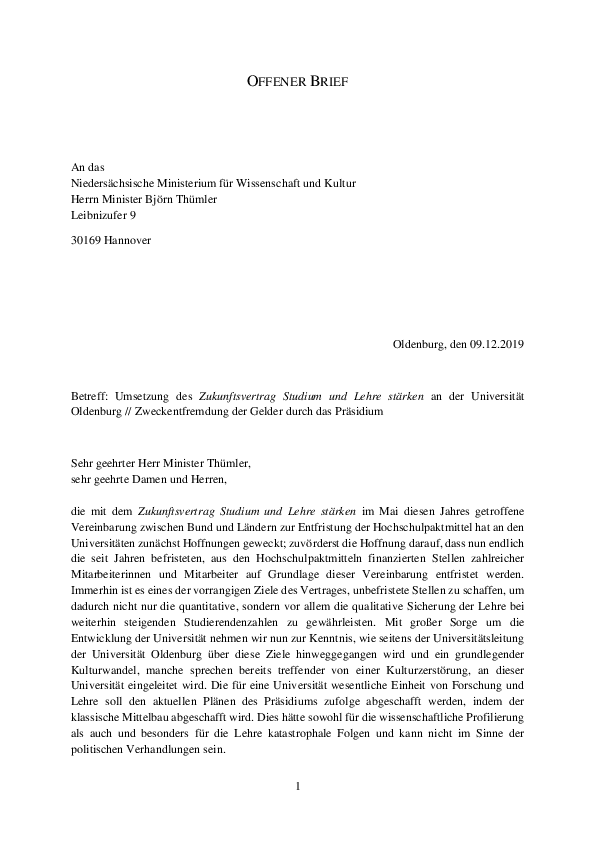
The Presidential Board’s only solution is to create LfbA positions. A disaster for teaching and many lecturers, as this means twice the teaching load for research assistants on the same salary.
- Your current semester fee: €401.27
- chronically underfunded student services
The state of Lower Saxony can think of nothing better to do than to do nothing. That is why the Studierendenwerk Oldenburg plans to increase the semester fee by €30 soon. Currently, only €68 goes to the student services organisation.
- Our response is: NO! So JOIN THE STRIKE!
You can find the online petition on the Lfba issue at www.change.org/p/carl-von-ossietzky-universit%C3%A4t-oldenburg-gegen-die-verschlechterung-der-lehre
For more on Studierendenwerk Oldenburg, see: weact.campact.de/petitions/more-financial-support-from-the-state-for-student-services-to-ease-the-burden-on-students

"Philosophy and Film" Programme, winter semester 2019/20

We are pleased to be able to present a small selection of films again this semester. As always, a discussion is planned after each film, to which every visitor can join. We hope you like our programme and that we can welcome you in large numbers.
We would like to thank the F3V, the AStA, the SchwuRef and the Institute of Philosophy for their financial support.
The screenings will take place at CineK .
Lecture by Christine Resch (Frankfurt a. Main): Reflections on a sociological aesthetics of interaction
In my critique of Adorno’s aesthetics of the work of art, I shall attempt to develop a theoretical framework within which Adorno’s aesthetics and the studies of reception – which have been driven forward in particular by cultural studies – can be reconciled. The proposal aims at a theory of ‘aesthetic action’ which, unlike Adorno’s, takes the culture industry as its starting point rather than the work of art. What is emerging is an aesthetics that subverts the opposition between the aesthetics of the work and the aesthetics of reception within a more comprehensive aesthetics of interaction. It is, furthermore, an aesthetic theory that is applicable to the broad spectrum of media and genres, and does not – like most previous aesthetics – rely one-sidedly on experiences with Greek sculpture or classical or contemporary literature or theatre or panel paintings in museums or (as in Adorno’s case) contemporary music. Adorno’s strict work-centred aesthetics meant that he was unable to recognise or acknowledge Dadaist and Surrealist forms of resistance, and that he diagnosed in jazz and performance art merely a proliferation of products of the culture industry. Taking the culture industry as a starting point – to which even ‘autonomous’ art has long since been subjected – one can explore the question of resistance within the culture industry.
Further information:
Anti-Semitism theme week
From 27 - 31 January 2020, various events on the topic of anti-Semitism will take place as part of the Anti-Semitism Theme Week.
27.01. Film screening Shoah by Claude Lanzmann
12:00 - 20:00 V03 0-E003
www.facebook.com/events/1178952819114539/
28 Jan. It's not systemic- Antisemitism in academic anti-racism. Lecture & discussion with Ingo Elbe
18:30 - 20:30 A01 0-005
www.facebook.com/events/175654330479773/
29.01. On guilt and defence. Why knowing about the Nazi past does not help against anti-Semitism.
Workshop with Olaf Kistenmacher
14:00 - 18:00 V03 0-D001
www.facebook.com/events/154899409141780/
30.01. "Nakba", "apartheid state", "child murderer" On anti-Israeli myths in the past and present.
Lecture and discussion with Alex Feuerherdt
16:00 - 18:00 A01 0-010a
www.facebook.com/events/187130832479020/
31.01. Antisemitism in German rap
Lecture and discussion with Konstantin Nowotny
19:00 - 21:00 A01 0-006
www.facebook.com/events/170463337390944/
Contradictions. Adorno in context
Series of lectures organised by the Adorno Research Centre
Theodor W. Adorno died in the summer of 1969. The 50th anniversary of his death in 2019 provides the occasion for a series of lectures devoted to the philosophical and political relevance of his work. The speakers in the series of lectures are less concerned with asking what we are to make of Adorno today, and are instead seeking to determine how our present-day society can be understood through the lens of Adorno’s work. During the summer semester of 2019 and the winter semester of 2019/20, the series of lectures will, on the one hand, present the perspectives developed and the research projects carried out at the Adorno Research Centre, and, on the other hand, will welcome guests from Germany and abroad who have made significant contributions to Adorno research.
You can find the current programme for the winter semester 19/20here.
How do you become a nationalist?
One-day seminar with Marlis Stein and Ingo Elbe
Nationalism – that sounds like xenophobia, like being conservative, right-wing and prone to violence. But do you have to have something against foreigners to be a nationalist? Do you have to glorify your own country’s history? Do you have to feel pride in your own nation? Is it enough simply to be proud of not being proud? Could there perhaps also be such a thing as progressive, left-wing nationalism? In the workshop ‘How does one become a nationalist?’, we aim to explore the topic of nationalism from an academic perspective. Alongside a fundamental analysis of what nationalism actually means and the various theoretical frameworks that explain it, we will also examine the role of authoritarian sentiments in nationalism and the links between nationalism and anti-Semitism.
Marlis Stein completed her Master’s degree in Philosophy at the University of Oldenburg in the summer of 2019. She specialised in the critique of capitalism and nationalism and wrote her Master’s thesis on the relationship between nationalism and democracy.
Ingo Elbe is a private lecturer and research fellow at the University of Oldenburg. He has authored numerous essays on the topics of nationalism and anti-Semitism. His publications can be found at: uol.de/philosophie/pd-dr-ingo-elbe/publikationen/
An overview of the seminar texts and registration details can be found at finja.krueger@asta-oldenburg.de
Sat 19 Oct 2019, 10.00 am to 4.00 pm
Venue: University of Oldenburg, Room A01 0-007
Critical Theory Today
Philosophy of history and social criticism
Workshop with Dr Peggy Breitenstein (Jena)
CRITICAL THEORY TODAY. Workshop series of the Adorno Research Centre at the University of Oldenburg
Critical theory lives from its constant reflection on the social present that has become historical. The contemporary core with which it provides its concept of truth forces it to examine its central concepts and theorems with regard to their explanatory potential and to constantly realign them with regard to their objects. The aim of the workshop series CRITICAL THEORY TODAY is to discuss classic texts of critical theory and more recent research in order to determine what the contribution of critical theory to philosophy and social theory is today. Previous guests have included Ruth Sonderegger, Robin Celikates, Marc Nikolas Sommer and Michael Städtler.
Organisation: Dr Maxi Berger and Dr Philip Hogh
Philosophy of history and social criticism
Workshop with Dr Peggy Breitenstein (Jena)
Lecture: Natural History and Widergeist. Adorno and the late Marx
Friday, 18 October 2019, 6-8 p.m.
University of Oldenburg, Haarentor campus, Room: V 03 0-D001
Workshop
Saturday, 19 October 2019, 10 am - 3 pm
University of Oldenburg, Haarentor campus, Room: V 03 0-D001
The concept of history is a central concept of critical theory. The reference to the historical dynamics of its concepts and objects serves Critical Theory to demonstrate the changeability of social conditions. Nevertheless, a form of social criticism based on the philosophy of history is not only confronted with the problems that also occupy classical approaches to the philosophy of history (such as the question of a necessary historical development or the justification of historically occurring suffering), but above all with how a philosophy of history must be constructed that can serve to justify social criticism. In her work "The Liberation of History", published in 2013, Peggy Breitenstein worked out the solutions that can be found in Adorno and Foucault in this regard. The workshop will focus primarily on her reflections on Adorno.
The number of participants is limited, the texts to be read will be sent out after prior registration. Please register at: by 29 January 2019.
Dates for the O-week from 7 to 11 October 2019
Dear first-year students,
From 7 to 11 October 2019, the orientation week will take place at the C.v.O. University of Oldenburg takes place. We also have a few dates where you can get to know each other and us from the Student council. On Tuesday, we cordially invite you to get to know our cinema series Philosophy and Film . This will take place in the local cinema CineK. Admission is free for all students. On Thursday, there will be a Freshers' Café where we will give you some information about studying, but also about us and what we do. We will also be happy to help you with organising your timetable, the course of your studies and any other questions you may have about studying. In the evening, if you like, we can meet up at Marvin's for a pub evening.
Tuesday: 18:30 - Philosophy and film at CineK
Thursday: 15:00-18:00 - Ersti Café and timetable help in room A01 0-009
from 20:00 pub night at Marvin 's
Autonomy and fait social in Adorno's aesthetic theory
Workshop during the semester break
Location
University of Oldenburg, Ammerländer Heerstrasse 121, 26111 Oldenburg Room: V03-1-M136
Dates
Wednesdays from 3-6 p.m. from 31 July, last date: 25 September 2019
Contact person
Maxi Berger:
Topic
According to Adorno, works of art cannot be understood independently of the social contexts within which they are experienced. Thus, the conditions for the reproduction of artists and recipients are also given by society. But it is not only through individuals that art is socially constituted. Adorno is interested in the question of how the content of artworks can be interpreted socially, also or perhaps precisely because they refuse direct political appropriation by whomever.
In this workshop, the relevant passages from Aesthetic Theory will be worked through and discussed using the close-reading method in order to find out how Adorno defines the relationship between autonomous art, the culture industry and the social situation.
Literature
Theodor W. Adorno, Aesthetic Theory, Frankfurt a.M. 1997
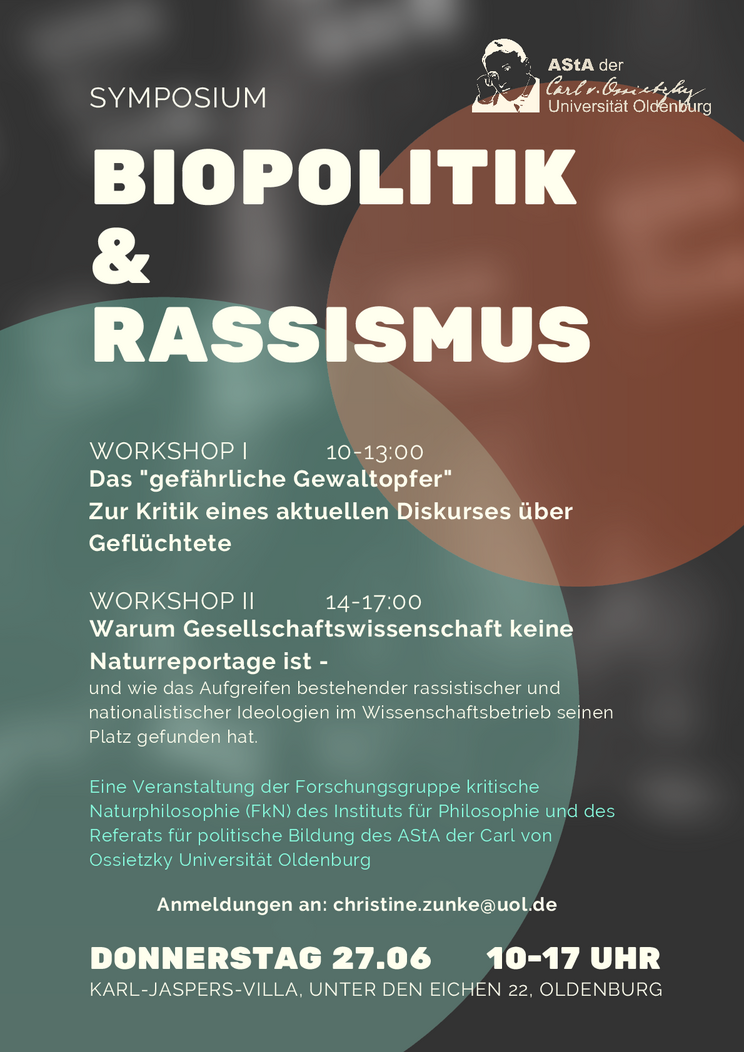
Symposium Biopolitics and Racism on 27 June from 10:00 a.m. in the
Karl-Jaspers-Villa
Register at:
Workshop 1: The ‘dangerous victim of violence’. A critique of the current discourse on refugees (10.00–13.00)
It is well known that concern for people can also become intertwined with violence against them. Thus, powerful processes of social discipline and repression can also be found under the guise of therapy and integration. The German Academy of Sciences, the Leopoldina, for example, expresses concern in a recent statement about the mental wellbeing of refugees. It proposes screening all refugees and providing short-term therapy on a nationwide basis to ensure rapid assistance for those suffering from trauma. In doing so, however, the researchers imply the following equation: refugees = potentially traumatised = potentially at risk = potentially dangerous. As a consequence of this line of argument, the figure of the ‘mentally unstable refugee who refuses to integrate’ is portrayed as a threat to the German ‘
’ host society. Such constructions of a ‘dangerous class of refugees’ form one of the foundations of an influential discourse that can also provide justification for new deportation regulations, as well as police and psychiatric legislation. In our workshop, we aim to analyse this discourse on “dangerous, traumatised refugees” using the Leopoldina’s position paper
as a case study. To this end, we will examine the foundations of knowledge production underlying the statement and the consequences of the political proposals articulated therein, as well as
the explicit and implicit assumptions regarding the links between society and the individual, and between biology and the psyche.
Speakers:
Marcus Balzereit, educational scientist (Frankfurt)
Tobias Heinze, Goethe University Frankfurt am Main, Institute for
Political Science
Workshop 2: Why social science is not nature reporting – and how the adoption of existing racist and nationalist ideologies has found its place within the academic community. (14:00–17:00)
In both political debate and academic discourse, it is often claimed that one’s own position has been substantiated by the latest findings on the biological nature of hum
. Even theories that do not appear to be biologically grounded frequently feature biologistic arguments. For example, economic problems are often explained by reference to the ethnic characteristics of the
protagonists. Biological explanations of human behaviour, as presented in particular by (popular) scientific accounts of genetic and brain research, reflect—as the results of
empirical research—real-world discrimination and social power relations, and thus find a connection to the social sciences. Alongside populist conservative viewpoints, which are purported to be explained by human biology, even well-meaning positions that regard themselves as
progressive also employ biologism to bolster their stance. In doing so, they do not always go so far as to declare humans to be entirely unfree and at the mercy of their biological nature
. However, human actions and social conditions are not reflected upon as such, but are attributed, wholly or in part, to their supposed natural basis. Critics of these conditions are then countered with the argument that people are simply the way they are. The path to achieving change, therefore, does not lie in political criticism of the status quo, but must proceed from a fundamental (unquestioned) acceptance of the status quo. Alongside the obvious usefulness of biological explanations for thinking and acting in terms of domination, it is precisely the
correspondence with experiences of impersonal domination in capitalist society that makes their explanation via fundamental biological constants and behavioural patterns so plausible. In this workshop, we aim to highlight and collectively discuss, from various perspectives, the mechanisms by which uncritical research often unconsciously reproduces racist/ethnicist notions.
Speakers:
Anna-Sophie Schönfelder, University of Osnabrück, Department of Political Theory
Matthias Spekker, University of Osnabrück, Department of Political Theory
Sascha Wittneben, Matthias Claudius Gymnasium, Gehrden (Biology, Philosophy)
Oliver Voß, University of Hildesheim, Institute for Media, Theatre and
Popular Culture
Johannes Zimmermann, University of Kiel, Institute for Experimental Medicine
Contradictions. Adorno in context
Series of lectures by the Adorno Research Centre
Theodor W. Adorno died in the summer of 1969. The 50th anniversary of his death in 2019 provides the occasion for a series of lectures devoted to the philosophical and political relevance of his work. Rather than asking what we are still to make of Adorno today, the contributors to the series of lectures seek to determine how our contemporary society can be understood through the lens of Adorno’s work. During the summer semester of 2019 and the winter semester of 2019/20, the series of lectures will, on the one hand, present the perspectives developed and the research projects carried out at the Adorno Research Centre, and, on the other hand, will welcome guests from Germany and abroad who have made significant contributions to Adorno research.
Wednesday, 8 May 2019
6.00–7.30 pm
A 14, Lecture Theatre 3
Philip Hogh (Oldenburg): ‘…where it hurts.’
On the social dimension of pain and suffering in Adorno’s theory
Followed at 7.30 pm
Adorno, pets, art and an expanded handbook.
Presentation of the expanded 2nd edition of the Adorno Handbook
Lectures by and discussion with the editors Richard Klein
(Freiburg), Johann Kreuzer (Oldenburg) and Stefan Müller-Doohm
(Oldenburg)
Monday, 27 May 2019
6.00–8.00 pm
Haarentor campus, Room A 01-0-007
Sebastian Tränkle (Berlin): Negative Rhetoric.
Materialist Critique of Language following Adorno
Monday, 3 June 2019
6.00–8.00 pm
Haarentor campus, Room A 01-0-007
Karin Stögner (Vienna): Images of femininity as a contradiction
– Critical Theory and Feminism
Monday, 17 June 2019
6.00–8.00 pm
Haarentor campus, Room A 01-0-007
Maxi Berger (Oldenburg): Aesthetic Constellations of
Self-Awareness – Dewey and Adorno
Organised by: Dr Maxi Berger, Dr Philip Hogh
Further information at: maxi.berger@uni-oldenburg.de,
philip.hogh@uni-oldenburg.de
'Can the Philosophers speak?' - Reaction of the Student council Philosophy to a statement by the POOL collective
At the end of January, a group called POOL Collective appeared during an AStA meeting and accused the AStA in general, the student body Philosophy in particular and the AStA officer for "Political Education, Criticism of Racism and Anti-Semitism" in particular of 'discrimination' or supporting it. These kinds of accusations are a great way to play politics at universities these days, because who wants to be accused of not being an upright anti-racist? The wild conglomerate of insinuations, allegations, half-truths and suggestions was quite obviously aimed at denouncing unpopular critics who have probably been a thorn in the side of the collective for some time with lectures criticising Islam and racism with infamous references to reason and enlightenment.
According to 'Flurfunk', the postmodern discourse guardians' bullying campaign is now beginning to bear fruit. The newly appointed AStA will probably be ruled by the 'discrimination-experienced' experts of the POOL collective when it comes to determining what counts as racism and discrimination. This means that anyone interested in sensible enlightenment and emancipation will in future have to be increasingly prepared for events on illustrious topics such as 'cultural appropriation', 'decolonise something' and 'empowerment for XYZ', which will result in the efforts for a universalist critique of domination (see also our critique of 'empowerment yoga'). Criticism of the 'empowerment yoga' of the Feminist Department from 10 August 2018).
Further evidence of the anti-racist regression was recently in this embarrassing piece of work which suggests a personal overlap with POOL, but at least an ideological continuity. It has encouraged us to publish a response to the POOL collective, which, although belated, has lost none of its topicality. To the supporters of the Centre for Migration, Education and Cultural Studies (CMC) and its spiritus rector, Paul Mecheril, are also highly recommended to read it, as some of the POOL members come from these contexts.
In order to make our response more comprehensible, we also take the liberty of including the written statement of the POOL collective for the sake of clarity.
Please click on the text to view/download our statement.

"Philosophy and Film" Programme, Summer Semester 2019
We are pleased to be able to present a small selection of films again this semester. As always, a discussion is planned after each film, to which every visitor can join. We hope you like our programme and that we can welcome you in large numbers.
We would like to thank the F3V and the AStA for their financial support.
The screenings will take place at CineK.
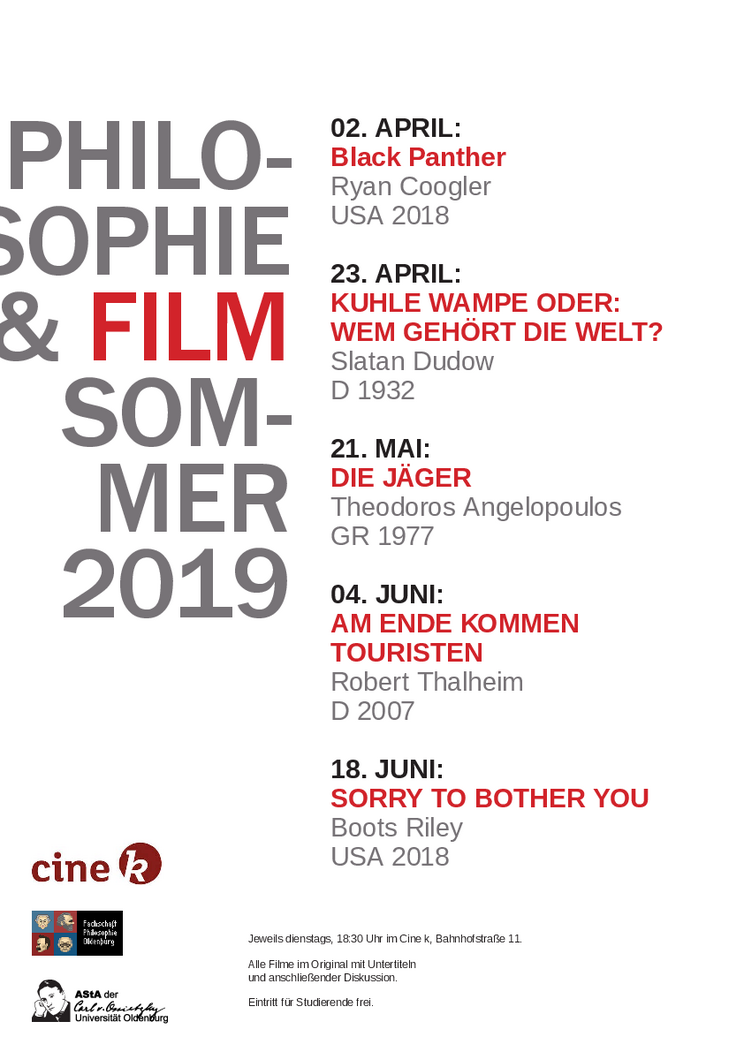
Postmodern 'racial segregation' at university
Statement by the Student council Philosophy on the "Empowerment yoga practice workshop" organised by Femrefs at the University of Oldenburg

Journal for Critical Social Theory and Philosophy - New Issue
The journal for critical social theory and philosophy has just published a new issue. This time also with a contribution from a current student and a former student of the Institute of Philosophy.
Some articles are freely accessible: www.degruyter.com/view/j/zksp.2018.5.issue-2/issue-files/zksp.2018.5.issue-2.xml?fbclid=IwAR2NvoHY3VWMxmdWUcKaaqeT4a_UTlUs7hZ-AneOhq1KeMCeKoSC9Iz7JNI
The entire journal is available free of charge from the university library.

General Assembly of the Philosophy student body
19.12.2018
The Student council of the philosophy student body invites all philosophy students to this year's general assembly on Wednesday, 19 December 2018 at 12.15 pm in M 0-035.
Agenda:
- Regularia
- Reports and questions
- Miscellaneous
You can find the preliminary minutes of the last two plenary meetings in our StudIP event under Files -> University Politics -> Plenary Meetings of the Philosophy Student Body.
Event announcement: 13 December, 19:00, A1 0-005
The struggle for the proletariat
On the historical utility value of the working class
Thursday 13 December 2018, 19:00, A1 0-005
Lecture & discussion with Niklaas Machunsky (editor of the magazine Prodomo)
As society becomes increasingly polarised, the advocates of the social question sense an opportunity. Large sections of society have slipped into precarious working conditions, even though the economy has been booming for years. There is agreement on the right and left that something needs to be done. But even more astonishingly, there is also agreement on the direction of travel: back to the sovereign nation state!
In retrospect, the German economic miracle of the past presents itself as rosy-cheeked, calm and hopeful. The time of the miracle was one of restoration. It was characterised by the attempt to recapture the unleashing of National Socialism through fixed forms. Precisely because of the successful restoration, it could be described as a clearly defined social order, as a "levelled middle-class society" (Schelsky) or as an "administered world" (Adorno). It was a society in which material differences shrank and the working class was integrated through participation in mass consumption. In other words, a society that lived protected behind the fixed borders of the nation state and whose members lay on the couch after work, watched Derrick, leafed through the Neckermann catalogue and dreamed of their next camping holiday. Today, this post-war "economic miracle" is rarely explained as a consequence of the victory over Nazi Germany, but rather viewed in isolation from war and barbarism. However, it was precisely the productive forces unleashed during the war and the destruction of commodities and people that made it possible for the masses to participate in consumption in the post-war period, and it was precisely these productive forces that liquefied the supposedly fixed forms again.
Because the dynamics of globalisation that began in the late 1970s only threaten to create ever more precarious conditions and are increasingly affecting the middle class, its right and left wings want to return to the idyll behind the border fence of yesteryear. There, some hope to find the ethos of the national community and others mass consumption and full employment, and both fear cheap competition from abroad. Both factions see the means to achieve this goal in the proletariat and therefore invoke its return. It should serve them as a momentum to oust the establishment. The green-liberal establishment, the centre, also sees the potential for a revolt growing, but where the others invoke the proletariat, they only recognise white trash. Out of democratic respect, however, they address it as the proletariat and promise it new forms of representation. The proletariat today is therefore above all a spectre with which the individual factions of the middle class frighten each other.
This struggle for and with the proletariat will be presented in the lecture and the social dynamics of which this struggle is an expression will be illuminated. Particular attention will be paid to the development of the use value, because its destruction was supposed to mean the end of history. But neither is the proletariat returning, nor are we at the end of history!
Workshop with Michael Städtler on the "End of Philosophy" by Peter Bulthaup. Part II
Friday, 23 November in room A1 0-008 from 10 a.m.
Dear all,
The workshop from 10 July this year is to be continued, as we did not manage to work through the text. If you were unable to attend the first session, you are welcome to try to catch up.
You can find the text under the following link: Text
The announcement text from the first part of the workshop:
In this workshop, the script for Peter Bulthaup's farewell lecture will be read. "On the End of Philosophy" poses the question of the current situation of philosophy, which is dialectically caught between enlightenment and capitalist rule, and threatens to end in the affirmation of the existing. Only by reflecting on the genesis of this development in relation to the validity of the concepts of philosophy can its critical content be determined.
Peter Bulthaup was Professor of Philosophy in Hanover until 2004.
Michael Städtler is a professor and member of staff at the Institute of Philosophy at the University of Wuppertal and on the board of the Peter Bulthaup Archive.
Gender equality work at the Institute of Philosophy - information event
12 November 2018 at 4.30 pm in Room V03 3-S340
Dear colleagues and students,
We, Christine Zunke (Equality Officer for School IV) and Anna Plader, would like to invite you to an information session on equality work at the University of Oldenburg and the Institute of Philosophy. Gender equality work is an important area at the university. It focuses in particular on supporting female students and staff in their studies, teaching and research. This can be achieved in a variety of ways (e.g. by ensuring an appropriate balance between male and female tutors when allocating tutorial roles, or by actively encouraging women to apply for academic posts). We would like to inform you about the responsibilities, opportunities and purpose of Gender equality and hope, in this way, to spark your interest in this important area of work, so that we can fill the post of Equality Officer at the Institute of Philosophy – which became vacant on 1 October 2018 – as soon as possible.
The meeting will take place on 12 November 2018 at 4.30 pm in room V03 3-S340, with coffee/tea and cake provided. To help us with our planning and for further information, we would appreciate a brief, informal registration by 5 November 2018 to .
We hope you will be interested and that many of you will attend. Kind regards!
Christine Zunke & Anna Plader
Polysophic reading V - The uncanny. Music: MARX
The fifth polysophic reading will take place on 8 November at 7.30 pm. Members of the student council and old comrades-in-arms will be taking part again, so get there!
200 years of Marx. 150 years of DAS KAPITAL. The sting remains!
On 2 and 3 November 2018, the Oldenburg Forum for Marx Research at the University of Oldenburg is organising the second Oldenburg Marx Conference on the theme: 200 Years of Marx, 150 Years of *Capital* – The Thorn Remains!
You can download the flyer and the programme booklet, which includes explanatory texts, here.
Apply now: Teaching posts for the 2019 summer semester
You can now apply for teaching posts for the 2019 summer semester.
The deadline for applications is 2 November 2018; applications should be sent to the relevant module coordinators for the module in which you intend to hold your course.
You must submit at least the following:
- the title and description of the course
- Module allocations
- CV
- Copies of your degree certificates
- a list of courses taught to date, if applicable
-Teaching evaluations, if applicable
-Reference letters, if applicable
As a rule, at least a Master’s degree is required to be eligible for a teaching post.
Further information here: uol.de/philosophie/studium-lehre/lehrauftraege/
"Academic studies" - Max Horkheimer's welcoming speech to students in 1952
Joint reading in group study room 2.5 of the university library, Wednesday, 10 October, 2-4 p.m.
To mark the start of the semester and the beginning of your studies, we would like to read with you a welcome address by Max Horkheimer, which he delivered to new students in 1952. Horkheimer was for many years Director of the Institute for Social Research in Frankfurt am Main, where critical theory was taught in the spirit of Kant, Hegel, Marx and Freud. The text appears under the title ‘Academic Studies’ in Volume 8 of Horkheimer’s Collected Works. In his speech, Horkheimer, in the face of the prevailing trends of the time, insists on an educational process that “preserves the memory of what it means to be human” and refuses to conform to capital, the state and domination. Together, we want to explore whether the text’s fundamental theses still hold true for today’s society and the university, and, if so, what implications this has for the study of philosophy.
“The university is the place where the memory of what it means to be human is preserved and where humanity, with all its possibilities, is to be kept alive. It is the place where individuals are educated who can reflect on the process and help ensure that it nevertheless leads to the good. By voluntarily committing yourselves, as students, to doing justice to the academic endeavour, to following it in all its nuances, and to being dedicated and open-minded as researchers, you are developing into thinking, active individuals who can resist the world as it is.”
The text will be provided on site.
You can find further events during Orientation Week here: uol.de/fsphilo/studienbeginn/
Film & Reading Circle: The Miracle of Bern - Catharsis of the Nation
Dear all,
In the discussion about the film The Miracle of Bern, which we last showed in the film series Philosophy and Film, it emerged that in our view its psychological power deserved a closer look. For this reason, we would now like to invite you to watch the film again together and then read the text Das Wunder von Bern. Catharsis of the Nation by Sonja Witte.
In the essay, the psychoanalyst explores the question of how a "change in Germanness after 1945" is "proven" by the film. Drawing on Sigmund Freud's theory of mass formation, she aims to show that film, as a "German dream congealed in images", serves the (unconscious) need for collective identification, in which community is supposed to have replaced the people, family and homeland replaced blood and soil, and guilt replaced recovery from defeat.
For legal reasons, the film screening can unfortunately only be for students, but the reading group is open to the public. You do not need to register to attend, but you should read the text beforehand. If you already know the film, you can of course come to the reading circle first.
A copy of the text can be found in the university library in room 11 in the philosophy seminar room.
We would be very pleased about your participation,
Student body Philosophy
When and where?
On 19.09.2018:
14:00: Film
16:00: Reading circle
Location:
Initiative House
Uhlhornsweg 68
FALLS OUT ---- Identity thinking as alienation in Adorno - Onur Dogenay (Berlin)
Mon 02.07.18, 6 pm, A14 - Lecture hall 3
as part of the Philosophical Colloquium
The Miracle of Bern - Philosophy and Film | 12.06. | 18:30 | cine k
In the "Philosophy and Film" series, the Philosophy student body presents the film "Das Wunder von Bern" (2003) by Sönke Wortmann with the kind support of the AStA.
A few days before the opening match of the 2018 World Cup in Russia, the nation is once again in the grip of "football fever", with daily updates and excitement about "our team".
In order to take a critical look at the function of the "people's sport" for the people and or nation, we want to look at this film about the German victory in the 1954 World Cup and its modern cinematic treatment under the label of myth ("miracle").
This myth is also related to that of the later "summer fairy tale" of 2006 in that it accompanied and helped determine the affective stripping away of the past and the "reparation of the Germans".
Admission is free for students.
12 June 2018,
18:30
at Cine K
Attention change: Philosophy and film
Next Tuesday, 5 June, we will not be showing "Queimada, the Island of Terror" as planned in the Philosophy and Film series, but "The Great Mistake" (Bernardo Bertolucci, Italy | France | Germany, 1970).
See you there!
Philosophy and film - New dates!
Dear all,
It’s that time again on Tuesday!
Our ‘Philosophy & Film’ series kicks off with four new sessions for this summer semester:
10 April – The Square (Ruben Östlund)
8 May – The International (Tom Tykwer)
5 June – The Conformist (Bernardo Bertolucci)
12 June – The Miracle of Bern (Sönke Wortmann)
The films will be screened every Tuesday at 6.30 pm at Cine k, 11 Bahnhofstraße. Afterwards, we invite anyone interested to join us for a discussion in the foyer.
Admission is free for all students, courtesy of the AStA at the University of Oldenburg.
Do come along in large numbers and bring your loved ones with you!

Recommendation: Jörg Huber - On the critique of political ecology

Everyone knows that climate agreements are not worth the paper they are written on. The signatories only honour their non-binding promises to reduce greenhouse gases when they seem opportune. There is a huge gap between the moral high-minded claims of climate policy and reality. There are mainly ideological reasons why climate policy, although it can hardly influence the climate, still attracts attention with its annual mammoth conferences. The climate has to be used to justify a ruthless policy.
One grotesque example of this was the recognition of Syria as a climate saviour, which the Tagesschau reported on 7 November 2017:
USA isolated - Syria also joins climate agreement
Syria is now apparently the last UN country to want to join the Paris Climate Agreement. The USA, whose President Trump announced its withdrawal at the beginning of June, would thus be the only opponent of the agreement to be completely isolated.
[...]
"It is extremely gratifying that Syria has just announced its intention to join the Paris Climate Agreement," said Sabine Minninger, climate spokesperson for Bread for the World. In the face of "devastating climate change", the world is showing unity.
[...]
How is the broken civil war-torn country of Syria supposed to develop and adhere to a national plan to reduce greenhouse gas emissions, as envisaged by the Paris Agreement? After 6 years of murderous fighting with hundreds of thousands of deaths, large parts of the country are no longer
able to provide even the most basic necessities. How can anyone take seriously the declaration of intent of a regime that constantly uses poison gas and thus also violates the Geneva Protocol it has signed?
It is the cheap symbolic success that makes us forget all the obvious contradictions and justifies the cynical agreement with Syria and other brutal regimes in the eyes of climate activists: The USA appears internationally isolated. In order to mobilise against this supposedly worst climate denier and to feel politically united with the whole world, any ally will do.
The lecture will trace the development of political ecology and will not only criticise the over-hyped climate actionism. It is about understanding in general how ecological debates underpinned by seemingly scientific argumentation patterns can promote regressive policies that want to take away the social freedoms gained in the West in the name of the environment and would prefer to withhold them from the rest of the world altogether.
Violations of the examination regulations - information event organised by the Philosophy student body
14 May, 6.30 pm - A14 1-112

What do the study and examination regulations in the subject of Philosophy prescribe and what do they not prescribe?
Ø Can teachers demand active participation?
Ø Can I be obliged to attend courses?
Ø Do I have to be registered for a course via stud.ip in order to participate?
Ø What can I do if lecturers violate the examination regulations in their seminars?
As your student representatives, we have recently been receiving more frequent enquiries about the examination regulations. We have been told that some lecturers are arbitrarily disregarding the applicable regulations and demanding special work for active participation. Many students are unsure whether this is permissible. Not all of them dare to ask the lecturers and accept the special participation requirements for their seminars because they don't want to get into trouble. The number of unreported offences is therefore likely to be much higher.
We also observe that a tone of reprimand and discipline towards students is spreading at the Institute. The compulsory attendance and attendance control in courses, which has not yet been reintroduced - partly due to student protests - is being enforced by some lecturers through moralising appeals to students in an informal manner. Those who only attend seminars irregularly or refuse to provide additional work for active participation are considered "uncollegial" or even lazy.
Our opinion on this: If you treat students like underage pupils, you will get the same in the seminars. Instead, the Student council for Philosophy insists on the difference between school and university! The best guarantee for well-attended and instructive seminars is and remains good teaching by the lecturers themselves, who address students at eye level and are committed to the cause of philosophy!
We would like to invite all philosophy students to an information event at which we will present the current examination regulations and discuss with you how we intend to counter the many violations of these regulations. We would also be happy to use the event to provide a general overview of the student council's work and opportunities for participation.
Your student body Philo
AStA advertises vacancies
The newly formed AStA for the 2018/19 legislative period (election on 26 April 2018 -> stupa-oldenburg.de/legislaturperiode/) has advertised two positions:
AStA newspaper "die kleine Weltbühne"
current issue: Wi(e)derstand
"Last week, the new issue of "Die kleine Weltbühne", the magazine of the AStA of Carl von Ossietzky University, was published. It is available free of charge at numerous locations at the university and beyond. A digital version in PDF format can be downloaded from the AStA website (asta-oldenburg.de/asta-zeitung/).
We are now looking for your contributions for the spring issue! The theme of the upcoming issue is "In Serie". We are particularly interested in articles in which you report on your experiences with series - as procrastination, as what welds your relationships together or leads to conflicts. Articles in which you report on the parallels between specific series and your studies, articles that reflect on the social dimension. The phenomenon of the series can also be taken up in a broader sense - the series of the experiment, the serial nature of your everyday life.
In addition to articles, we are particularly interested in poems, creative contributions, drawings and photos.
All image files should be in high-resolution quality (300dpi). The guideline for articles is a character length of about 3500 characters including spaces for one page.
Deadline is 6 March 2018.
If you have any questions or would like to submit an article, please send an email to
Student initiative Ulrich Ruschig
Student initiative for a new vote on the teaching assignments of Prof Dr Ulrich Ruschig
Dear fellow students,
Contrary to the vote of the students, the Institute Council of the Institute of Philosophy decided in a meeting on 13 December 2017, which had become necessary due to the student veto, that the former Institute Director Professor Dr Ulrich Ruschig should no longer receive any teaching assignments and thus no longer be allowed to give seminars at this university. Around 450 students have already signed a petition demanding that Mr Ruschig's seminars should continue to take place. Four professors are of a different opinion and want to decide which teaching is authorised and which is not. They declared that these student signatures were not decisive for their decision. They were unable to give any objective reasons relating to the content of the seminars in question. The Nordwest-Zeitung also reported on this (18.12.2017).
In such a case, in which a student interest is ignored as here, the Lower Saxony Higher Education Act (Section 20a) and the university charter of the University of Oldenburg (Section 10 (8)) open up the possibility of a student initiative. If 3% of a university's students sign a petition, the matter must be dealt with by the responsible body of the university, in this case the Faculty Council of the School of Humanities and Social Sciences as the body responsible for teaching, which should be done in a public university meeting. We are calling for this and are now collecting signatures.
The seminars in question are a seminar on Marx and one on Adorno, which the institute director claims are superfluous. A university must be able to tolerate different positions and decide through discourse - and not through power - what is truthful. The philosophy professors, however, have so far justified their decision merely by the incomprehensible accusation of 'uncollegiality', which we students consider to be bullying and therefore inadmissible.
We therefore feel compelled to emphasise our student position with a student initiative, as provided for by law in such a case, and thus demand that we are not outvoted by four professors on this important teaching issue. All registered students at the University of Oldenburg can take part! This is a fundamental issue: namely the right of us students to co-determination in matters of teaching and whether supposedly politically uncomfortable professors at this university can be removed against the will of students.
The signature lists will be distributed in many seminars. They are also available in the AStA Office (in the AStA wing, first door on the right) and can be obtained from the student body for Philosophy (M 0-035). You can simply drop by there and sign up or take lists with you to distribute in your seminars. Signature lists can also be handed in to the AStA and the Philosophy student body. Or you can print out a copy yourself and put it in our post box (sports wing, 1st floor, next to the other Philosophy post boxes)
Best regards
Student body Philosophy
Job advertisement at the Research Training Group
An additional position for a research student (22 hours/month) is being advertised at the Research Training Group Self-Formations. The recruitment period is one year (01.04.2018-31.03.2019). The application deadline is 11 March 2018.
Here you can find the job advertisement.
Are you missing something in your teacher training programme?
THIS IS YOUR CHANCE!
Your opinion is needed here!
The Didactic Centre (DIZ) would like to offer events to complement the teacher training courses at the University of Oldenburg. Participation in the events offered is voluntary for students. These events should be orientated towards what we student teachers want.
We from the student body have created this survey in which you can vote on suggestions and also contribute your ideas and wishes.
So please take a few minutes to vote on which events you would like to see as a voluntary addition to the teacher training programme.
Best regards
from the student body teaching degree programme
fslehramt@gmx.de
Philosophy and Film – Winter Semester 2017/18
Philosophy and film - seeing and recognising
"Photography is the truth. Cinema, that's the truth 24 times a second." - From "The Little Soldier" by Jean-Luc Godard
"Film is lying 24 times a second to serve the truth, or to serve the attempt to find the truth." - Michael Haneke
If cinema or film were simply the truth, then there would be no questions to ask, no reason for misunderstanding or incomprehension of what is perceived, it would be pure revelation. But the difference between photography and cinematography, i.e. film, namely the 24 frames per second sequence in classic analogue cinema, only gives the illusion of movement. The mere static nature of the individual image is transformed by the projector into the appearance of dynamism. But the camera gives the biggest hint of deception: it is only a section in which the viewer is at the mercy of the director. The truth of what we see, if there is any, cannot lie in the immediate visual impression, but must first be extracted from it.
In the "Philosophy and Film" series, which the Philosophy student body is allowed to realise with the financial support of the AStA, the Independent Student Council and the Autonomous Department for the Disabled, we try to elicit from the films presented what not only corresponds to the mere material, but only reveals itself in context. In a joint discussion, we try to exchange views on what we have seen and thus, step by step, to penetrate from the first individual impressions to the essential content of the film. The intention of the creator does not have to play the essential role, because often what makes a film so worth seeing and insightful lies in its assertions about it or in its failure to achieve what it actually wants to portray.
So it is not only the great, admired classics of cinema that we have dedicated ourselves to in this series, but also precisely those films that can create controversy, that are perhaps even despicable in their content, that appear to be mere lies, but at least reveal something about the makers and their environment. In this way, we hope to provide an interesting and debatable filmic basis for our discussion afterwards.
This year's series begins with the latest film by Finnish director Ari Kaurismäki: "The Other Side of Hope", which tells the story of a Syrian refugee in Helsinki. A look at the regressive understanding of homosexuality in Germany in the 1950s will be provided by a film by the former star director of National Socialism Veit Harlan: "Anders als du und ich (§ 175)", which ironically had to defend itself against the intervention of the FSK for its overly open thematisation of homosexuality. In co-operation with the BeRef, we want to show the film "Freaks" from 1932, which was also only allowed to be shown in the USA after being severely censored.
The films will be shown every Tuesday at 6.30 pm, usually every two weeks at the cine k here in Oldenburg. Admission is free for all students and everyone is welcome. Initially, the focus is on enjoying the film and thus the opportunity to see the films in the setting for which they were made, the cinema and the screen. But the discussion afterwards is of course also open to everyone and we look forward to welcoming numerous participants. We want to approach the film analysis slowly and overcome all the uncertainties and initial difficulties that such discussions can cause for some people.
An overview of this year's film programme:
24.10. The Other Side of Hope (Aki Kaurismäki, Finland 2017)
07.11. If... (Lindsay Anderson, United Kingdom 1968)
21.11. Addio, Uncle Tom! (Gualtiero Jacopetti, Franco Prosperi, Italy 1971)
05.12. Andrej Rubljow (Andrei Tarkowski, USSR 1966)
19.12. Anders als du und ich (§ 175) (Veit Harlan, Germany 1957)
16.01. Cosmopolis (David Cronenberg, Canada 2012)
23.01. Freaks (Tod Browning, USA 1932) - in co-operation with the BeRef
30.01. Man Bites Dog (Rémy Belvaux, André Bonzel, Benoît Poelvoorde, Belgium 1992)
06.02. The Joyful Science (Jean-Luc Godard, France 1969)
13.02. The Man with the Camera (Dsiga Wertow, USSR 1929)
[Elections] Faculty Council: Critical students
The "Critical Students" list for the School IV Faculty Council election
The list of critical students is a group of students who have set themselves the goal of representing the interests of the status group of students, i.e. primarily to improve study conditions or prevent them from deteriorating. This includes opposition to compulsory attendance and active participation as well as the demand for critical teaching and individual examination options. To this end, the Faculty Council should be used as a supervisory body vis-à-vis the individual Institutes as well as networking with its committees, such as the Study Commission. Co-operation with other status groups or just individuals is essential for this purpose. We hope for the effect of the better argument, but we are also not so naive as to overlook the fact that majorities are at stake, which may be composed differently depending on the interests of the status groups. This requires a political alliance, the ability to argue and the ability and willingness to put your finger on the wound. Students do not have the luxury of a structural majority of university lecturers, so there are no automatic mechanisms in the dispute over better study conditions, only the clever use of the instruments provided by the Faculty Council.
Therefore, vote for the list of critical students.
You can vote:
Tuesday 23 January, 9.30-14.30 in Wechloy on the Ringebene
Wednesday 24 January, 9.30-14.30 in Haarentor in the BIS-Saal
Thursday 25 January, 9.30-14.30 am in Haarentor in the BIS-Saal
-please do not forget an official photo ID-
further elections:
-Student Parliament
-University group of international students
-University Senate (together with the Faculty Council elections)
-Promovierendenvertretung
Series: Philosophy and Film
16.01. 18:30 - Cosmopolis (David Cronenberg, Canada 2012)
Cosmopolis (2012) by David Cronenberg is the film adaptation of the novel of the same name by Don DeLillo. Twilight star Robert Pattinson plays stockbroker Eric Packer, who drives through New York in his stretch limousine to get a haircut at his favourite hairdresser. Due to the presence of the president and an anti-capitalist demonstration in the city, he can only drive at walking pace. On the way, Packer is visited by his lover, his doctor and various employees in his limousine. During his odyssey through Manhattan, his previous life begins to totter more and more.
Cronenberg's adaptation of the novel has been interpreted as a parable of the financial crisis and the Occupy protests. The extent to which this attempt to portray financial capitalism does justice to its subject matter could be discussed together after the film.
The film will be shown next Tuesday (16.01) at 18:30 in the CineK. Admission is free for all students of the University of Oldenburg!
Outrage is not enough!
Dear fellow students,
Next Wednesday, 13 December, at 1 pm in A4-0-022 (Zeichensaal), the Institute of Philosophy's public university council meeting will take place, in which the teaching assignments of apl. Prof. Ruschig will once again be discussed and voted on. We should all turn up there to make our position clearly visible and audible!
On 25 October 2017, the professors in the institute council decided against our vote that the seminars on Marx and Adorno by Mr Ruschig may no longer be offered in the next semester - and as has now been expressed to us: also in the coming semesters. The professors want to stick to this position and ignore the fact that more than 400 people, students as well as external university lecturers, are now protesting against this decision. We demand that the teaching assignments of apl. Prof. Dr Ulrich Ruschig continue to be approved.
The reasons given to us by the professors for no longer approving Mr Ruschig's teaching assignments are all unobjective and "based" on personal antipathies (against Ulrich Ruschig as a person). There were and are differences of opinion with regard to political and academic issues, which are now to be quietened down in this way by no longer allowing apl. Prof. Dr Ruschig to give lectures. This is not an acceptable means, especially at a university that thrives on criticism and debate.
A mediation meeting between representatives of the student body and professors with the dean last Wednesday confirmed that this is the background and failed because the professors of the Institute are still not prepared to compromise even after numerous discussions, but insist on their purely subjective positions and arbitrarily set standards. For his part, Mr Ruschig sought a discussion to bring this conflict back to an objective level, but the professors on the institute council rejected this without explanation. At the same time, it was demonstrated to us that although we students are consulted by the professors' representatives on the institute council, this has no influence on the professors' decision, as they believe they know that they can simply outvote us.
We students demand free teaching and free science at the University of Oldenburg and we demand that democratic principles are not merely formally adhered to. The many students cannot simply be outvoted by a few professors on this issue that affects their studies. We can judge for ourselves which seminars we want to attend, and we would like to reiterate that whether or not a professor likes another professor should not be a criterion for the quality of teaching.
As the students in the institute council vetoed the decision as a group, it will be discussed and voted on again next Wednesday. This must not happen against the students' interest in good teaching and behind closed doors! Therefore, come to the public meeting of the institute council on Wednesday at 1 pm! You have the same right to speak there as all other members of the Institute and can make your position known. The more people who come to the Institute Council on Wednesday, the better! We will meet at 12:50 in front of the building.
Best regards
Student council Philosophy
No teaching assignments for Ulrich Ruschig in the 2018 summer semester?!
For critical teaching at university!
Dear fellow students,
let’s stand together against cuts to our course offerings!
At the last meeting of the institute council on 25 October 2017, the Institute of Philosophy voted on the course programme for the coming summer semester. Of the 29 proposals for teaching posts required to ensure the Institute’s minimum teaching provision, two were rejected: ironically, both were from Associate Professor Dr Ulrich Ruschig. Why?
Mr Ruschig, who is, amongst other things, a former Director of the Institute, has been deeply committed to teaching over the past decades and has continued to champion students’ interests even after his retirement in 2013. Through his teaching, Ruschig ensures a diverse range of courses, which will no longer be the case following this decision by the institute council. No objective justification was given for the rejection of these two seminars in particular. We students can only conclude that this is down to personal animosity, which could now lead to our range of courses being restricted.
Teaching at the Institute of Philosophy has been in a precarious state for many years. In order to ensure that the required number of seminars is offered, the institute relies on awarding teaching contracts to individuals who are not in permanent employment with the university. However, the number of seminars alone does not guarantee the quality of teaching. This makes it all the more important that qualified and experienced lecturers agree to offer seminars. The quality of teaching cannot be maintained by early-career researchers alone. Ulrich Ruschig draws on many years of teaching experience and a wide-ranging spectrum of topics in classical philosophy – including courses on Plato, Aristotle, Descartes, Kant, Hegel, Adorno and others. Such a wealth of experience must not be overlooked, particularly when the aim is to involve many early-career researchers.
In his seminars, Ulrich Ruschig addresses topics that are no longer taught, or are only marginally represented, at many philosophy institutes. These include, in particular, Critical Theory in the tradition of Marx, Adorno and Horkheimer. In recent years, Oldenburg has gained a reputation beyond the region for preserving and further developing this philosophical tradition, in contrast to the general trends within the subject. In our view, every philosophy degree programme should teach all these topics just as it would, for example, an introduction to practical philosophy. Furthermore, in March 2017, Ulrich Ruschig, together with other colleagues as part of the Oldenburg Forum for Marx Research, organised a conference on *Capital* to mark the 150th anniversary of this significant work. The conference was attended by more than 150 guests. Many of them were students, and quite a few had travelled long distances to attend. There could scarcely be clearer evidence of the interest in Ruschig’s teaching programme.
We therefore disagree with this decision: it runs counter to our interests as students in high-quality, expert teaching and a broad range of subjects on offer at our university.
The student representatives have therefore lodged a group veto against this resolution in the institute council and are demanding that Ulrich Ruschig’s proposals be reconsidered and put to a fresh vote. To demonstrate that students are completely opposed to this decision – which cannot be justified on either substantive or financial grounds – we will be collecting signatures.
Regardless of whether you are studying philosophy or whether you wish to attend these seminars, it is important that the quality of teaching is guaranteed, that the range of courses on offer is diverse, and that students’ interests – particularly on this issue – are not overlooked. We therefore hope for your broad support.
Good teaching concerns us all!
Best regards
Your Philosophy Student Council
Student body Christmas party 2017

Dear comrades,
Religion as conceived by the critical spirit has been stripped of its irrationality and reduced to that which cannot be separated from its means. Critical thinking has also made its way through that from which it has to turn away once and for all: religion. This path does not allow it to remain in its ruins, but knowing about its inner aporetic necessities, thinking can only look back in an enlightened way in the awareness of its history of origin, namely to that which prepared the foundations of its present critique, but to which it can no longer return due to the burnt bridges of its activity.
We celebrate Christmas! The feast of the coming of our Saviour Jesus Christ! May he hear us and one day deliver us from our misery here on earth to receive us at the right hand of the Father in the kingdom of heaven.
Mulled wine, beer and snacks will be provided. It starts on Thursday (21 December) at 7 pm in our student council room. Anyone who has been forgotten or wants to come along is also welcome.
Holy greetings
Your student body Philosophy
Philosophy and film
Different from you and me (§ 175) (Veit Harlan, Germany 1957)

Different from you and me (§ 175) (Veit Harlan, Germany 1957)
Tuesday 19 Dec, 18:30 OF
Veit Harlan, who was sponsored by the Nazi Minister for Popular Enlightenment and Propaganda Joseph Goebbels and was responsible for some of the most important productions of the time, such as Jud Süß from 1941, which is still probably the best-known anti-Semitic propaganda film of the time, was allowed to direct again in West Germany as early as 1950. In 1957, in Anders als du und ich (§ 175), he addressed homosexuality between men, which was punishable by prison under §175 of the German Criminal Code, the content and interpretation of which was partly taken from the Nazi legal catalogue. The first version of the film was objected to by the FSK due to its supposedly too uncritical attitude towards homosexuality, as "all sections of the population who still have a sense of morality and law (and this is by far the majority of the people) are hit hardest in their feelings."
Content: The family of young Klaus Teichmann is more than worried: he is increasingly socialising with homosexuals. Dr Boris Winkler and various artists, who support the boy in his preferences for art and culture, have taken a particular liking to him. Although psychologists and doctors warn the parents, they try to "save" their son.
Followed by a discussion.
Lecture: The Contribution of Aesthetic Education in Adorno's Critical Theory and its Obstacles
Lecture by Simon Helling
Tue 12 Dec, 7pm, A07 - Lecture theatre G
The idea that art makes an essential contribution to education is outdated. Everyone seems to agree on this: on the one hand, in the unofficial hierarchy of public educational institutions, the subjects of art and music are only of marginal importance and their practice, even more so than in other subjects, is that of occupational therapy rather than critical penetration of their subject; on the other hand, this subject is virtually non-existent as an educational subject outside of public institutions. It is as if Hegel's thesis of art as a stage of the spirit that has been overcome is being confirmed once again.
In Adorno's critical theory, on the other hand, art is of essential importance insofar as it expresses suffering, which is not readily possible for discursive thinking, and thus reveals both the necessity and the potential for a change in reality in a concrete form. However, in order to make the world speak through art in this way, the subject of education must not idealistically subsume artistic works to the concept; nor must it relate to them in a purely affirmative or detachedly schematic manner, as is probably the more common behaviour at present. Rather, by criticising these modes of behaviour that miss their object, it must advance towards a behaviour that engages with the artistic work without obscuring it with ideological presuppositions. At the same time, aesthetic education must adopt a critical attitude towards both the works and reality. Only in this tension can it make experiences with both.
The lecture aims to develop the form and the possibility of such an aesthetic education.
organised by the AStA
What is left-wing Nietzscheanism?
Lecture by Paul Stephan
Mon 04 Dec, 6.15 pm, Lecture Hall 3
There is hardly a philosopher who is as "ambiguous" in political terms as Nietzsche: on the one hand, he radically criticises all metaphysical restrictions on thought and action in a way that seems almost anarchistic; on the other hand, he calls for thinking about "new slavery" and calls anarchists the worst current representatives of resentment in the same breath as anti-Semites. This ambiguity inherent in Nietzsche's work itself is echoed in his reception history: both right-wing and left-wing thinkers repeatedly use Nietzsche as a central cue. The lecture aims to provide an initial conceptual and historical approach to the phenomenon of "left-wing Nietzscheanism" without claiming to be exhaustive. It will focus in particular on the Nietzsche reception of the Frankfurt School and post-structuralism.
Self-organisation vs. autonomy - Systematic reflections on two concepts in the context of educational theory
Lecture by Steffen Stolzenberger (Braunschweig/ Hanover)
Mon 27 Nov, 7 pm, BIS-Saal
Skills development, it seems, has replaced education as the central goal of European education policy. According to the OECD, competences are nothing less than a means to a successful and well-functioning society. Meanwhile, an inflationary use of the term "competence" can be observed, which indicates the lack of an adequate definition of the term. The starting point of the lecture will be the well-founded suspicion that this lack is not evidence of a neglected philosophical research focus. Rather, the relativistic operationalisation of "competence" is functional within an education system that tends to organise the complete adaptation of individuals to economic objectives. However, this is obscured by the false assertion that competent individuals are to be understood as autonomous subjects who determine themselves within lifelong learning processes. An examination of the concept of self-organisation, which plays a key role in so-called competence research and through which advocates of competence orientation believe people's autonomy to be grasped, will show that the idea of self-organised learning negates the claim to freedom that the term education necessarily implies. At the same time, the lecture will show that the regression to a humanistic ideal of education does not suffice to unveil and criticise the ideological content of the concept of competence.
-organised by the AStA of the C. v. O. University of Oldenburg
Criticism and reconciliation - anthology
Contributions to the Debate on Critical Theory:
We are delighted to draw your attention to the volume *Critique and Reconciliation – Contributions to the Debate on Critical Theory*, which has just been published. The essays are based on papers presented and discussed by postgraduate students and early-career researchers at the ‘Critique and Reconciliation’ conference we organised at the University of Oldenburg in January 2015.
The contributions approach the relationship between the concepts of ‘critique’ and ‘reconciliation’, as well as the analysis of the social conditions constituting this relationship, in a wide variety of ways; at the same time, they promote the congress’s aim of countering the marginalisation of Critical Theory at universities. In this respect, the conference can also be understood as an initiative of the political work carried out by the Philosophy Student Body in Oldenburg. In addition to an introduction and a commentary, the volume contains a total of 18 essays, as well as an appendix introducing the authors and documenting the conference weekend (primarily in the form of photographs). In addition to the academic presentations, this included a supporting programme featuring readings of literary texts and musical performances.
To give you a clearer idea, you can view abstracts of the contributions. We would, of course, be delighted if you were interested in our volume. Anyone wishing to purchase a copy of the volume for €19.80 can do so via Amazon, directly from BIS-Verlag, or by contacting us at .
For those on a tight budget, the texts are also available online free of charge. Furthermore, the anthology can be borrowed from the University of Oldenburg Library as well as from numerous other libraries.
Kind regards,
The editorial team: Jaro Ehlers, Ulrich Mathias Gerr, Eike Köhler, Martin Vialon & Steffen Stolzenberger
Advertisement for E13 position in Religious Studies
Dear fellow students,
You have until 15 August 2017 to apply for a post in Religious Studies at our Institute (or to draw the attention of anyone who is qualified to this vacancy).
The role is intended to take on a significant proportion of the teaching in the field of Religious Studies, which is compulsory for all teacher-training students. Among other things, this will mean that students will no longer need to commute to Bremen for some of their modules.
It has not yet been definitively decided whether this reorganisation will take place as early as the coming 2017/18 winter semester, but it is the Institute’s intention. All students wishing to commence the relevant module, phi 250, in the 2017/18 winter semester should, for the time being, enrol in the placeholder course ‘phi 250 History and Theory of Religion’.
Full details of the role’s requirements and responsibilities can be found here: uol.de/stellen/?stelle=65555
Our beautiful postmodernism - lecture series on the critique of post-structuralism
Postmodern theories are on everyone's lips. Particularly in the humanities departments of academia (e.g. social sciences, cultural studies, gender studies, postcolonial studies, education, art colleges and many more), doctrines are now increasingly establishing themselves that are - at least implicitly - based on a series of 'turns'. Be it the 'linguistic turn' ('language creates reality'), the 'cultural turn' ('identities are constructed symbolically') or the 'narrative turn' ('argumentative texts are also narrative texts'). Every few years, the time seems ripe for a new paradigm shift, for new thought patterns or even for a 'new way of thinking' altogether. What is the unity of all these manifestations? And can postmodern consciousness even make this unity the subject of its own theories? After all, this again presupposes concepts of tradition (reason, unity of thought...) with which the universality and necessity of knowledge would be claimed. However, one would like to say goodbye to this tradition, above all to metaphysics, which is identified with domination, as completely as possible.
In the lecture series, we would like to work out what all these theories have in common by examining specific manifestations of postmodern theory in areas such as feminism, the concept of the political and linguistic theory, and determine what postmodernism actually is. To what extent is the postmodern critique of Enlightenment philosophy and concepts such as reason, humanity, science, history, universalism, system and totality relevant? What is the conceptual basis of this critique? What political consequences are derived from it? Are postmodern theories, with their replacement of the critique of social relations by manifold identity politics, even capable of conceiving, let alone justifying, the promise of an "association of free people"? This series of lectures will raise well-founded doubts about this.
Lectures:
24.4. Andreas Benl - Clash of Civilisations or War of Ideas? Cultural relativism in the light of the current situation in the Middle East
8.5. Günther Mensching - Phosphorus, thought and nihilism - On the prehistory of postmodernism
15.5. Martin and Antje Mettin - On language getting lost in itself. Lyotard and postmodern knowledge
12.6. Karina Korecky - Poststructuralist feminism and inauthentic experience
26.6. Ingo Elbe - Die postmoderne Querfront - Zur Kritik des Linkspopulismus am Beispiel seiner VordenkerInnen Chantal Mouffe und Ernesto Laclau
3.7 Jan Rickermann - Der kommende Ausnahmezustand: Zur Kritik des Politischen Existentialismus bei Giorgio Agamben
10.7 Alex Gruber - Postmoderne Seinslehre - Über die Unmöglichkeit poststrukturalistischer Gesellschaftskritik
---
All events take place on Mondays at 6.30 pm at the University of Oldenburg, room A05 0-056.
Announcements for the respective lectures can be found on facebook.
The event series is organised by students of the Institute of Philosophy.
You can find the audio recordings of the lectures on the pages of the rote ruhr uni.
List of events summer semester 2017
The events calendar for the coming summer semester is now online (and can be viewed without logging into StudIP).
Once again, there are plenty of interesting courses on offer at the Institute of Philosophy. We wish you a lovely holiday and a great summer semester 2017.
Ballot for culture ticket
Dear fellow students,
We would like to inform you that the ballot on the introduction of a cultural ticket in Haarentor will take place on Tuesday, 6 June and Wednesday, 7 June in the Mensa foyer, from 10 am to 4.30 pm.
The Staatstheater, theatre wrede+, Casablanca and the Oldenburger Kunstverein are all on board. Free admission, discounts and concessions for €3 per semester and student. More information is available at asta-oldenburg.de/kulturticket/
Call: Report attendance checks
"Dear fellow students,
this is a call from the AStA to all students to report to us any courses where attendance is monitored.
The background to this is that the Lower Saxony Higher Education Act (NHG) stipulates that ‘study and examination regulations may only require students to attend courses if this is necessary to achieve the course’s objectives.’
In order to verify whether this restriction is being observed in practice, the Minister for Science and Culture of the State of Lower Saxony, in a meeting on 20 April 2017, offered the student unions of Lower Saxony the opportunity to report all cases of compulsory attendance at their respective universities to the Ministry by 20 May 2017.
We therefore ask you to send the AStA, by 18 May, a list of all courses from the current 2017 summer semester and the last 2016/17 winter semester that you are aware of where attendance is monitored, to vorstand@asta-oldenburg.de.
Please include the following details:
Course title:
Subject/School:
Lecturer:
How is attendance recorded:
Department for Internal University Policy, semester public transport pass and campus development
AStA of the C. v. O. University of Oldenburg"
Results - General Assembly of the Institute of Philosophy
The following members were elected for the students:
as member: Jaro Ehlers
as deputies: Johannes Bruns, Michael Heidemann, Sabine Hollewedde, Eike Köhler, Enrico Pfau
---
Dear fellow students,
We would like to draw your attention to the next plenary assembly of the Institute of Philosophy. At this annual plenary meeting, the representatives of the Institute Council of the individual status groups (annually for students, every two years for academic staff, MTV and university lecturers) are elected.
The plenary assembly will take place on Wednesday, 3 May at 2 pm in room A04 0-022 (drawing room). The students will elect one member and at least one deputy member to represent them.
All students can cast their vote at the General Assembly and also stand for election themselves.
The current member and many deputy members of the student body are standing for re-election:
as member: Jaro Ehlers
as deputies: Johannes Bruns, Michael Heidemann, Sabine Hollewedde, Eike Köhler, Enrico Pfau
Best regards
Student council Philosophy
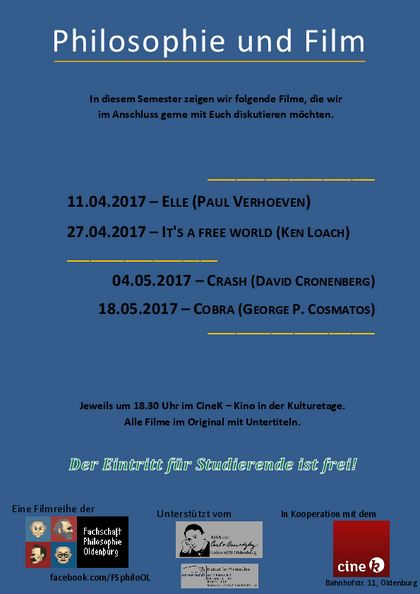
Reactions to the lecture "Ideology in black and white. On the critique of anti-racism"
Fake AfD honorary memberships were apparently sent to us as a Student council and to private individuals. Like the organisers of the series "On the Critique of Anti-Semitism", we show solidarity with those personally affected.
More information: "Zur Kritik des Antisemitismus" homepage and on Facebook.
"If we eliminate you, we lose nothing." On the social theory of Khmer Rouge communism - lecture by Jan Rickermann
04 April 2017, 6.15 pm Lecture in A14, Lecture Hall 3:
During the Khmer Rouge's tyranny, which lasted from 1975 to 1979, political murder and the starvation of large parts of the population were the order of the day.
While some interpreted the rule of the Khmer Rouge as a fatal consequence of any communist perspective of liberation, parts of the European left, who already longed for liberation from the alienated Western civilisation with images of the Chinese Cultural Revolution, enjoyed a movement that declared war on individualism and any sign of 'Western decadence'.
The lecture will take a look at the constitutional conditions of the movement that became a state and its ideology, and show that the Khmer Rouge was not concerned with a liberated society in which "the free development of each is the condition for the free development of all" (Marx), but rather that blind collectivisation was set as the counter-principle to imperialism, which was located on all sides.
The concept of 'national capitalism' committed to autarky, as already presented by Khieu Samphan in his dissertation, served here as the impetus for a catch-up industrialisation and regressive crisis solution that attempted to position supposedly productive labour against 'usury' and 'unproductive groups'. The urban population and, above all, the minorities living in Cambodia, who fell victim to the Khmer Rouge, were the first to experience first-hand what this meant.
Philosophy & Film
As in every winter semester, the philosophy film series is back at Cine k, Bahnhofsstraße 11. As usual, we’ll be watching a film that is philosophically relevant in the broadest sense and discussing it afterwards.
Unlike in previous years, this year’s sessions will take place on Tuesdays at 6.30 pm. We’ll also be starting in the third week of lectures and will be showing three more films at the start of the lecture-free period in February.
You can find further information in the ‘Philosophy & Film’ course (code: 4.03.998).
Films:
1 November: Matt Ross – Captain Fantastic (US 2016)
22 November: Nicolas Winding Refn – Bronson (UK 2008)
29 November: Thomas Vinterberg – Festen/The Celebration (S/D 1998)
13 December Veit Harlan – Opfergang (D 1942/43)
20 December Richard Fleischer – Mandingo (US 1974)
10 January: Mike Nichols – Who’s Afraid of Virginia Woolf? (US 1966)
24 January: Andrei Tarkovsky – Zerkalo/The Mirror (SU 1973/74)
31 January Takeshi Kitano: Takeshis’ (JP 2005)
7 February Jonathan Glazer – Under the Skin (GB/US/CH 2013)
14 February: Alain Resnais – L’Année dernière à Marienbad / Last Year at Marienbad (F/I 1961)
21 February: Marcus Mittermeier – Muxmäuschenstill (D 2004)
All films will be screened in their original language, with subtitles where necessary.
Incidentally, the university cinema ‘Gegenlicht’ takes place on Wednesdays at 8 pm; click here for the programme.
AFTERMIN of the lecture:
"Ideology in black and white. On the critique of anti-racism" by Clemens Nachtmann
NACHHOLTERMIN
The lecture by Clemens Nachtmann "Ideology in Black and White. On the Critique of Antiracism" will be held today , Friday 10 February, at 7 pm s.t. in the BIS room of the University Library.
In view of the day of the week, we would like to ask you all the more to arrive as punctually as possible so that we can start at 7 pm sharp.
Criticism of the lecture "Ideology in black and white. On the critique of anti-racism"
NACHHOLTERMIN
The lecture by Clemens Nachtmann "Ideology in Black and White. On the Critique of Antiracism" will be held today , Friday 10 February, at 7 pm s.t. in the BIS room of the University Library.
In view of the day of the week, we would like to ask you all the more to arrive as punctually as possible so that we can start at 7 pm sharp.
---
The student body Philosophy has invited the author Clemens Nachtmann to give a lecture on the topic "Ideology in Black and White. On the Critique of Antiracism" (Wed, 8 February, 7pm, A14-HS3) in Oldenburg. In the run-up to the lecture, there were already outraged re-registrations (some of which have since been withdrawn), in the course of which the student body was publicly accused of offering "racist demagogues"(Oldenburger Rundschau) space to spread their right-wing slogans and thus placing itself in the vicinity of right-wing populists.
The concept underlying this assessment is precisely the subject of the lecture. The criticism of forms of anti-racism is not right-wing populist, but in the sense of an emancipatory criticism of left-wing self-understandings directed precisely against right-wing ideas - as intended by this lecture. If anti-racism is not understood but becomes a slogan, it tends to degenerate into a mere reflex. Such a form of attitude politics will be criticised in the lecture itself. Nachtmann's criticism is not "right-wing propaganda", which the student body is just as opposed to as the invited author. However, unreflected anti-racism threatens to become a mirror image of racism. From such a position, individuals are then subordinated to cultures and inalienable characteristics are ascribed to them. The taz has now also problematised these developments: www.taz.de/Ueber-Rassismus-reden/!5375695/.
Contrary to the insinuation contained in the accusations that Nachtmann wants to "distribute caresses to the German national soul" (Oldenburger Rundschau) , he is concerned with criticising those who, with the purest smug conscience, preach tolerance for everything (and indeed everything regressive) that the cultural pool has to offer in order to develop a new 'purified' national pride. He thus points out that there are common foundations to certain forms of anti-racism, nationalism and racism. He is not interested in defaming an (imagined) group, but in critically reflecting on a theoretical and political position and thinking through its consequences and pitfalls.
To make sweeping judgements about individual theses in advance, while at the same time placing the author and the organisers in the same league as AfD, PEGIDA and co., not only defames the people concerned, but also makes any form of reasonable debate that we hope for from Nachtmann's lecture impossible.
Of course, the student body does not unconditionally support all of the theses in the announcement text, which should generally be the case in the relationship between the organiser and the speaker. If his theses are not supported in the lecture, this can and must be criticised.
Clemens Nachtmann - Ideology in black and white. On the critique of anti-racism
Fri, 10 Feb. 2017, 7 p.m. s.t. Lecture in the BIS hall - by Clemens Nachtmann:
"Anti-racism, once a hobbyhorse of small left-wing groups, has long since become German raison d'état: moral outrage against alleged racists and solidarity with refugees are part of the good tone of the Berlin Republic. The idea of "racism" on which this attitude is based has absolutely nothing to do with insight into, let alone analysis of, xenophobia: "racism" is rather an ideological buzzword of an anti-racist racket that lacks any reference to reality, that its members carry before them only as proof of their firmness of conviction and respectability and that serves them as a tried and tested means of arbitrarily and freely determining who is to be considered a "racist". "Anti-racism" is the ideology of a refined society that collaborates with political Islam and therefore needs a flexible and above suspicion, i.e. "anti-fascist" declaration of enmity against all those who mark this collaboration by name. Refugees are bearers of a culture that enriches "us"; other cultures, especially Islam, must be respected and honoured. From this perspective, the mass mobilisation of 2015/16, marketed as a "welcome culture", was a mixture of an Islamophile children's birthday party and an anti-racist popular front, which of course was not about refugees, but about the self-presentation of the good Germans and another attempt in the endless effort to re-equip post-Nazi society into a multicultural tribal association. The lecture traces the basic lines of this process, paying particular attention to the social character that is expressed in it and with a special focus on all those capitulators of the intellect who act as euphemists for this communitarian regression and the Islamisation it entails."
FÄLLT AUS - The child of the world and its prophets. Jean-Paul Sartre in Berlin, 1948 - CANCELLED
CANCELLED
Thu, 26 Jan 2016, 20:00 Lecture in A14, Lecture Hall 3 - Magnus Klaue:
Even before the founding of the two German states, Jean-Paul Sartre's existentialism, which shortly afterwards became the progressive guiding philosophy of the West German cultural chic, found its way into young German not only in the form of his theatre plays, but also through Sartre himself. In 1947, the German premiere of Sartre's drama "The Flies" ("Les Mouches") took place in Düsseldorf, and in 1948 Sartre travelled to Berlin for another premiere of the play. The Düsseldorf performance was directed by Gustaf Gründgens, the Berlin performance by Jürgen Fehling. During the "Third Reich", both had been on Goebbels' and Hitler's "Gottbegnadetenliste", a list of the most important Nazi artists, and had been able to continue their careers after the Allied victory.
The drama, which was able to pass the marks at its French premiere under German occupation in Paris in 1943, although according to the reading promoted by Sartre it was an allegory of the Resistance, was received in Düsseldorf in 1947 as an antique parable of the Allied occupation, and in 1948 in view of the bloc confrontation as a criticism of Stalinism, and in its reception history has undergone almost all the political twists and turns that Sartre did. The lecture will show that the reason for this was not an ambiguity testifying to the aesthetic rank of the drama, but on the contrary a constitutive vagueness that is intimately connected with the political conformism of existentialist phraseology. Based on an analysis of the discussion of "The Flies" with Sartre in Berlin in 1948, it will be shown that this vagueness contributed significantly to the neutralisation of the political and experiential contradictions existing between the discussants.
CANCELLED
Adorno's reception of Kant:
A neglected foundation of critical philosophy
17 Jan. 2017, 6.15 pm Lecture in A14, lecture theatre 3 - by Sabine Hollewedde:
The significance of Kantian philosophy for critical theory will be discussed in the lecture. It will be shown that Adorno's engagement with Kant is central to the analysis: the antagonism that pervades bourgeois society is the basis of the antinomies in the bourgeois concept of freedom. Adorno emphasises this in Kant and thus criticises what is commonly claimed and understood as freedom today.
Starting from the critique of idealism, Adorno develops an immanent critique of Kant. In doing so, he emphasises Kant's philosophy against idealism and at the same time points out its idealistic aspects. Using arguments from the philosophy of history and the history of philosophy, Adorno combines classical philosophy with Marx's social theory to show how social antagonisms are represented in the philosophy of German idealism and how idealistic philosophy fails to fulfil its own claim, namely the formulation of a concept of freedom.
Adorno's answer to the question of the "right life", which is traditionally the subject of moral philosophy, is apodictic: "There is no right life in the wrong one." On the futility of private ethics, he states pointedly: It "belongs to morality not to be at home with oneself." It was precisely by leaving antinomies unresolved (and not resolving them idealistically like his successors Fichte and Hegel) that Kant captured the inherently contradictory consciousness of the bourgeois subject. At this point, Adorno follows on from Kant, criticises Kant's attempted solution of dividing the empirical and intelligible worlds and shows that this insoluble antinomy points to the antagonism in society on which it is based.
Accordingly, Adorno's examination of Kant's practical philosophy cannot be described as a "negative moral philosophy" (Schweppenhäuser), which establishes a new 'ought' through negation and is characterised by a "normative dualism". Nor does it contain the demand to bring an "unfinished project of modernity" to an end (Habermas), but rather clearly demonstrates the contradictory nature and ideology of such a 'project'. Adorno, on the other hand, reveals the antinomies of private ethics and shows why moral philosophy fails in bourgeois society. He traces this private ethics back to the antagonistic core structure of bourgeois society through immanent criticism and in conjunction with Marx's theory.
Through the immanent critique of idealism in connection with its reference to social theory, Adorno uses Kant to demonstrate the dialectic in the concepts of reason and freedom and at the same time emphasises the emancipatory aspect of Kant's philosophy in relation to his idealist successors. In doing so, he also criticises Hegel's dialectical resolution of Kant's antinomies. The method of a negative dialectic is thereby outlined.
This can also be taken up in debates on enlightenment and emancipation.
David Schneider and Mario Möller - The People's Party of Common Sense. The AfD and its opponents
15 Dec. 2016, 7 p.m. Lecture in the BIS hall:
The AfD emerged victorious from the 2016 election year. Since the party also entered state parliaments in western Germany, observers have agreed that the notorious protest party is no longer purely an eastern phenomenon. However, this neglects the fact that the share of votes in the East is double that of the West, as the need to conformistically rebel is particularly pronounced there, which incidentally leads to the Left Party losing more and more ground as a de facto people's party in the new Federal States and its voters defecting to the AfD in droves. The AfD's success - not only in the east - is the result of its open rejection of the federal government's immigration policy and the fact that its messages are tailored to the social character of the argumentative politiciser who is increasingly incapable of reasonable understanding and experience.
However, as authoritarian and delusional as the majority of the AfD's programme is, as repulsive as its sympathy for Putin's Russia is, it offers little in the way of a socio-political response to what is likely to plague some of its voters: It can be assumed that there are striking differences within the party between an East German-ethnic wing and the liberal-conservative position, which did not stop the deputy party chairman of the SPD, Ralf Stegner, from formulating the consensus of panicked AfD opponents and labelling the AfD "a party of right-wing populists and right-wing extremists", regardless of all internal party differences. With the declared fight against actual Nazis, who also exist in the AfD, an equally necessary criticism of Islam is prevented by branding its critics as racists and xenophobes with reference to the AfD.
The lecture will focus on both the AfD and its opponents.
Further information is also available on Facebook.
Course catalogue WiSe 16/17
The events calendar for the coming winter semester is now online (and can be viewed without logging into StudIP).
Once again, there are plenty of interesting courses on offer at the Institute of Philosophy. We wish you a lovely holiday and a great winter semester 2016/17.
Sonja Witte - In the Mirror of Innocence: Sexual Morality in Post-Nazism.
Of "child molesters", "fornication", "childlike purity" and other symptoms
27 Oct. 2016, 6.30 p.m. Lecture in A14 0-031:
In 2013 in particular, the question circulated in politics and the media: Have we looked closely enough at the danger posed to children by paedophiles? This 'sharpened eye' is a central element of a currently omnipresent panic of suspicion, as can be shown by the example of journalistic publications on the exposure of paedophiles. According to the thesis, what is condensed in the social image of the 'child molester', among other things, are excessively invasive aspects which, from a psychoanalytical perspective, are considered constitutive of the sexual itself and which represent an 'allergic point' (Adorno). This is the starting point for an examination of various 'allergic points' of sexual morality in (post-)Nazi Germany. It will be seen that the meanings of the links between sexuality and the German 'coming to terms with the past' are constantly changing. Against this background, the current concern for the protection of children and the panic about paedophiles proves to be not only a symptom of the current negotiated moral ideal of innocent sexuality, but also how this is interwoven with the history of German 'coming to terms with the past'.
Call for Papers:
150 Years of "Das Kapital" - Capital in Critique
The Forum for Marx Research Oldenburg is organising a conference on 24 and 25 March 2017 to mark the publication of the first volume of Karl Marx's Capital 150 years ago.
Applications for the call for papers can be submitted until 30 September 2016.
Open letter: No cancellation of the Salzborn professorship!
FSR of the University of Göttingen demands an end to the marginalisation of the social sciences
You can find the letter and further information on the website of the Student council of the School of Social Sciences at the University of Göttingen.
Campus radio open air festival on 26 July
The Campus Radio Open Air Festival is taking place for the first time this year.
Confirmed bands are:
- Linc van Johnson & the Dusters (Folk'n Roll from Oldenburg)
- Tr!iad (sound art from Hamburg)
- Lighthouse Down (college rock from Oldenburg)
- Jan Hiller & Thomas Bisitz (performance & live electronics from OUT in Oldenburg)
- Mother & Son (acoustic rock from Oldenburg)
The event starts on 26 July at 5 pm on the meadow between the A7 and A10 motorways, Haarentor campus. End: 10 pm.
An organic food truck from Bremen will be offering pasta, beer, coffee and cake.
18 June 2016, Workshop:
With Gerhard Scheit: On the connection between linguistic and ideological criticism: Adorno's "Jargon of Actuality"
Please register at .
The workshop will involve a reading of Theodor W. Adorno’s *Jargon der Eigentlichkeit*. Copies of this work may be made available on request.
Dr. phil. Gerhard Scheit lives in Vienna as a freelance writer. He has published works on Critical Theory and written on anti-Semitism, criticism of the state and questions of aesthetics; Scheit is co-editor of the Jean Améry Collected Works (2002–2008) and the journal *sans phrase* (since 2012). His books include, amongst others: *The Hidden State, Living Money. On the Dramaturgy of Anti-Semitism (1999, 2003); ‘The Jargon of Democracy. On the New Behemoth’ (2006); ‘The Delusion of World Sovereignty’ (2009); ‘Crossroads of Modernity. Gustav Mahler, Theodor W. Adorno, Viennese Traditions’ (2010) (co-author: W. Svoboda); ‘The Tormented Body: A Critique of Society after Adorno’ (2011); ‘A Critique of Political Engagement’ (2016).
>>Three Colours<< - Polish Art and European Freedom - Series of Events
This coming Sunday, 17 January, the first of three Sunday matinees that the Karl Jaspers Society is organising in the spring together with the German-Polish Society and Cine k will take place from 11:00 am.
In the series "Polish Art and European Freedom" you are first invited to the Cine k, Bahnhofstraße 11, for a short breakfast. At 11:30 am, after a short introduction, the film will start in German. This will be followed by a discussion led by philosopher Marek Zmiejwski and Oldenburg professor Matthias Bormuth.
The world-famous "Three Colours" trilogy was created by Polish director Krzysztof Kieślowski in the last years of his life. It takes up the colours of the French national flag, the tricolour, and is dedicated to the ideas of freedom ("Blue", 1993), equality ("White", 1993) and fraternity ("Red", 1994) associated with them.
In the first part, "Blue", Kieślowski offers a drastic and consistent interpretation of the concept of freedom in the form of the protagonist, played masterfully by Juliette Binoche. For this role, she received the award for Best Actress in a Leading Role at the Venice Film Festival. The film was also awarded the Golden Lion and Best Cinematography.
The other two parts of the trilogy will be presented on 21 February and 24 April in Sunday matinées, each starting at 11:00 a.m. with the option of a small French breakfast.
Admission (as usual at Cine k) is €8.00 and €6.50 reduced. The reduced price also applies to members of the participating organisations.
Further details on the films and the series of events, which will conclude with a musical evening on Polish poetry in the Karl Jaspers House, can be found in the attached flyer and on the Cine k and Karl Jaspers Gesellschaft websites.
forschen@studium - Oldenburg Conference - Call for Papers until 06 March 2016
Two conferences entitled forschen@studium will take place at the University of Oldenburg from 8 to 10 June 2016:
From 8 to 9 June 2016, students from all disciplines will have the opportunity to present their research findings and discuss them with interested students and lecturers at the first nationwide and interdisciplinary conference for student research.
You can submit abstracts until 6 March.
Philosophy & Film
Hello everyone,
As in every winter semester, the ‘Philosophical Cinema’ series is back at Cine k. As usual, we’ll be watching a film that’s philosophically relevant in the broadest sense and discussing it afterwards.
Unlike in previous years, this year’s sessions will take place on Wednesdays (rather than Thursdays) at 6.30 pm. We’ll also be starting in the third week of lectures, on a Tuesday. From the fourth week onwards, a film will be shown every Wednesday.
You can find further information in the course “Philosophy & Film” (code: 4.03.905).
Admission is free (as before) for all students at the University of Oldenburg.
Best regards,
Philosophy Student Council
Journal for Critical Social Theory and Philosophy - new issue
Dear fellow students,
The new (fourth) issue of the 'Zeitschrift für kritische Sozialtheorie und Philosophie' has just been published. It can be obtained electronically and free of charge via the university library (directly from the university network or via your personal access data).
It can be found in print (but cannot be borrowed) in the central university library under the shelfmark Z phi 868 j ZB 4578.
Collection of texts Rosa Luxemburg Initiative Bremen/ associazione delle talpe
Dear all,
the Rosa Luxemburg Initiative Bremen and the associazione delle talpe have published the third collection of texts on their lecture events of recent years:
www.rote-ruhr-uni.com/cms/Maulwurfsarbeit-III.html
Third issue of the 'Journal for Critical Social Theory and Philosophy'
Dear fellow students,
The new (third) issue of the 'Zeitschrift für kritische Sozialtheorie und Philosophie' has just been published. It is available electronically and free of charge via this link. Just click on the line ' To the full texts: DFG-funded Alliance Licence : Vol. 1 (2014) -', then you can access the texts on the following page with your Unilogin.
Printed copies (but not available for loan) can be found in the central university library under the shelfmark Z phi 868 j ZB 4578.
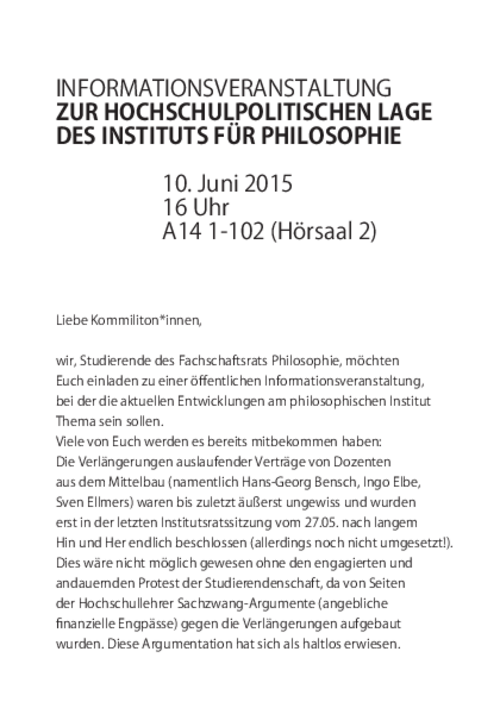

Hans-Georg Bensch must be extended!
Dear people,
Many of you will know Hans-Georg Bensch as a lecturer. Now his contract expires on 30 September this year and it does not seem very likely that this contract will be extended. This would mean that we would all lose an outstanding lecturer.
To prevent this from happening, we would like to ask you all to sign the following petition to show that you also support him, his content and his way of teaching. The list of signatures is available in our student council room (M 0-035), it will be passed around in seminars and of course you can also print it out and send it to us personally or by post. The Philosophy student body mailbox is located together with all other Philosophy mailboxes on the first floor of the sports building, just a few metres behind some offices and the Secretariat for Philosophy.
Support needed in the Faculty Council
Dear students of School IV,
Next Wednesday, 25 February, will be the last meeting of the Faculty Council in its old composition. As student representatives, we can look back on a very stressful and conflict-ridden time in the Faculty Council, in which many of our concerns, which we endeavoured to push through, were blocked by the barely manageable professorial majority in the Council. Particularly when we opened up fundamental democratic policy discussions, we realised that the other members of the Faculty Council had little understanding or willingness to cooperate. For example, we have criticised the fact that in the past three semesters, the formal means of the "proposal to break off the debate" has been demonstrably (!) misused to prevent the minority represented by us or committee guests from articulating their opinions and convictions on important issues. Despite our criticism, little has changed in this respect; since the discussion of this problem, the "cancellation of the debate" has again been used to prevent discussion after an infamous insult was hurled at us by two university lecturers.
We noticed that the many controversial debates were subsequently concealed by a very one-sided presentation in the minutes of the meeting. As we again criticised this, the last few meetings resulted in prolonged discussions of the minutes. In our admission, the Faculty Council confirms our poor image when the consequence, once again enforced by a professorial majority, is the decision to only have minutes of results taken in future. We have lodged a suspensive group veto against this decision, which means that the decision will have to go through the Faculty Council again next Wednesday.
We would like to take this opportunity to call on all students and in particular the Student Councils of the subjects in our School to come to the Faculty Council next Wednesday and take part in the discussion. As representatives, we will endeavour to ensure that all committee guests are given the floor. Irrespective of the respective political colour and despite all conflicts of interest, it should be a concern of all of us that decision-making processes as well as the associated controversies and differences of opinion are documented in favour of consistent committee work in order to help the substantive ambitions of minorities to have their say. Recording political decision-making processes in university committees only according to the result and thus formally smoothing them out is a deeply undemocratic approach and should be prevented in the interests of us all.
For this reason, we ask you to come to the Faculty Council in room A04 0-022 on Wednesday at 14.00 and support us in this endeavour.
Thank you in advance for your support!
With best regards,
Raban Witt & Steffen Stolzenberger
WAHLAUFRUF!
Dear all,
We would like to ask you to take part in the election this Wednesday and Thursday (9.30 am - 2.30 pm in the BIS hall)!
Students from our and other student bodies are running for the Faculty Council of Fak. IV under the name "KRITISCHE STUDIERENDENGRUPPE". Who we are and what we want...
It is equally important to vote for the student parliament (STUPA), because it is important to prevent the AStA and various departments from being voted out! You can do this by voting for the 'GUM plus Social' (GPS) list!

Congress 'Critique and Reconciliation 2015'
- Lecture programme
Unfortunately, Lou Kordts' lecture on Saturday at 10.30 am has to be cancelled. Everything else will remain as usual, including the good morning coffee from 10am.

Questions of meaning in the cinema - a taz article from 04. 12. 2014

This extract: "For the future, things could be a little less academic: The question of the 'ghost in the machine', for example, could also be dealt with in a very appealing way using a popcorn genre film such as 'Transformers'".
Killing Gandhi: The Question of Indian Guilt - Mon 15 Dec. 7 pm at Karl Jaspers Haus
"Dear members and friends of the Karl Jaspers Society,
I would like to invite you today to a second lecture, which will take place at the beginning of next week, on 15 December at 7 p.m. in the Karl Jaspers House, Unter den Eichen 22. In co-operation with us, the Erich Auerbach Archive is organising an evening with the literary scholar and poet Prof. Makarand Paranjape, who teaches in New Delhi. He will speak in English on the topic:
Killing Gandhi: The Question of Indian Guilt
Professor Paranjape, who has just been appointed as the first visiting scholar to the Erich Auerbach Visiting Chair for Global Literary Studies at the University of Tübingen, will explore the question of the extent to which the assassination attempt on the Indian freedom fighter Mahatma Gandhi in 1948 can be explained and interpreted in the context of Karl Jaspers' work The Question of Indian Guilt (1946). The lecture is aimed not only at students of philosophy, but above all at a broad audience who would like to learn more about the forms of civil disobedience practised by Gandhi. The Indian independence movement led by Gandhi contributed to the end of British colonial rule in 1947. Further information on the person and the lecture can be found in the abstract below.
We look forward to seeing you there and wish you all the best,
Prof Dr Matthias Bormuth Prof Dr Martin Vialon
Abstract:
In 1945, soon after the defeat of Germany and the end of World War II, Karl Jaspers delivered a series of profound and moving lectures on 'The Question of German Guilt'. These were published in German as Die Schuldfrage in 1946, a few months before Gandhi's assassination, and in a widely discussed English translation in 1948 soon after. Jaspers begins by acknowledging that 'The temptation to evade this question is obvious; we live in distress - large parts of our population are in so great, such acute distress that they seem to have become insensitive to such discussions' (Jaspers 1946; 2000: 21). Perhaps, a vast number of Indians also felt a similar sense of distress and apathy after the traumas, bloodletting, and displacement of the Partition. Under the circumstances, it would not be difficult to understand the evasion, if not repression, of their guilt not only in the enormous carnage and violence of Partition but also in the murder of the Mahatma which was somehow so intrinsically linked to this subcontinental tragedy. Though the circumstances were so different, we may have much to learn from Jasper's exploration of German guilt over the atrocities against the Jews and the great bloodbath of the war. This talk, based on the recently published The Death and Afterlife of Mahatma Gandhi (London: Routledge, 2014), is an attempt to tease out the implications of Jasper's work in the context of the aftermath of India's Partition and Gandhi's assassination."
Kick-off for the working group for plural economics in Oldenburg
sounds quite interesting:
"Dear people,
We are looking for fellow campaigners to found a working group for plural economics in Oldenburg! For some time now, there has been resistance against the one-sidedness of Economics Education. Through a group in Oldenburg, we want to support this process and educate ourselves together.
Our (still completely open) idea is to discuss the diversity of economic theories in the working group for plural economics. We then want to use these theories to discuss the social and economic problems of our time (refugee movements, environmental destruction, financial market and euro crisis). We want to create a space to critically scrutinise the often taught mainstream economics of economics and discuss alternative approaches that could do justice to the complexity of social issues and illuminate these issues from different perspectives.
In the kick-off event, we would like to discuss the idea of the working group with you and consider which topics we want to work on and how (e.g. panel discussion, reading circles, etc.).
We will meet on Thursday, 11 December at 6 pm at the University of Oldenburg in room A04 4-407.
We look forward to seeing you!"
KONGRESS - Extension of the Call for Papers
Dear all,
Today, one day before the end of our CfP, we can report that we
are extremely satisfied with both the quantity and quality of the abstracts submitted so far.
Nevertheless, we have decided to extend the deadline for submissions up to and including Wednesday 19 November 2014 for last-minute producers
.
We wish you a productive weekend and look forward to receiving further suggestions for topics.
You can find the call for papers and other important information on the congress homepage.
There will also be an event for Oldenburg students who only want to attend as listeners.
Best regards
KuV organising committee
Start of studies and semester
Dear new and returning students,
A warm welcome (back) to the university for the 2014/15 winter semester! We wish you a wonderful and successful semester and a good start to your studies. You can find helpful information and links to get you started HERE.
We’re also organising an event as the student body.
The language of hostility towards Jews in the 21st century.
Reading and discussion at the PFL
Dear all,
I would like to cordially invite you to the reading from the book
"Die Sprache der Judenfeindschaft im 21. Jahrhundert" with
Mathias Jakob Becker from the Technical University of Berlin
on Tuesday, 14 October at 7.30 pm at the PFL Cultural Centre
.
Conference "Subject and Violence in Law" 11-13 September in the BIS Hall
From 11 to 13 September, the conference ‘Subject and Violence in Law’ will take place in the BIS Hall, and we would like to draw your attention to it here.
You can find the programme leaflet and further information via the following link:
uol.de/philosophie/forschung/aktuelle-veranstaltungen/
This year's tutor training
"Dear Student Council members,
I would like to inform you that there will once again be an interdisciplinary tutor training programme this year (29 September – 10 October 2014), which is being coordinated by the ZSB and can now be viewed online at: uol.de/tutorenschulung
Once again, many members of staff and PhD students at the university have agreed to contribute to the tutor training programme, enabling us to put together a wide-ranging programme.
Registration for the training course opens on 1 September via Stud.IP. A programme leaflet is available on request. As in the previous year, all subject tutors are welcome to attend the training course. Attendance is compulsory for first-time tutors.
[...]
Please directany enquiries to the coordinator, Margrit Ladenthin (ZSB), Tel.: -2466, email:
Kind regards, Margrit Ladenthin"
18 to 20 July - Student council trip to Iffens
Dear students,
The Philosophy Student Body is once again inviting you to the Iffens Environmental Centre for the Philosophy Student Body weekend. There, you can enjoy a relaxing weekend with opportunities to read, discuss, sing, go for walks, play games and simply enjoy yourselves. The cost of the weekend is €17; bed linen can be hired for an additional €3.50.
The trip is scheduled to take place from 18 July to 20 July. If you’re interested, please send an email to FSPhilo@uol.de or add your name to the non-binding registration list in the Philosophy Student Council room, M0-035.
Warm regards, your Student Council team
The Business and Law Student Council supports the Autonomous Women's Refuge Oldeburg e.V.
Dear fellow students,
As you may have already noticed from the numerous posters, the Student Council for Economics and Law is organising a charity event "Hinschauen statt Wegschauen" (Look instead of looking away) on 9 July 2014 from 4 to 10 pm for the benefit of the Autonomous Women's Shelter Oldenburg e. V.. We will be organising a barbecue near the barbecue area at A11, to which students from all disciplines are cordially invited. As a supporting programme, we are offering table football and a bull riding station. We will also be broadcasting the World Cup match. All proceeds will go to the above-mentioned beneficiary, so that this event corresponds to our understanding of social responsibility.
We would be very pleased if you, as representatives of the student bodies, would visit our event, publicise it via the mailing lists available to you and thus support us in our campaign. You can find more information on Facebook at www.facebook.com/events/488681744611928/?ref_dashboard_filter=upcoming.
Under this link you will also find information about lecturers who will be climbing on the bull or challenging themselves at the foosball table.
We look forward to welcoming many faces and spending a great day.
Thank you in advance for your support, see you on Wednesday and best regards,
Benni and Jannis
(FSR WiRe)
AGs for the round table
With considerable delay, we are now reporting on the minutes of the three meetings of the working group that have now taken place on the initiative of the Study Commission in preparation for a third round table.
The first of the three meetings took place on 11 December last year. There are two sets of minutes, one by Sören Koselitz and one, with additions, by Matthias Huck.
The working group met for a second time on 8 January of the current year. The points from the first meeting that were considered interesting were taken up and discussed, as can be seen here. As requested by the majority, on this day, as well as at the third meeting, opinion polls were drawn up on the topics discussed, which were to form a conclusion for the working group. However, these opinions only represent the personal views of the participants and have no impact on the competences of the Round Table, which must remain the determining body in the discussion about the Senate resolutions of 2009.
At the third meeting of the working group, on 29 January, discussions continued on the points considered to be of interest. This is initially reflected in the following minutes. These minutes were anonymously corrected in the following version and subsequently commented on by Jaro Ehlers.
The next round table will now take place on 07 May.
Journal for Critical Social Theory and Philosophy
Incidentally,here is a new, certainly not entirely uninteresting journal, largely co-edited by two Oldenburg philosophers, Sven Ellmers and Ingo Elbe.
Conference in Freiburg on "Violence - History - Society" on 30 May and 1 June
"Hello dear student bodies,
We are a group of students from the Bachelor's and
Master's degree programmes in History and German Studies at the University of
Freiburg and are organising an interdisciplinary
student conference on the topic of "Violence - History -
Society", which will take place from 30 May to 1 June 2014 at
Freiburg.
For your information, we have attached the call for papers as well as
and the draft for our poster. All important
information can also be found on our homepage:
gggtagung.wordpress.com. We would be grateful if you could inform
students about our plans (via Facebook etc.)
and thank you in advance for your help.
If you have any questions, please do not hesitate to contact us at this e-mail address
.
Kind regards,
The conference planners"
23.1.2014 - Election result
Information fresh from the Elections Office:
The "Critical Student Group" has received more than 3/4 of all Faculty IV votes and thus receives both seats on the Faculty Council!
We are happy and thank you for your support!
More details at the Elections Office.

January 2014 - ELECTION: Faculty Council and University Senate - UPDATE
Dear student body, dear students of School IV, on 22 and 23 January, the election of student representatives to the Faculty Council and the University Senate will take place on the Uhlhornsweg campus (in the library hall, don't forget your ID) from 9.30 am to 2.30 pm. Please take part in the election! David Barteczko and Jaro Ehlers are among the candidates for the University Senate on the wide-ranging FuWi list from the Philosophy student body. We would also like your votes for them. (Incidentally, List 2 does not want to be elected - it has only put itself forward on the basis of special voting rights). Steffen Stolzenberger, Raben Witt, Jaro Ehlers, Jannik Kordts and Matthias Huck (in this order) are running for the Faculty Council under the name "Critical Student Group". Please take the small step of voting next week, because the "Critical Student Group" urgently needs your votes! And if you read something like this in the Asta calendar, even more so.
You can find the official information on the Elections Office website.
January 2014 - ELECTION: Faculty Council and University Senate
Dear student body, dear students of School IV,
On 22 and 23 January, the election of student representatives to the Faculty Council and the University Senate will take place on the Uhlhornsweg campus from 9.30 am to 2.30 pm.
Please take part in the election!
Important: You can take part in the election even if only your second subject is assigned to School IV, as long as you fill out a corresponding assignment form by 15 January (download HERE).
(This "assignment" only applies to the elections and has no further consequences!)
You can post the completed form in the Philosophy student body mailbox or slip it under the door of the student body room (M-0-035, next to stage 2 of the Unikum). We will send all documents to the Elections Office.
Please take this step, because the "Critical Student Group" urgently needs your votes!
And if you read something like this in the Asta calendar, even more so.
You can find the official information on the Elections Office website.
14.11.2013 - Minutes of the 2nd round table on 16 October and next steps
The minutes of the 2nd Round Table of School IV have been finalised and can be downloaded HERE.
At yesterday's meeting of the Study Commission, it was decided that a working group - consisting of three student representatives and one MTV member, one Mittelbauler member and one professor per Institute - would develop targeted proposals for measures to improve teaching. These proposals will then be presented and discussed at a third round table. The Dean of Studies announced that he would be inviting students to this working group in the near future.
13.11.2013 - GENERAL ASSEMBLY OF PHILOSOPHY STUDENTS
INVITATION TO THE GENERAL ASSEMBLY OF PHILOSOPHY STUDENTS
The (extraordinary) general assembly will take place on 13 November 2013 from 4 pm in room A01-0-005.
Every enrolled student of Philosophy/Values&Norms is invited.
11/11/2013 - NWZ reports on events at the University of Oldenburg, the Institute of Philosophy and School IV

17.10.2013 - "Philosophy & Film"
Dear Student Body,
We are delighted to announce that, in co-operation with cine-k, we will be offering the seminar ‘Philosophy and Film’ in the 2013/2014 winter semester. The seminar offers students from all departments the opportunity to watch films that mostly convey socially critical or psychoanalytical content, followed by a group discussion to reflect on them philosophically.
The seminar is an initiative of the student body and is funded by student grants. This means that admission is free for students. No credit points (KP) can be earned through the seminar. Rather, the aim is to provide students with an interdisciplinary and culturally engaging space for reflection, beyond the usual pursuit of credit points.
The seminar will take place every Thursday from 6 pm to 10 pm at cine-k. On certain dates, to be announced, the discussion following the film will take place at Marvin’s.
There will be 14 sessions, of which 10 films have already been confirmed (you can view the list of films already selected HERE ). For the remaining four sessions, films suggested by students will be selected. Please us if you would like to suggest a film for the seminar.
We look forward to seeing you!
Yours,
Student Body
16.10.2013 - 2nd Round Table of School 4
Dear students of School 4,
You may have already noticed in your emails or in stud.ip the invitation from the Dean's Office to the "2nd Round Table" next Wednesday 16 October 2013 at 4 pm in the BIS hall.
We would like to encourage you to take part in the discussion about the possible far-reaching changes to our study conditions.
Under discussion are significant changes to the Bachelor's examination regulations [BPO] (e.g. attendance control, several examinations per module, etc.). The 2nd Round Table gives us all a platform to express our opinion(s) on this and to work on constructive improvements to prevent the current study conditions from becoming even more restrictive and school-based.
In order to be able to take a closer look at the background to this process and the round table event, we are providing you with some information material here.
- Invitation text for the current round table (interesting: for comparison: the invitation text of the 1st round table)
- Minutes of the 1st round table from 19 June 2013
- Position paper of thedeans of studies and as a possible answer to this the:
- Draft position paper by students (many thanks to Elisabeth Franzmann from the "Study Structure Project").
We look forward to a lively, goal-orientated discussion and your numerous attendance at this rare opportunity away from the daily routine of small, inner circles in the sparsely populated student committees of the university. See you on Wednesday!
01.10.13 - Post from Prof Dr Ruschig
Dear student body,
Yesterday we received a message that we regretted to hear and would like to share with you here. We would like to thank Mr Ruschig for his commitment as Institute Director and as a dedicated professor in research and teaching. You can read his email to the members of the student body below:
____________________________________________________________
Dear members of the Philosophy student body,
On Friday I received the news that the Lüneburg Higher Administrative Court has not upheld my appeal against the Presidential Board's rejection of my proposal to postpone my retirement. Consequently, as of today (1 October 2013) I am no longer a civil servant university lecturer at the Institute.
First and foremost, I would like to thank you all very much for your wonderful support!
I would have liked to continue working at the Carl von Ossietzky University because I feel committed to the students and the development of free study and because I feel committed to political philosophy. I would also have liked to continue in the office of Institute Director, to which I was elected so often, because I know that the free spirit of study does not simply exist and because the equal participation of students, academic staff and MTV employees in all matters of the Institute has to be fought for again and again, sometimes against considerable resistance on the professors' bench (and in the staff offices).In contrast to the students and the academic staff, the professors at the Institute (I learnt that there are professors and professors, namely those who have a permanent position ("chair") and those who do not; in the following, this refers to the former) did not support me; moreover, there are 'colleagues' professors in the Institute and in the School (the former department, see The former department, see previous bracket) who, in co-operation with the staff units and the President, invented the 'constraints' that prevented me from continuing to work and thus actively and also (supposedly) passively pushed for my forced retirement - you have to call it forced retirement if, on the one hand, there is my willingness to work longer of my own free will and, on the other hand, there is a legal obligation to do so, on the one hand, and on the other, a legal situation that enables and even favours such continued work, together with the flexibilisation of the age limit being pushed forward by the state, which is intended to relieve budgets of the growing pension payments and is presented as a financial policy necessity. Everything spoke in favour of extending my contract: there is a need for professorial teaching in the field of practical philosophy; Prof. Kreuzer is in a research semester; student numbers are growing; the degree programme is at 140% capacity; the seminars are overcrowded. What's more, it would have been easy to finance the extension of the contract. The fact that these 'colleague' professors enforced my retirement against my will and against the will of an overwhelming majority at the Institute, even though there was a need and even though the extension could have been financed, indicates that the 'practical constraints' cited in court, which allegedly prevented me from continuing to work, are pretence and are in fact cited for political reasons, which these gentlemen represent and yet do not publicly acknowledge.The 'colleague' professors in question will celebrate my forced retirement as a success of their political bullying and as the first step towards expelling the free spirit from the Institute. The Lüneburg Higher Administrative Court has not put a stop to this step. However, this does not mean that standing up for free study is wrong. This advocacy does not depend on one person and not on the fact that a person is no longer a civil servant university lecturer.
Thank you once again for your support. What this means is not devalued by the fact that the university authorities, in conjunction with an OVG, have proved to be stronger.
Despite all this!
Ulrich Ruschig
