
Experience reports from the FWJ in the Physics Didactics and Science Communication Working Group
Experience reports from the FWJ in the Physics Didactics and Science Communication Working Group
Here, participants in the Voluntary Scientific Year (FWJ) report on their experiences in the Didactics of Physics and Science Communication working group at the University of Oldenburg.
Katja Seidel, FWJ 2021/2022
Where are you working and what are your tasks in the FWJ?
Together with my FWJ colleague Anna, I'm spending six months as a volunteer in the Oldenburg physics didactics group.
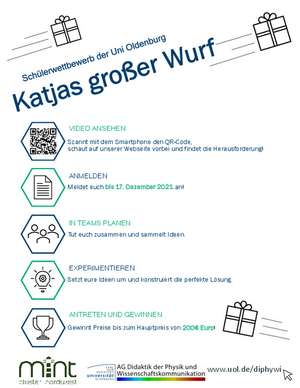
In the beginning, we were able to accompany members of the working group separately during the semester break to activities outside the campus, e.g. to a press conference or later to a school visit. We were also given our own major project from the very beginning, which would accompany us for the rest of our FWJ. Since then, our task has been to organise a regional competition for pupils aged between 10 and 14. In the first few months, we have therefore been working on the basic concept of the assignment and are now working on a corona-compliant alternative to a competition event in presence. On the side you can see the flyer that was part of our tender :)
Despite the close cooperation regarding the competition, Anna and I are otherwise going our separate ways at the university and have each been attending two different courses of the AG since the start of the lecture period.
For example, the Master's students have a longer stay in the schools ahead of them, for which they are prepared in an accompanying seminar. After the weekly lesson on the learning process-orientated design of physics lessons, this gave me the opportunity to prepare and present a joint lesson plan with a student.
Instead, Anna attends the lecture "Learning and teaching physics", which she and the students in the first semester actively help to shape through their presentations. She also works with the tutors of the "Experimental internship with professional relevance" on its preparation and follow-up, as well as on the development of new experiments to expand the script. Thanks to her increasing insight into the subject matter, she can accompany the students during the experiments on site and draw their attention to the learning processes intended by the experiment.
What does your day-to-day work look like?
Although we have been given amazing freedom and, unlike the students, are allowed to enter the university around the clock, we are only bound by individual deadlines, including lectures, seminars, internships and the working group meetings (the "MoNa"). I can often work on some of my tasks in my home office and switch to the office on campus at any time during the day.
As there is no one to keep a close eye on you, it is all the more important to learn how to work independently. However, as the members of the working group are always there to support you and think through ideas and approaches, you are carefully introduced to this independence, which is commonplace at university.
What difficulties have you encountered?
With the idea of creating a student competition from scratch, we were thrown in at the deep end at the beginning. Despite this - or perhaps because of it - the project was able to develop week by week and once the competition was publicised in Oldenburg and the surrounding area, the response from the students was incredible.
As an employee of the university, you can also complete a guest study programme free of charge alongside the FWJ, which is why I take part in a different module and an additional seminar. It is therefore difficult to organise yourself and your work well. This gives you the chance to prepare for a proper degree programme without stress and to learn how best to deal with the pressure of studying.
What have you already learnt during the FWJ?
On the one hand, I have learnt new technical skills that will certainly be useful to me during my studies. For example, the knowledge about the basics of "research-based learning", some methods or the design and comprehensibility of learning materials (from the accompanying seminar and the lecture "Modern physics and its didactic implementation", which I also attended as part of the FWJ) can be helpful later on if you are thinking of giving some tutoring to pupils alongside your studies.
On the other hand, through contact with students and staff, you expand your personal skills. Through the close collaboration with Anna and her view and criticism of my work, I would say that I have become much more of a team player. I was also constantly encouraged to leave my own comfort zone and face my inhibitions.
There are also countless other opportunities at the university to pursue your interests. Be it an English course, a guest student programme or university sports courses ... there is a wide range of possibilities.
In addition, all FWJ students attend workshops on topics such as time and self-management or academic work, reading and writing, where they can also make new friends with other volunteers.
What surprised you positively?
Since the university is known to have a hierarchical structure, as an FWJ volunteer you are bound to be at the bottom and sooner or later get lost in the jungle of the university's complex everyday life?
Not at all!
Because the Oldenburg physics didactics department works in a very pleasant atmosphere and currently consists of a handful of both smart and caring and nice people. As a result, you are quickly accepted into the group and are always helped with useful answers to all kinds of questions about tasks in the FWJ and your studies.
What interests make physics didactics the right place for me?
It seems to be an open secret that you can use a voluntary service to bridge the gap if you are still undecided and want to gain experience elsewhere. At the university in Oldenburg, you get the almost unique opportunity to experience a scientifically orientated voluntary service at a university. If you would like to orientate yourself in a scientific direction, you will certainly be in good hands in physics didactics. You don't have to be studying physics or aiming to become a teacher, and you don't need to be "well informed" about everything right from the start. I was told at the beginning that they are open to a wide variety of reasons for starting an FWJ in physics didactics. This means that if you are looking for a change, for example in your musical career, you can also find something there.
Ultimately, of course, the knowledge you have gained in physics lessons at school will still help you to keep up with the events.
What advice would you like to give future volunteers?
I can't emphasise enough at this point that during the FWJ you will grow with a wide variety of demands and people. That's why I hope you develop the courage to approach your fellow human beings and strike up a conversation. When we welcomed the first-year physics students into the lecture theatre, it almost seemed to me as if everyone already knew their way around and was quite sure of themselves. That's why I hope that this daunting appearance won't deceive you for too long and that you will gradually make contact with many lovely and remarkable people! :)
Subsequent note on the report: Click here for the report on the student competition that Katja organised and ran together with Anna.