
Experience reports from the FWJ at the University Clinic for Paediatrics and Adolescent Medicine


Experience reports from the FWJ at the University Clinic for Paediatrics and Adolescent Medicine
Here, participants in the Voluntary Scientific Year (FWJ) report on their experiences at the University Clinic for Paediatrics and Adolescent Medicine at the University of Oldenburg.
Mila Hoffmann, FWJ 2025/2026
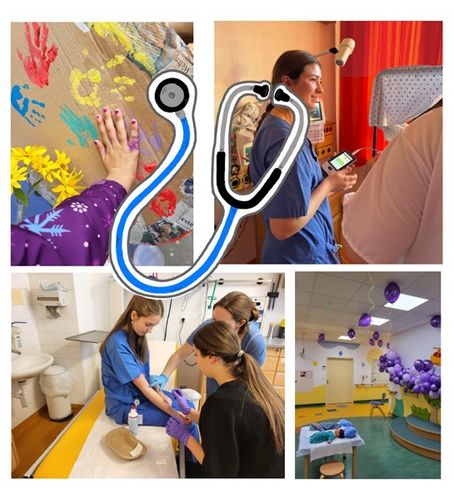
My FWJ at the paediatric clinic in three words:
- exciting
- varied
- challenging
In secondary school, I decided that I wanted to study medicine. A friend of mine told me about the opportunity to do a Voluntary Scientific Year, which she had completed before starting her medical studies and which was also recognised as a positive experience. This proved to be a good opportunity for me to gain confidence in my career aspirations and to learn as much as possible about medicine.
My place is in the paediatric clinic at the hospital. Here I can work on different wards, in the operating theatre or in the laboratory. The nice thing here is the variety and the opportunity to see several areas. We are very much encouraged and supported here to gain different perspectives of the academic appointment and to have a say in the direction we want to take. We are also invited to and taken along to events where many different representatives of interdisciplinary working groups exchange ideas. Here we experience first-hand what it means to work scientifically.
In addition to the theoretical part, we are also allowed to take part in sample generation in the laboratory, for example, or are an integral part of the follow-up consultation for children who were born with a risk factor, such as premature birth. After discharge from hospitalisation, the parents and their children present themselves to us in the office hours, so the children are usually still very young. As FWJ students, we are involved in many different ways, record what happens in the office hours and are also allowed to assist with some of the examinations.
Processes quickly become more independent, and so do you. At the beginning of my FWJ, I didn't just want theoretical knowledge, but also to be able to develop personally and take on responsibility, and I definitely got that here.
This year we were two FWJ students in the paediatric clinic for the first time, which was great because we were able to gain our first experiences together. Nevertheless, it was also important to be given tasks to do on your own, projects that you had to organise yourself and feel responsible for. For me, for example, this was the introduction of a special hearing test in the paediatric clinic, for which I was allowed to sit in at the Protestant hospital and can now carry out the test here. It can be difficult at first, but it feels all the better when you've done it on your own, as you usually don't have enough confidence in yourself. And even if you need help, that's okay. I have also learned here that asking questions is important and that "not knowing" can also be important for optimising processes.
I would also like to emphasise the team at this FWJ position. Everyone here is extremely open and courteous, I feel useful here and that my tasks and wishes are taken seriously and I receive a lot of trust, support and patience, even in a very stressful working day. You also have to learn to deal with that here, but it's realistic for this line of work. It has also taught me how to deal with stressful situations better and how to organise myself faster and better, a skill that can also be very important later in life, especially when studying. With regard to my studies, I have seen and heard many perspectives here, through contact with doctors, nurses, etc., but also with medical students, and was thus able to get a better picture of what to expect. I also have the opportunity to attend lectures or take part in projects for or by students in the hospital, e.g. bedside teaching or the teddy bear hospital.
In conclusion, I can say that this year has also had an incredibly motivating effect on me. I was able to gain insights into the professional field, experience special situations and was given advice that will probably stay with me and support me for a very long time and that I will remember positively, as will the contacts that were made here. I now have the feeling that I am not starting my studies blindly, but with a lot of knowledge and an idea of how I would like to work later, and this has now become much more concrete and, above all, more realistic thanks to the Voluntary Scientific Year.
I would highly recommend this position to anyone who would like to do an FWJ. Between caesarean sections, primary care, exchanges with parents or symposia in Groningen or Mannheim, you also learn a lot about yourself here, get to know your limits or, even more, learn to grow beyond them every day. It is important to ask questions where there are questions, this is the only way to really understand step by step what is behind the processes, everyone makes mistakes and nobody expects you to know everything already. It's all a process, just like scientific work :) It's also important to have fun, and you have more than enough of that here with the team!
Nina Kurandt, FWJ 2021/2022
Hello, my name is Nina and I have been doing a 12-month FWJ at the University Clinic for Paediatrics and Adolescent Medicine since 1 September 2021.
Why did you decide to do a FWJ?
After leaving school, I wasn’t sure whether I wanted to study medicine or biomedicine – lab or hospital, patients or cell cultures. The FWJ at the paediatric clinic is a great way to get to know the processes and the work in a hospital, as well as to gain an insight into what doctors do. Because of the close collaboration with both doctors and paediatric nurses, you get to experience both professions and their day-to-day work, can take a look behind the scenes in the outpatient department and on the ward, and also learn a lot about the organisational processes within the hospital.
What are your areas of responsibility?
I’m based in paediatric pulmonology and allergology, as well as in neonatology. The focus of my work is the ‘PAPI study’ (Paediatric Airway Pathogen Incidence Study), a study into severe infections with RSV and other respiratory viruses in infants and young children. Our respiratory and allergy ward is usually full of patients, many of whom have respiratory tract infections. But it’s not just this one ward that looks after children who are suitable for the study – as part of patient recruitment, I’ve also visited patients on the oncology ward and our paediatric intensive care unit. In the event of a respiratory tract infection that meets the inclusion criteria, I speak to the parents and explain the content and objectives of the PAPI study to them. If they agree to enrol their children in the PAPI study, I work through a questionnaire with the parents covering medical history, previous illnesses and the treatment received for their current infections. I then pseudonymise the children’s data and collect key information using the digital medical record, which is entered into a register. The nasopharyngeal swabs taken from patients in our paediatric A&E department are sent to me from our hospital’s laboratory. I send these to an external laboratory in Freiburg, where a multiplex PCR test is carried out; this often alerts us to the presence of additional viruses and mixed infections in the swabs. Two and four weeks after discharge, I telephone the parents of RSV-positive children to monitor the further course of the illness. My duties as part of the PAPI study also include liaising with the study centre in Hanover and regular data entry. As the RSV season was particularly severe in autumn 2021, I had my hands full with the PAPI study and was able to enrol a large number of patients and observe a wide variety of clinical histories and infection courses.
Furthermore, I am responsible for a COVID-19 data collection project and the anaphylaxis register, collect data from cystic fibrosis patients, and had the opportunity to help with data entry for a study in the neonatal intensive care unit.
In addition, I’ve also had the chance to get to know other wards, outpatient clinics and departments within the paediatric hospital; for example, I help with organisational tasks on the neonatal ward and am allowed to attend courses offered by the university, such as an English course and an anatomy lecture. I’ve already been on two work trips, observed operations in the urology, cardiac surgery and paediatric surgery theatres, and attended online lectures organised by the hospital.
What do you think this year will bring you?
A great deal! As well as the medical knowledge I can acquire, the insight into the hospital’s many departments, wards and outpatient clinics, and the university courses I’m able to attend, this year is helping with my personal development. Time management, personal responsibility, social skills and communication are just some of the skills that are important at work and which you learn and practise every day.
What have you learnt so far during your voluntary service?
An incredible amount! Thanks to my degree course, I’ve already learnt a great deal about clinical pictures, including their symptoms and progression. As part of this, for example, I record the results of blood counts and blood gas analyses, find out about patients’ medical histories and learn about a wide range of viral pathogens, which gives me a very diverse insight into different areas of medicine. I’ve also had the chance to take part in many conferences, such as an online anaphylaxis training course, lectures on allergy-related topics and a two-day online seminar for future doctors, organised by *Die Zeit*. With the university account, you also have access to a wide range of scientific papers covering a diverse range of specialist areas, case studies and clinical presentations. And whenever questions arise whilst reading or regarding patients, the doctors are always happy to explain them to you!
What was your highlight of the FWJ?
I can’t single out just one highlight. The endoscopies, the anatomy lectures, the conferences, the pulmonology, allergology and neuropaediatric office hours, the rounds on the paediatric intensive care unit, and seeing a patient with omphalocele in the neonatal intensive care unit were all fascinating experiences.
However, a daily highlight is my working group and the lovely colleagues at the Children’s Hospital. Everyone is very friendly, and I have colleagues I can turn to at any time, who give me lots of fascinating insights into everyday hospital life and medicine.
Why did you choose to do your voluntary service at the University of Oldenburg of all places?
A Voluntary Academic Year within this framework is only offered in Hanover and Oldenburg. The German Cancer Research Centre offers similar federal voluntary service programmes in the medical field in Heidelberg and Mannheim, but these are not as closely oriented towards research and hospital work. What’s more, the public relations work in Oldenburg was excellent – an informative website with all the key details, fascinating experience reports from volunteers in previous years, and an online information session featuring current FWJ volunteers who talk about their roles and day-to-day work.
What made finding accommodation and moving to Oldenburg incredibly easy was the hospital’s offer of a room in the nurses’ hall of residence, which is right next to the children’s hospital. I live there with people, most of whom are training as nurses at the hospital.
What advice would you give to future volunteers?
Feel free to take a year off after school before you start university, especially if you’re not yet sure which direction you want to go in! Thanks to my work at the paediatric clinic, I’ve become certain about what I want to study, and I’ve already learnt a great deal and, above all, gained insights that have not only helped me make this decision but will also prove valuable and helpful during my degree. The FWJ has enriched my life in so many ways; I’d choose to do it again in a heartbeat.
An interview with Nina Kurandt and her two FWJ practical supervisors, Prof. Dr Axel Heep and Dr Holger Köster, can be found here.