
Experience reports from the FWJ at the Institute of Material Culture
Experience reports from the FWJ at the Institute of Material Culture
Here, participants in the Voluntary Scientific Year (FWJ) report on their experiences at the Institute of Material Culture at the University of Oldenburg.

After leaving school, a voluntary service with a scientific focus seemed to be just the right mix of personal responsibility and a first introduction/insight into university life.
And as it turned out, this is indeed the case:
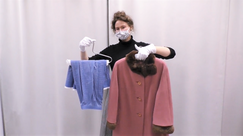
My work so far at the Institute of Material Culture in the "Collection of Everyday Textile Culture" is wide-ranging. I support the lecturers in their teaching and get to take a look behind the scenes. I learnt a lot about writing scripts and editing videos while making instructional videos on how to use the online collection database. I was even allowed to present the work in the collection and the safe handling of objects in front of the camera as the main actor (keyword: preventive conservation). At the end of projects like this, a lot of initiative and communication with everyone involved is required.
This makes it all the more exciting to actively participate in the corresponding courses. Of course, it is up to the volunteers themselves to decide which or how many events they want to take part in. In my case, I mainly orientated myself towards the lecturers at the Institute of Material Culture and opted for five cultural studies courses. (A little tip: this amount was a bit steep for one semester and I would rather recommend two to four).
The seminar "Learning about things" is all about collecting (the use and development of university collections and how they are organised, collecting as a cultural practice, why do we collect at all?) "Approaches to practical research into material culture" attempts to familiarise me with the basic theory and practice of research into material culture. In the related lecture "Material Culture Lunchtime Lecture for Beginners and the Curious", I learn, with a focus on everyday culture, how experiences and actions, relationships and power relations are stored in things - and how, conversely, things shape us, our practices and our society. I'm also taking a little detour into history and embarking on an excursion through the historical foundations and different eras (from antiquity to modern times) with the seminar "History as a science". And last but not least, I embroider happily in the practical course "Introduction to hand embroidery: technique, motifs, tradition", under the talented guidance of textile artist Stephanie Ritterhoff.
But no matter what you decide to do, taking part in LV practises reading/understanding/discussing scientific texts or taking notes during lectures.
In some places, I can also contribute my personal interests during the FWJ. For example, I can show my creative side in the form of small illustrations for guest lecturers or the objects of the month. Both the teaching content of the seminars and the archive with its wonderful items of clothing or historical catalogues provide me with plenty of inspiration.
I also help out in the university's biological collection by sticking on plants for the correct storage of a herbarium. In my opinion, this is an incredibly aesthetic process in which I can lose myself wonderfully. Further assistance is already planned in the collections of the library archive, which are not normally directly accessible.
The measures to contain the Covid19 pandemic are of course changing everyday life at the university somewhat. Wearing a mask, keeping my distance and limited attendance times still allow me to do my voluntary service. And I'm working from home during the lockdown. Online seminars, index cards from the clothing archive that need to be digitised and regular contact with colleagues and the other FWJ volunteers at the university provide me with plenty of varied input and friendly communication.


Andra Haake, FWJ 2019/2020
Why did you decide to do a voluntary academic year?
After my Abitur, I didn’t want to go straight to university; I wanted to do something else first. A voluntary year seemed like a very sensible option for this period, as I still wanted to gain plenty of experience and get a bit closer to deciding on a career path.
What are your areas of responsibility?
I mainly work with the ‘Collection of Everyday Textile Culture’, cataloguing objects (clothing, books, etc.). This involves, amongst other things, digitally recording items in a database and disinfecting new additions to the collection. I also update the website and help promote (teaching) events. I’ve also been given the opportunity to get to know and work with two other university collections: the natural history collection at the Institute of Biology and a collection of poetry albums at the Institute of Educational Sciences.
I spend part of my working hours attending lectures or seminars, which I was allowed to choose at the start of the semester.
Why did you choose to do your voluntary service at the University of Oldenburg of all places?
The University of Oldenburg offers plenty of opportunities to further your education and meet new people. You can attend language courses here, take part in various workshops (e.g. reference management, TYPO3) or join sports classes. What’s more, I’m getting to know university life without any stress and can gradually prepare myself for life as a student.
What do you think this year will bring you?
Lots of new experiences and new knowledge. For one thing, I’m learning what it’s like to be part of a working group over a long period – unlike at school. But the various lectures and workshops are also helping me to understand tasks and processes better and then tackle them independently. Furthermore, this year has helped me with my career guidance, as I’ve had more time to think carefully about which path I’d like to take in the future, whilst also discovering what I enjoy doing. As a little bonus: you get to meet lots of new people and make friends with one or two of them.
What advice would you give to future volunteers?
Take the opportunity to get to know working life and university life without the pressure and stress of studying. It’s well worth it! I’d also take advantage of as many activities as possible, as some of them are subsidised and count towards your working hours. Have fun and enjoy the experience!!!
Further information on the FWJ at the IMK can be found here.