
The animal: discourses in art and media history
Programme
Wednesday 4-6pm, A08 0-001
Tuesday 6-8pm, A08 1-110
25.04.2018, 4-6pm, A08 0-001
Dr Kerstin Brandes:
Introduction
Dr Silke Förschler (Kassel):
Parcelled out and aestheticised: On the traces of animal materials in the early modern period
08 May 2018, 6-8 pm, A08 1-110
Anna-Theresa Kölczer, M.A. (Kassel):
Wie (uns) Einhorn und Eichhorn in die Falle gehen. The animal illustrations for Konrad von Megenberg's "Book of Nature" between faith and life practice in the late Middle Ages
23 May 2018, 4-6 p.m., A08 0-001
Dr des. Isabelle Schürch (Constance):
Of stags, horses and centaurs. An equine history of impressions of the 'New World' (15th - 17th century)
06.06.2018, 16-18, A08 0-001
Prof. Dr Sabine Nessel (Berlin):
How do we look at animals? Medial animals in film and in zoo displays
20.06.2018, 4-6pm, A08 0-001
Prof. Dr Petra Lange-Berndt (Hamburg):
Animal Art: Posthumanist perspectives on taxidermy
03.07.2018, 6-8pm, A08 1-110
Prof. Dr Jessica Ullrich (Münster):
Interspecies Art. Animals as co-authors of artworks
The animal: discourses in art and media history
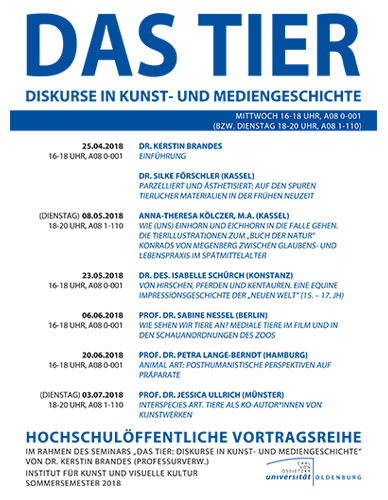
University lecture series as part of the seminar "The Animal: Discourses in Art and Media History", Dr Kerstin Brandes (Professor), Institute of Art and Visual Culture, summer semester 2018
Over the last 25 years, Human-Animal Studies (HAS) - or Animal Studies (AS) - has developed into an interdisciplinary field of research that aims to shift the usual anthropocentric perspective and look at the relationships between humans and animals in a new way. The lectures explore the question of how animals have been used and thematised in visual culture, in art and media history, in art and media studies discourses and to what extent this represents a challenge to Human-Animal Studies.
>>Programme as PDF