
Notes on the crediting portfolio
Notes on the crediting portfolio
A common method for recording existing competences is the creation of a portfolio: This involves systematically documenting educational contexts and relating them to the intended degree programme in order to confirm or reject equivalence in terms of content and level.
The PLAR Service (Prior Learning Assessment and Recognition Service) provides students with detailed advice on the credit transfer procedure and portfolio creation. Applications are submitted and processed completely digitally in stud.IP.
Whether and when students submit the proposal for credit transfer is not tied to any deadline, i.e. there can be any length of time between the counselling and the creation of the portfolio. For this reason, students can also find help with the portfolio on the PLAR Service website, which we have adapted for you here:
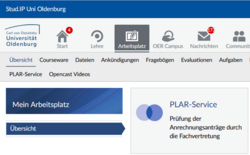
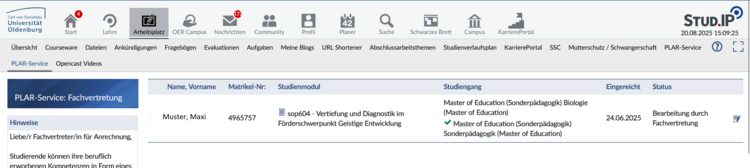
Reason
Students are asked to briefly introduce themselves (max. 500 words) and state why they are submitting the proposal with reference to acquired competences.
They are also given the following information:


Curriculum vitae
In particular, the CV should contain information on education, further education and training as well as academic appointments.
In addition, students receive the following tips and hints for preparing their CV:


Crediting synopsis
In the credit transfer synopsis, students must demonstrate that they have already achieved the competence objectives of the module for which credit transfer has been applied for through knowledge and skills acquired outside the university.
To do this, they should describe in their own words what they can already do (equivalent skills and abilities) in relation to the competence objectives of the module. The relevant stages are then linked in the CV to show where they have learnt or applied these skills. Finally, each entry is assigned corresponding evidence which should clearly show that the student has the skills and abilities described in the respective entry.

Evidence
The attached evidence should clearly show that students have the skills and abilities described. If necessary, they should refer to specific pages in the supporting documents and mark paragraphs.
Authentic evidence
The attached evidence can be very different. We give students the following options as examples:

work samples
- own publications: scientific contributions, monographs (in extracts)
- work reports
- reports prepared by the students
- written or pictorial representations of their approaches:
notes, work plans, visualisations and presentations (graphics, illustrations, videos of drafts and results)


Curricula are extracts from the educational programmes completed by the students: overviews of teaching content, teaching objectives, teaching processes

