

Doctoral candidates' day 2026
What do digital humanities actually do?
In her online lecture "New technology(s) - new science?" Frederike van Ooschot answers the following questions:
What does the narrative of a "new" science mean? Who is the subject of DH? Where can new epistemic logics be found? What is the research policy setting of DH? And how does all this relate to the self-image of "classical" humanities?
Doctoral candidates' day 2026


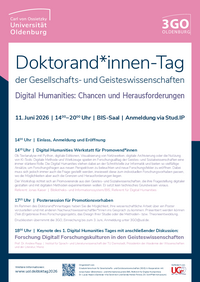
Social Sciences and Humanities doctoral candidates’ day
Key theme: Digital Humanities – Opportunities and Challenges
11 June 2026 | 2.00 pm – 8.00 pm | BIS Hall | Registration via Stud.IP
Programme
2.00 pm | Admission, registration and opening of the 3GO doctoral candidate day
2.15 pm | Digital Humanities workshop for PhD students
Whether it’s text analysis with Python, digital editions, network visualisation, digital archiving or the use of AI tools: digital methods and tools are playing an increasingly important role in everyday research in the humanities and social sciences. Digital Humanities sit at the interface with Computing Science and thus offer a wide range of approaches to examine research questions from new perspectives and open up new fields of research. However, it is always important to ask to what extent these methods are suitable for one’s individual research project, and where the opportunities, limitations and challenges lie.
The workshop is aimed at PhD students in the humanities and social sciences who wish to adopt a more digital approach to their research questions and experiment with digital methods. No prior technical knowledge is required.
Speaker: Jonas Kaiser (Digital Humanities Officer and Subject Specialist for Art and Visual Culture, Material Culture, Journalism and Theatre Studies, BIS)
5.00 pm | Poster session for PhD projects
As part of the PhD Students’ Day, you will have the opportunity to present your academic work via a poster and engage in discussion with other early-career researchers. You may present (partial) results of your research project, the design of your study, or the development of your methodology or theory. Printing costs will be covered by the 3GO Graduate School.
Deadline for poster submissions from all subjects in Schools I to IV (with the exception of Information Studies): 3 June 2026
6.00 pm | Lecture: “Digital Research! Research Cultures in the Humanities”
Keynote / Opening of the 1st Digital Humanities Day at the UOL
Prof. Dr Andrea Rapp (Institute of Linguistics and Literary Studies at TU Darmstadt and President of the Academy of Sciences and Literature, Mainz)
Registration
doctoral candidates wishing to attend the Doctoral Candidates’ Day should please register for the event via Stud.IP. Doctoral candidates wishing to present a poster .
Digital research? 1st Digital Humanities Day at the University of Oldenburg
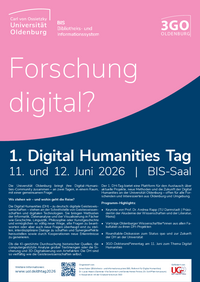
11/12 June | BIS-Saal
Where do we stand - and where is the journey heading?
The digital humanities (DH) are at the interface between the humanities and digital technologies. They bring methods of Computing Science, data analysis and visualisation to subjects such as history, linguistics, philosophy or art history and thus enable completely new ways of answering old questions or even asking new questions in the first place, creating interdisciplinary dialogues and synergy effects and generating new insights through co-operation. Further information and registration
Organised by:
Jonas Kaiser (Library and Information System / BIS, Consultant for Digital Humanities)
Dr Lucas Haasis (Gamelab Villa Geistreich and Gerda Henkel Fellow, German Maritime Museum)
in co-operation with the Graduate School 3GO