
Timetable creation


Timetable creation
How to create your timetable...
Right before you start your degree programme, you are faced with a challenge that - at first glance - seems almost impossible to solve: Creating a (hopefully!) good timetable.
But don't worry! We know how overwhelming everything can seem at first glance. And that's why we've put together all the most important information for you on this page.
On the one hand, you can find a short video tutorial here that explains how to create your timetable.
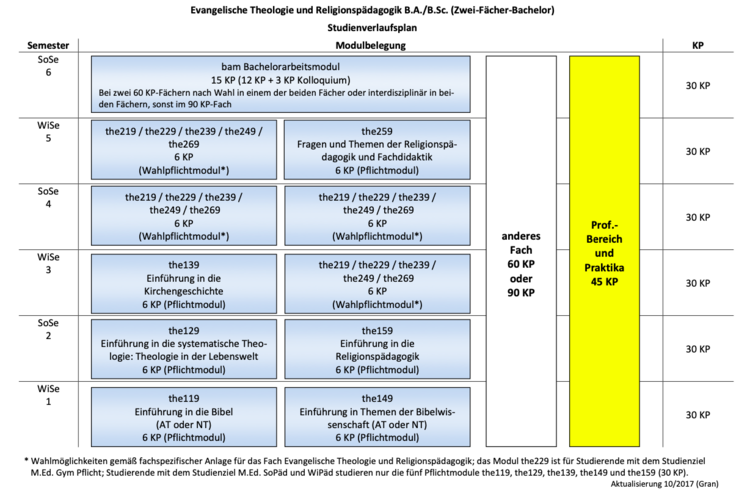
We have also provided you with all the relevant information about the courses in theology and the study plan right here.
Further down, you will also find important tips and tricks from students of some second subjects in the drop-down tabs. You can find further information from the respective student bodies.
Nothing should stand in your way when creating your timetables!
If you still have any questions, please come and see one of our timetable assistants (further information can be found under"Programme & Registration").
Information on the courses in Protestant Theology
Here are a few general tips on registering for modules in Protestant Theology/Religious Education. Further down, you’ll also find the study plan, which shows you which modules you need to take as part of your Bachelor’s degree and provides a recommendation on when you might take them. However, as mentioned, these are merely recommendations. The only important thing is that you take the core modules before the advanced modules and that you take all the courses within a module – for example, the lecture and seminar – in the same semester.
General tips
- It is recommended that you take the basic module in Religious Education (the159) in a later semester (see study plan).
- Anyone who is required to take language courses should start as soon as possible. Furthermore, the language courses are time-consuming, so you must bear this in mind when planning your semester. You can find further information on the languages below.
Enrolment procedure in Protestant Theology
In Protestant Theology, the registration process operates on a‘first come, first served’ basis: registration for a course opens at a specific time. The first people to register for the course will be allocated a place, until the course is full. So: Make a note of the times when the courses open for enrolment and enrol as quickly as possible.
You can find further information on enrolment and how the whole process works in the explanatory video at the top of this page.
‘Cross-enrolment’ in the 119/the 149
The two introductory modules in biblical studies can be chosen from the New Testament (NT) and the Old Testament (OT). Please note that you must study either the119-OT + the149-NT or the119-NT + the149-OT. Within each module/‘the’ code, you must enrol in one lecture and one seminar from the same discipline (New Testament or Old Testament).
the119-AT + the149-NT = the119: Lecture ‘Introduction to the Old Testament’ ’ & ‘Introductory Course in the Old Testament ’ + the149: Lecture ‘The Gospels: Biblical Studies and Introductory Questions on the New Testament ’& Seminar ‘Jesus of Nazareth: New Testament’
the119-NT + the149-AT = the119: Lecture ‘Biblical Studies of the Gospels and Introductory Questions on the New Testament’ & Introductory Course in the New Testament + the149: Lecture ‘Introduction to the Old Testament’ & Seminar ‘Major Texts of the Old Testament’
According to the study plan, students are expected to start with these two modules. However, it should be noted that this will result in a semester heavily focused on biblical studies, involving a great deal of reading and work on the Bible. Those who prefer to spread this over two semesters must bear in mind the rule described above. An alternative to one of the biblical studies modules in the first semester could be the139 Basic Module in Church History.
Ancient Languages
Are you aiming to become a secondary school teacher?
Then, to progress to the Master’s programme, you must demonstrate at least subject-specific knowledge of Latin plus knowledge of Hebrew or Greek. However, if you have already obtained the ‘Kleines Latinum’, ‘Graecum’ or ‘Hebraicum’ at school, you can have these recognised for credit. If not, you’ll need to take the relevant language courses for theology students with Mr Gran and/or Mr Strübind. Each course runs for two semesters and always begins in the winter semester; you should therefore start with a language course in your first semester. It is best to choose the Hebrew or Greek course so that you can demonstrate these language skills in good time for your exegesis, for which you will need them.
In Hebrew, there has also always been a ‘summer term holiday intensive course’. The Institute recommends taking Hebrew or Greek first, as this will enable you to write your exegesis later on with the relevant knowledge.
Are you planning to train as a teacher for GHR (primary/secondary/lower secondary schools)?
You are not required to take these languages, but you can, of course, enrol in them for your own further education.
Would you like to do something outside school?
The languages can be taken as part of a professional development programme leading to a certificate. Further information on the area of specialisation for non-school professionals is available here: Area of Specialisation including Training Modules – Non-School Career Path 2020 (Appendix 3a)
The same regulations apply to the master's degree programme in Ecumenism and Religions as to the GYM teacher training programme. In addition, you can then take the third language as part of your professional development during your Master’s degree.