Wiebke Trunk
Wiebke Trunk
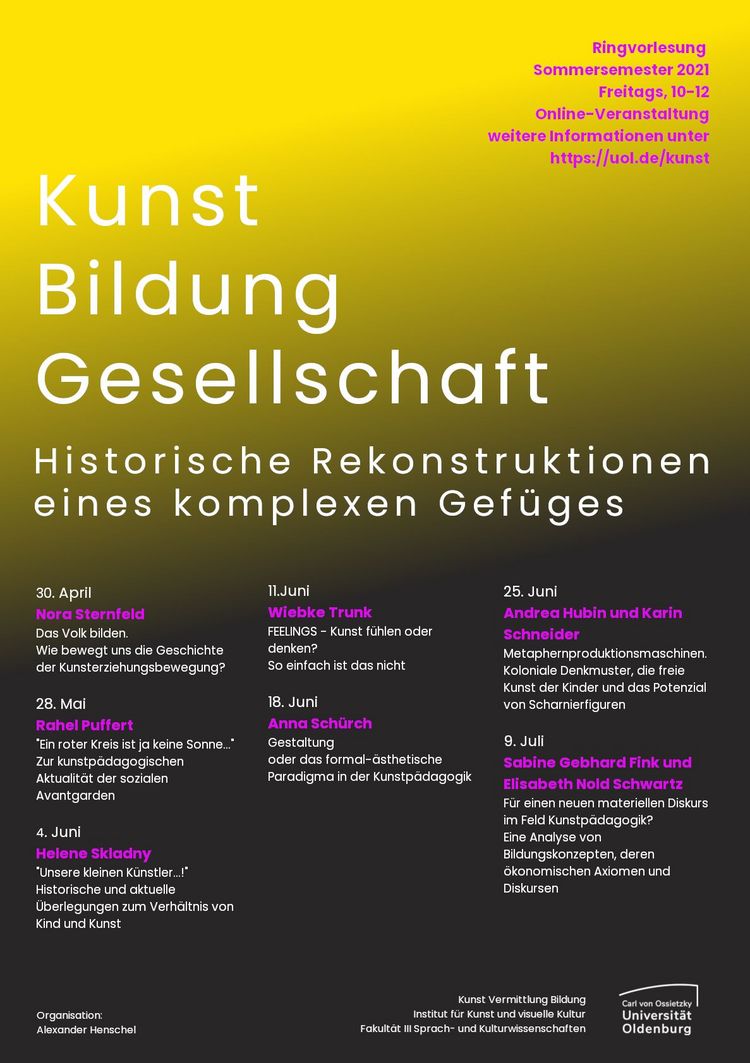
FEELINGS - Feeling or thinking art?
It's not that simple
Lecture on 11 June, 10:15-11:45 a.m.
Emotionality in connection with the reception of works of art is a well-known phenomenon. Various notions of the associated ideas emerge, such as: Art should be experienced with all the senses, art is a mediator of the inexpressible, or that the unbroken existence of man, nature and God finds expression and form in art, etc. This is based on a history that, among other things, developed during the Nazi era into a fundamental interweaving of art and political power in the sense of an aesthetic strategy. On the other hand, there is and was the idea of a rather distanced analytical reception of artistic production, which not least also reflects its affective experience. The question is - are these contradictions or are they connected - and where is the will of the viewer?
Wiebke Trunk initially studied stage design at the State Academy of Fine Arts in Stuttgart (Prof. Jürgen Rose); she then continued her studies in philosophy and art history at the universities of Stuttgart and Würzburg. Today, her work focuses on the field of cultural education, in particular on the realisation of contemporary forms of art education. Since 2014, she has been a research assistant at the University of Oldenburg in the Department of Art and Visual Culture. Since 2019, as part of the Ole+ project, she has been investigating ways of raising language awareness in teaching degree programmes ("Von Kunst aus Sprechen"). On an international level, she works as an advisor for the Institute for International Relations. She is currently completing her dissertation on the communication of art in the Nazi era; the working title is: "Kunstberichte im Erziehungsstaat - eine Untersuchung der Presseberichte im NS über die jährliche "Große Deutsche Kunstausstellung" in München 1937-1943".