Many songbirds use the earth's magnetic field as a guide during their migrations, but radiowaves interfere with this ability. A new study has found an upper bound for the frequencies that disrupt the magnetic compass.
Peatlands, meadows, forests: About 80 percent of habitats in Europe are in poor condition. Rainer Buchwald explains in this interview why this trend should be reversed and what role the EU plays in nature conservation.
Pioneers in digital presentation and research of cultural heritage
How can historical objects and documents in museums and archives be preserved, interpreted without bias and made more widely accessible using digital technologies? This question is at the centre of a new research network.
With an unusual and interdisciplinary exhibition, the Institute of Material Culture and the Institute of Biology and Environmental Sciences are making common cause - and drawing attention to a hidden treasure of the university.
The shell is finished: Those involved celebrated the topping-out ceremony for the new replacement laboratory building on the Wechloy campus. From the beginning of 2025, the building will provide temporary accommodation for various working groups.
New algorithm for quicker detection of antibiotic resistances
Oldenburg researchers develop method for improved identification of potentially resistant bacterium which can cause, among other things, urinary tract infections and blood poisoning.
Best mood, delicious food and fantastic acts: At the stage on the square between the A14 and the SSC, at the 30 stands with dishes from all over the world or in the middle of the hustle and bustle, university members celebrated the summer.
With the exhibition "Showtime", students of the Institute of Art and Visual Culture provide insights into their artistic works and project work. They show experimental art of various genres.
Top News
Higher Education Policy
International affairs
An extraordinary friendship
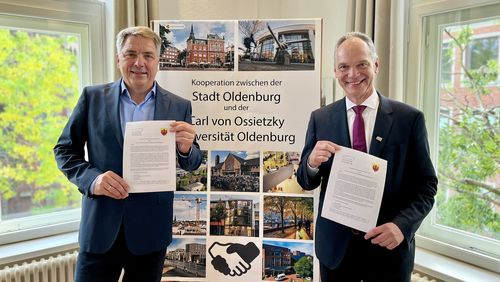
The University of Oldenburg and Nelson Mandela University in Gqeberha, South Africa, celebrate 25 years of cooperation - and adopt a roadmap with eight key fields of action for the coming five years.
How are racism, sexism and queer hostility intertwined? In this interview, Sylvia Pritsch talks about decolonisation and the responsibility that universities and gender studies have for self-reflexive forms of knowledge production.
Researchers investigate long-term consequences of the coronavirus pandemic
Researchers at University Medicine Oldenburg want to make long-term symptoms of COVID-19 predictable and investigate what impact the pandemic has had on the mental health of children and adolescents.
They are regarded as possible high-energy electricity storage devices of the next generation: lithium-air batteries. A research project with Oldenburg participation is testing a new concept to increase the service life of the battery cells.
What does it mean to be a good teacher? Student teachers work out the answers to this question in a very practical way in the university's eleven teaching-learning rooms. Here they can test themselves for their future academic appointment.
The local loss of species may often be underestimated. A new biodiversity study by Lucie Kuczynski and Helmut Hillebrand shows that species richness is not a reliable metric for monitoring ecosystems.
If you want to realise ideas, produce prototypes or record a podcast, the university's Innovation Campus is the place to be: on the ground floor of building V03 you will find everything creative minds need.
Living plant roofs, green oases of well-being, underground water reservoirs and biotopes in the neighbourhood: the "Oldenburg Climate Tour" shows how climate change is also changing the city, including in the university's Botanical Garden.
Increased rainfall and rising sea levels increase the risk of inland flooding in coastal areas: The KLEVER-Risk project shows how western East Frisia can adapt to climate change.