In the AVACS Collaborative Research Centre, top Computing Science researchers have made supposedly "undecidable" problems in safety-critical systems manageable. In this interview, spokesperson Werner Damm looks back on an exciting twelve years.
When was the Colosseum in Rome built? What is a bolie? And who was actually the second man on the moon? Anyone who enjoys tricky questions will get their money's worth on Monday, 2 May. NDR Info invites you to a quiz at the university.
"Immigrant" plants and animals can change entire ecosystems and cause millions of euros worth of damage. A team of researchers led by Oldenburg is predicting which regions are particularly at risk. Far ahead: the North Sea.
Is it legitimate which section of cultural reality museums show us? How does the present get into the museum? And how is the aura of originals created? "Openly asked! What exhibitions don't usually talk about" - this is the title of a student exhibition that focuses on the "museum phenomenon"…
Outstanding in Lower Saxony: the Cluster of Excellence Hearing4all is to receive millions in funding from the state to open up further fields of research and increase its chances in the follow-up programme to the Excellence Initiative. The new findings could have a lasting impact on our daily lives.
Like the University of Oldenburg, the Ocean University of China in Qingdao is also known for its marine research. In future, both universities want to cooperate in research and exchange students and lecturers.
Cuddly patients at Oldenburg Children's Hospital: medical students at the university organised a "Teddy Bear Hospital" for the third time. The event allays possible fears of visiting the doctor and at the same time trains the future doctors in dealing with children.
Lower Saxony Archive Day at the University Library
Which contemporary testimonies are in the right place in which archive? And how do archivists decide what to keep permanently and what to release for destruction? These questions are the focus of the 2nd Lower Saxony Archive Day, which takes place on 18 and 19 April at Oldenburg University Library.
"Is it bad if you have to go to hospital?" This is a question that particularly concerns children. To allay their fears of hospitalisation, medical students have created the "Teddy Bear Hospital". It's happening again on 12 and 14 April.
33 men and women started the newly designed orientation year for refugees at the university at the beginning of April. They would like to prepare for university studies in Germany.
Medication in nursing homes: don't forget the kidney
Oldenburg care researchers warn: one in five nursing home residents receives medication whose dose has not been adjusted to their kidney function or which should even be discouraged altogether. The results of their study were recently published in the German Medical Journal.
"Collaborating" - this is the title of an exhibition of works by art students from various degree programmes, which is now on display in the Lecture Hall Centre. The students created the works last semester under the direction of lecturer Norbert Bauer.
Success for Oldenburg didactics experts: The German Federal Environmental Foundation (DBU) is funding four projects conceived at the university with a total of 800,000 euros. They are intended to help make socially challenging topics such as climate change accessible to young people.
The guest lecture programme at the university will kick off the summer semester on Wednesday, 23 March, with information, an exchange of experiences and a lecture.
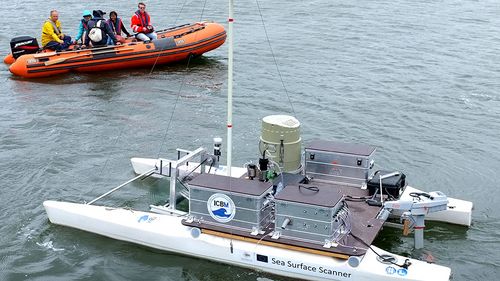
The state of Lower Saxony will be funding three newly designed doctoral programmes at the university in the coming years. A total of 36 scholarships are available for doctoral candidates. The programmes focus on marine analytics, the migration society and extracurricular learning.
MRI scanner goes into operation:
New possibilities for research
Psychological and medical research at the university has access to a new piece of large-scale equipment: The new magnetic resonance tomograph at the School V - School of Medicine and Health Sciences is being used for the first time for a study on the effects of chronic pain on numerical reasoning.
Injustice must be punished! Right? -
KinderUni lecture on the topic of law
Who decides what is wrong and how severe the punishment will be? And is it always fair? These are difficult questions that the legal scholar Prof. Dr. Dr. Volker Boehme-Neßler will get to the bottom of with eight to twelve-year-olds on Wednesday, 16 March at 4.30 pm.
The first step in the formation of dunes and thus an island is what are known as primary dunes - in Platt: "Wittbülten". The national park house of the same name on Spiekeroog, which has been operating a research centre in co-operation with the university since 2011, is now celebrating its tenth…
They started with a blank sheet of paper, lots of creative ideas and the will to create something new. One year later, eleven business informatics students have created a software prototype that they will soon be presenting at CeBIT.