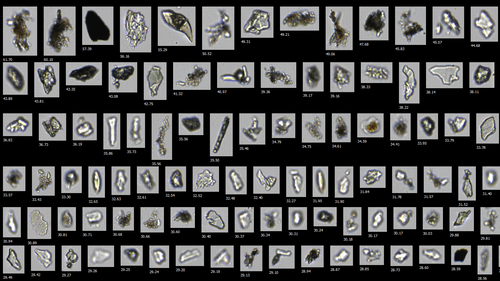
The microlayer between ocean and atmosphere is at the center of a new research group led by Oldenburg scientists. Over the next four years, the team will study this unique environment where harsh conditions prevail.
Without grammar, there is no language - otherwise there would be no structure. This also applies to Sater Frisian. Anyone wishing to learn it can now refer to an up-to-date reference work. An Oldenburg student has also contributed to this.
Campus Life
Landingpage [Discover] Personal
International affairs
Practising intercultural relations
Since 2011, the master programme EMMIR funded by the European Excellence Programme Erasmus Mundus, has been training students from all over the world. Here, four alumni report on their experiences.
Freedom is guaranteed to us as a fundamental right, but it also has limits. Scholars at our university share their thoughts in this online feature – including short video clips.
Top News
Higher Education Policy
International affairs
Refuge and support for scholars at risk
Autocratic regimes, wars and political persecution put academics all over the world at risk. As a member of the international network Scholars at Risk, the University of Oldenburg helps scholars who have fled their home country.
Hearing Research
Excellence Strategy
Research
Top News
Medical Physics and Acoustics
Better hearing through automatic speech recognition?
Speech recognition software is on the rise thanks to smart home systems. Researchers from Oldenburg have now taught an artificial intelligence to hear like an actual human. This could help people with hearing aids in the future.
CARL and EDDY have ensured excellent conditions for research at the University of Oldenburg for the past five years. Now the two high-performance computers are making way for their supercomputer successors, whose names have yet to be decided.
The University Society Oldenburg provides several funding programmes, including travel grants for conferences and congresses abroad. Students and doctoral candidates can apply for scholarships.
Anna Katharina Schliehe is interested in experiences of incarceration. The human geographer has been awarded a fellowship by the prestigious Marie Skłodowska-Curie Actions programme.
A view into the past of the Southwest Pacific Ocean
"Cast off" is the motto on board the research vessel "Sonne" this Friday. Led by Oldenburg geochemist Katharina Pahnke, an international team of researchers is setting off from New Caledonia in the South Pacific on an expedition to the Tasman Sea.
Starting into the summer semester as regular as possible with in-person classes: In his welcoming video, University president Prof. Dr Ralph Bruder explains which measures the university has taken and why being confident is so important.
Sater Frisian and Low German - two languages that are still part of everyday life for some people in Lower Saxony. A project at the Institute for German Studies is now collecting local dialects in a digital language atlas.
Gerd Hentschel, a Slavicist at the University of Oldenburg, provides insights on Ukrainian identity. Since the annexation of Crimea in 2014 he has studied the self-identity of the Ukrainian population – in particular in relation to Russia.
Helping refugee children and young people from Ukraine get started in German schools: Special education students will be taking on this voluntary task at a secondary school in Oldenburg over the coming weeks.
The number of solar modules on the roofs of the University of Oldenburg continues to grow: at the end of February, systems went into operation on the sports building, the fitness and health centre and the lecture theatre centre A14.
Fish migrations generally take place hidden from view. Researchers from the Magnetoreception Collaborative Research Centre at the University of Oldenburg are investigating how herring, sticklebacks and coral fish find their way in the sea.
Discussing the background and consequences of the war
In a three-part series of events organised by the university, experts will shed light on the "background, consequences and repercussions" of the war in Ukraine. The event is organised by the Office for University and Trade Union Co-operation with partners.
For example, he teaches future teachers how to deal with right-wing extremism. In this interview, Christian Pfeil talks about the reasons why people join or leave the scene - and what motivates him to help them leave.
Silja Stegemeier is an artistic associate for vocal training at the Institute of Music. Among other things, she teaches prospective music teachers how to form a choir. She recently became the director of the university choir.
Snow-white deep-sea crabs populate the seabed near hydrothermal vents. Oldenburg microbiologist Thorsten Brinkhoff was on the track of the animals with the submersible Alvin.