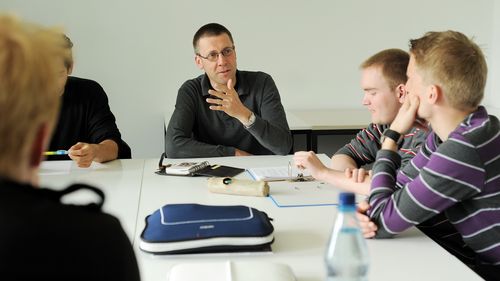
Thousands of students are currently applying for a place at German universities. But how does it feel to be a first-year student? Regina Wall, Rita Sonnenberg and Rachel Hänßler began their studies at the University of Oldenburg last winter semester and report on their experiences.
Kuni, the mascot of the KinderUniversität Oldenburg, is already in the starting blocks - with three exciting excursions into the world of science for KinderUni students from the city and region.
It all starts on Wednesday, 21 August! Now is the time to secure your tickets for the "autumn…
The BIX library index is a nationwide performance measurement tool for public and academic libraries. This year, Oldenburg University Library received top marks in three out of four categories.
Gunilla Budde appointed to the management committee of the Oldenburg State Theatre
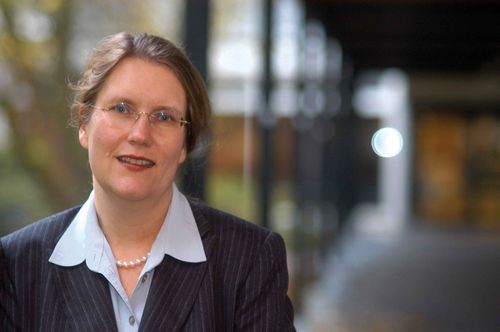
Prof. Dr Gunilla Budde, historian and Vice President for Studies and Teaching at the University of Oldenburg, has been appointed to the Oldenburg State Theatre's Administrative Committee by Lower Saxony's Minister for Science and Culture, Dr Gabriele Heinen-Kljajic.
Radiotherapy is one of the three pillars of cancer treatment, alongside surgery and drug therapies. Oldenburg scientists have been researching measuring devices that record the distribution of radiation doses in the body for ten years. A contribution by medical physicist Björn Poppe and the "Medical…
Humza Imran Mirza has travelled around 6,000 kilometres to study Engineering Physics at university. He only left his home country of Pakistan six months ago. But he already feels at home at university. In this interview, he talks about his first experiences.
Babette Simon on the new advisory board to support Charité health research
Prof Dr Babette Simon, President of the University, has been appointed to the Scientific Advisory Board of the "Private Excellence Initiative Johanna Quandt". The Advisory Board is to support the scientific work of the new "Berlin Institute of Health (BIG)/Berlin Institute of Health (BIH)", an…
More and more citizens are participating in energy cooperatives. What role can this co-operative form of business play in the future? The new BMBF joint project "EnGeno" aims to provide answers to this question. Irene Antoni-Komar and Niko Paech talk about the specific research objectives.
Babette Simon appointed to the advisory board of the German Consortium for Translational Cancer Research
Prof. Dr Babette Simon, President of the University, has been appointed to the Scientific Advisory Board of the "German Consortium for Translational Cancer Research (DKTK)" - one of six German centres for health research.
"Experience college life in America": that's what Katharina Bieloch wanted when she decided to spend a semester abroad at Longwood University in Virgina. There was a lot of paperwork to do beforehand. But for the Oldenburg student, the effort was more than worth it.
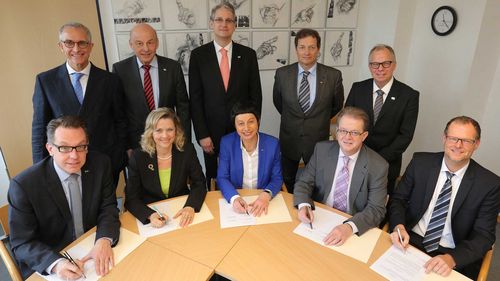
The newly founded Scientific Advisory Board of the Didactic Centre (diz) has held its inaugural meeting at the university. The committee is based on a recommendation from the Scientific Commission of Lower Saxony, which evaluated the diz in 2011.
Al-Shamery elected to the University Senate of the German Research Foundation
Prof Dr Katharina Al-Shamery, chemist and Vice President for Research at the University, has been elected as a new member of the Senate of the German Research Foundation (DFG) by the General Assembly in Berlin.
The University Senate is the DFG's most important science policy body. It addresses…
Having fun, learning new things, making a difference and helping: These are the most important motives for participating in service learning. The majority of students get involved for intrinsic and altruistic reasons. This is one of the results of an impact study.
From a small town in central Italy to the centre of a huge empire: how was the incredible rise of the Romans possible? And why is Roman history particularly interesting for us as contemporaries of globalisation? An interview with ancient historian Michael Sommer.
Helene Lange Kolleg "Queer Studies and Intermediality"
The Helene Lange College "Queer Studies and Intermediality: Art - Music - Media Culture" is focusing on queer art, music and media culture and will kick off on Thursday, 4 July at 5 p.m. (Haarentor Campus, Building A8, Room 0-001).
"Queer questions binary gender systems such as male and female,…
How do fish larvae that have drifted for kilometres manage to return to the reef where they were born? An international team of researchers has investigated the migratory behaviour of coral reef fish. And discovered that the animals use a solar compass to navigate in the open ocean.
2017 marks the 500th anniversary of the posting of Martin Luther's theses. What is the function of the Reformation anniversary? Can it be used for ecumenical commemoration? And is it possible to commemorate the Reformation "differently"? An article by theologian Andrea Strübind.
Erik Harms and Josef Lange jointly head the School of Medicine
The School of Medicine and Health Sciences at the University of Oldenburg has two new Deans: in future, the medical doctor Prof. Dr Erik Harms, Director of the University Children's Hospital in Münster until 2008, and the former State Secretary in the Lower Saxony Ministry of Science, Dr Josef…
City and region support healthcare research at the university
The School of Medicine and Health Sciences at the University of Oldenburg is once again receiving financial support. The district of Ammerland - on behalf of the Arbeitsgemeinschaft (AG) der Landkreise und kreisfreien Städte Weser-Ems - and the city of Oldenburg are providing a total of one million…
Destructions, emotions - works of art: students from the Institute of Art and Visual Culture investigated the aesthetic quality of deformations. Their works can now be seen in the "deconstruction circus" exhibition in Oldenburg. An interview with Kim Triebe and Alina Edelmann.