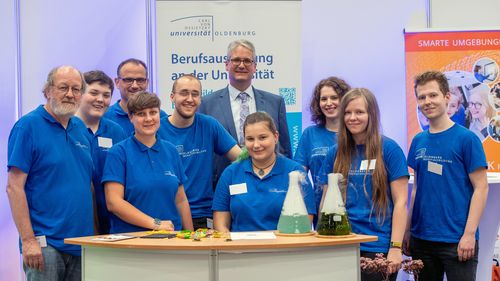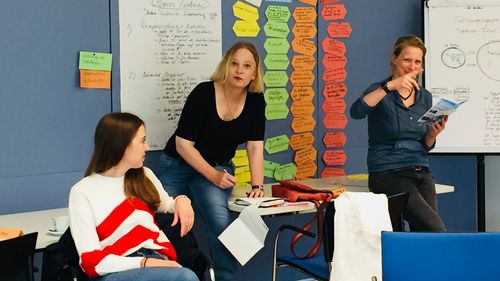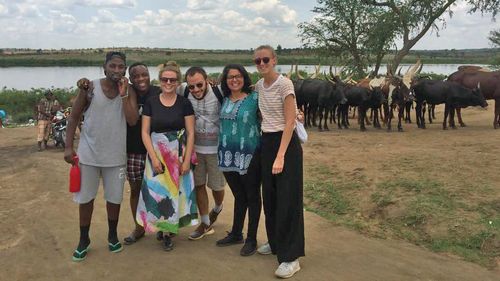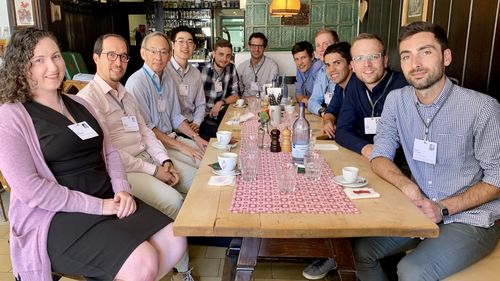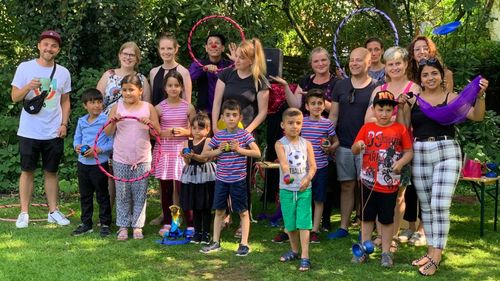
They come from Asia, Africa and Latin America: 23 young higher education managers are currently participating in the advanced training programme UNILEAD – while also getting to know the city and its surroundings.
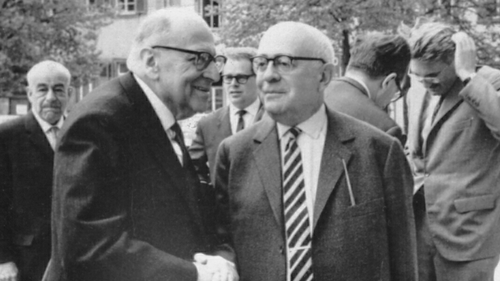
26 February marks the 50th anniversary of the death of philosopher Karl Jaspers. In this interview, Oldenburg philosopher Matthias Bormuth talks about Jaspers' ideas on the maturity of the individual citizen and the topicality of his ideas.
"The character of the internet would change permanently"
There is resistance to the EU copyright reform on the internet. Critics fear, among other things, that so-called upload filters will lead to marks. In an interview, legal expert Jürgen Taeger explains the background.
Silicon electrodes could help to increase the storage capacity of lithium-ion batteries. Oldenburg chemists have now observed for the first time how wafer-thin films grow on silicon electrodes.
The lives of emperors and kings are extensively documented. However, little is known about the fate of ordinary people. How did a maid live in imperial times, for example? Historian Gunilla Budde is researching this.
The WindLab research laboratory on Küpkersweg is one of this year's winners of the prestigious "German Design Award". "A timelessly modern design that fulfils the requirements of a closely networked scientific working method," was the jury's verdict.
Disposable plastic products are to be banned in the EU from 2021. A step in the right direction, says marine scientist Gabriele Gerlach. But there's more to it than that, she emphasises in the interview.
The German Federal Cartel Office today announced its decision in the proceedings against Facebook. The authority prohibited the company from collecting data outside the social network. Here is an assessment by legal expert Sebastian Louven.
On 6 February 1919, the constituent German National Assembly met for the first time in Weimar. History didact Dietmar von Reeken explains in an interview what role "Germany's first democracy" still plays in history lessons today.
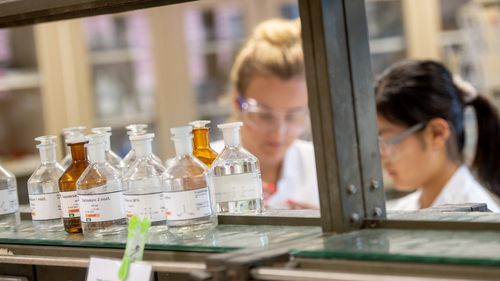
Oldenburg geochemist Katharina Pahnke-May is studying the precise distribution of various metals dissolved in the waters of the world’s oceans. They can serve as markers for ocean currents – and reveal a lot about their origins.
Studying alongside your sports career? This is possible at the University of Oldenburg, in the Bachelor's programme "Business Administration for Competitive Athletes". A degree programme with its own rules.
How is music used politically? Music educator Mario Dunkel deals with this question. Among other things, he is researching West German music diplomacy during the Cold War. In this interview, he talks about the special features of this period.
How do values develop in different political systems? Social scientist Stefan Walter explores this question in an unusual way: He analyses entries in poetry albums.
Student ID card, time recording chip, semester public transport pass: anyone who goes in and out of Oldenburg University needs several cards. This is about to change. The new CampusCard is coming in spring. Here is an overview of the facts.
"Internationally important centre for marine and climate sciences"
Lower Saxony's Science Minister Björn Thümler visited the site for the new Helmholtz Institute for Functional Marine Biodiversity (HIFMB) at the University of Oldenburg on Friday. He also informed himself about the research.
At the current Handball World Cup, it's not just the players who are under a lot of pressure, but also the referees. In this interview, Oldenburg sports scientist Dirk Büsch reveals what characterises a good referee.
Honours and music by the "Comedian Harmonists": around 550 guests, including Lower Saxony's Science Minister Björn Thümler, spent a stimulating evening at the New Year's reception of the University and the University Society (UGO).
Why do nearly one in three students in Germany drop out of higher education? The reasons can be manifold but there has been little systematic research on the subject to date. In order to change this Michael Feldhaus and Karsten Speck are embarking on new paths in their research project LAST. Their…