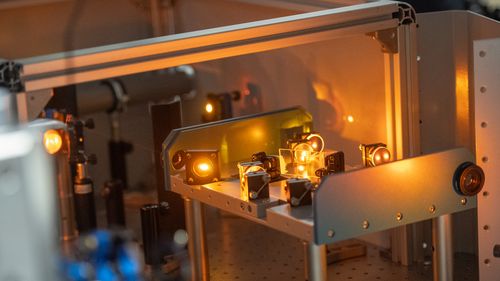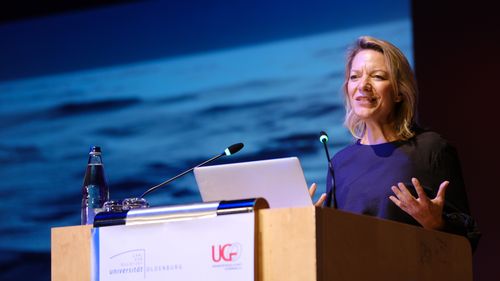
Special physical laws apply to distances of less than a hair's breadth. The physicist Svend-Age Biehs explores these amazing phenomena. He recently received the Gustav Hertz Prize from the German Physical Society.
On 11 May, Oldenburg Master's students will open the self-organised exhibition "HOW WE KNOW - Interfaces between research and everyday life". Pieces from the university's collections will be placed in an unusual context.
Yesterday, the World Biodiversity Council IPBES published its first report on the state of biodiversity. Dr Ute Jacob from the Helmholtz Institute for Functional Marine Biodiversity at the University of Oldenburg (HIFMB) was present in Paris.
How did tobacco, tea, caffeine, sugar, chocolate and opium transform life in northern Europe's port cities from the 17th century onwards? Historians from the universities of Oldenburg, Sheffield, Utrecht and Stockholm will investigate this impact.
Minimalism, cubic shapes and right angles: students at the University of Oldenburg were inspired by the works of various Bauhaus artists. Their project work can now be seen at the State Museum of Art and Cultural History.
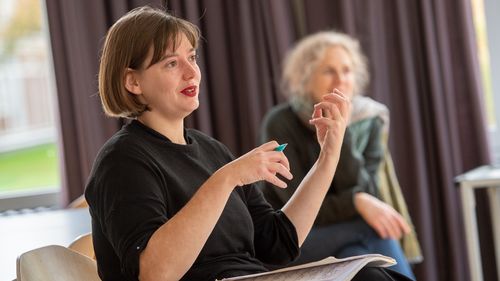
An image, a thought or a text - composer Violeta Dinescu is inspired by a wide variety of things. Above all, the university lecturer wants to teach her students how to compose authentic music. An interview.
In the REENEA project, scientists led by sociologist Jannika Mattes are researching the regional energy transition as a social process. The initial results from Oldenburg are now available - and generated discussion at a stakeholder workshop.
Writing a seminar paper, bachelor's or master's thesis can be quite challenging. Students of the humanities and social sciences can find support with the "Writing support for term papers and theses".
Voting with a cigarette butt? On the Haarentor campus, smokers can now use so-called ballot bins - bright yellow ashtrays that students regularly use to "choke off".
Medical physicists at the University of Oldenburg are investigating not only terrestrial but also cosmic radiation - a connection that only appears unusual at first glance.
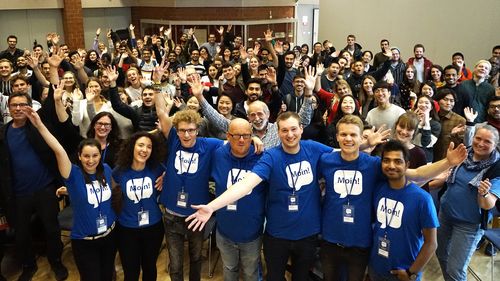
More than 300 speakers from 36 countries will be coming to the university at the end of May to present and discuss their findings and network at the World Congress for Student Research.
What can be done to fight multidrug-resistant germs in German hospitals? A Dutch-German team led by medical microbiologist Alexander Friedrichs is looking for solutions.
Sometimes small things have great power. Even grains of rice can trigger social, political and ecological change. Researchers in Oldenburg were recently able to see this for themselves.
Oldenburg research into artificial intelligence to be strengthened
Lower Saxony is intensifying its research activities in the fields of digitalisation and artificial intelligence (AI): The current branch of the German Research Centre for Artificial Intelligence (DFKI) in Osnabrück is being expanded into the DFKI Laboratory Lower Saxony with branches in Oldenburg…
Hearing Research
Excellence Strategy
Research
Top News
When sounds become noise
A new Emmy Noether junior research group led by neuroscientist Martin Bleichner is investigating how we perceive noise. To do this, the researchers want to measure brain signals in everyday life.
Repairing instead of throwing away - teachers, students and researchers came together in mid-March at the University of Oldenburg's lecture theatre centre under this motto. The final conference of the RETIBNE research project took place there.
Six years after it was founded, the human medicine degree programme has its first graduates. One of them is Johannes Grone. He is currently completing his specialist training in Oldenburg. His degree programme has prepared him well for everyday life as a doctor.
How has "fast fashion" changed our relationship to clothing? What are the ecological and social consequences? In her research, cultural scientist and ethnologist Heike Derwanz takes a close look at people and how they deal with clothing.
Can you live on the moon? Physicist Andreas Engel addressed this question in the 100th KinderUni lecture. At the end, it was clear to the children in the packed Audimax: the moon is definitely worth a trip!