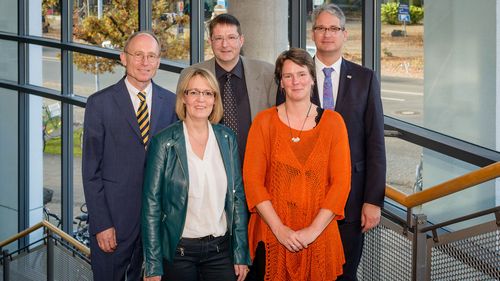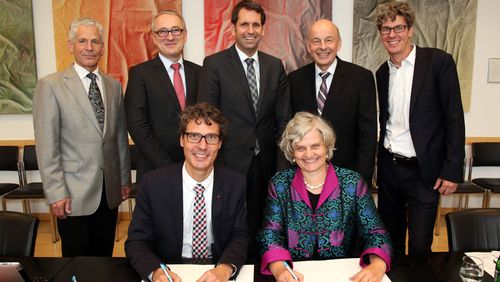
The new NeSSy research building on the Wechloy campus has been officially opened. It offers three of the university's outstanding research focuses a place for intensive exchange.
Philosophising with children - symposium at the university
Philosophising with children - a conference on this topic will be held at the University of Oldenburg on 3 and 4 July. The event entitled "The Educational Worlds of Things - Thinking Labs of Philosophising? On Practices of Understanding", the Institute of Philosophy is expecting more than 50…
Bacteria in the sea:
Hugely important for the global carbon cycle
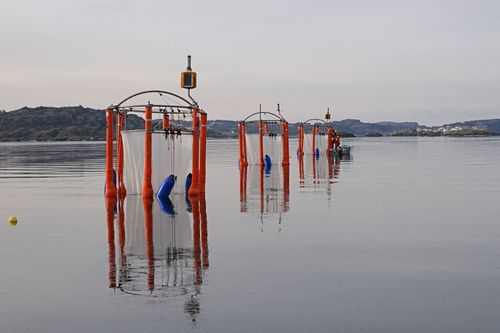
How is it that organic material dissolved in the sea can store carbon over thousands of years and thus keep our climate relatively stable? To get a little closer to the answer to this question, marine researchers at the university have conducted a laboratory experiment lasting several years.
Homogenisation of ecosystems:
Species communities are harmonising
The European Mediterranean snail can now also be found in South Africa and Australia. How this came about and what snails have to do with the homogenisation of ecosystems - ecologist Hanno Seebens researched this in an international team and published the results in the journal "Science".
Historical clothing, GDR film scripts or bacterial cultures: the university is providing an insight into its diverse scientific collections with an exhibition. This can be seen successively in the Botanical Garden, on campus and in the city centre.
Supplying the growing population with a sustainable source of energy without environmentally harmful waste is the centre of an interdisciplinary and international conference at the University of Oldenburg from 15 to 18 June.
The resources that a society has to distribute are scarce - for example in the social or healthcare system. Which distribution is considered fair and why? Political scientist Markus Tepe and philosopher Mark Siebel are investigating this in a new DFG research group.
Daycare centre strike: "Nursery teachers are not getting
not getting the recognition they deserve"
The nursery school teachers have made it clear: Their work is a fundamental part of the education system - and it should be better paid. A statement on the occasion of the daycare strike by Prof Dr Rudolf Leiprecht, spokesperson for the Social Pedagogy Section and the Pedagogy Working Group, as well…
Mushrooms instead of chemical fertilisers and solar cells for refrigerated transport: these projects won the "Climate Innovations" business competition organised by the university-led "Network Innovation & Start-ups in Climate Change" (NIK).
Palmyra World Heritage Site:
"Conditio of being human is up for grabs"
The feared iconoclasm of the world cultural heritage site by IS terrorists leaves most people in this country cold. Yet the site belongs in the cultural memory of European nations. An article by Michael Sommer, ancient historian and expert on Roman Syria.
People in central Ukraine often speak a mixture of Russian and Ukrainian. Slavicist Gerd Hentschel is currently investigating the phenomenon on site - and is also feeling the effects of the political crisis.
Massive Open Online Courses, or MOOCs for short, are changing university teaching worldwide. They go far beyond online courses or lecture recordings. How useful is their use at German universities? An article by Oldenburg economist Christoph Böhringer.
Oldenburg young scientist receives US award for innovative research
International award for a young scientist from Oldenburg: Antonietta De Sio from the "Ultrafast Nano-Optics" working group at the Institute of Physics has received the "Tingye Li Innovation Prize", endowed with 3,000 US dollars, in San José, California.
An academic CV in the fast lane: Munich geoscientist Xiaoxiang Zhu has been awarded this year's Helene Lange Prize by the EWE Foundation and the university for her outstanding achievements in research and teaching.
Rethinking education without abandoning the tried and tested: On the initiative of the University of Oldenburg, experts discussed the educational mission of the university at Herrenhausen Palace in Hanover. An interview with the Rector of the University of Siegen and Vice President of the German…
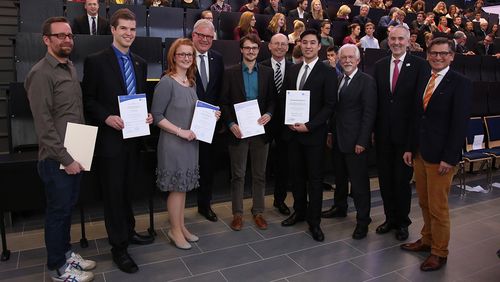
Award ceremony of the "Climate Innovations" competition
The best entrepreneurial innovations for adapting to the consequences of climate change will be honoured by the "Network Innovation & Start-ups in Climate Change" (NIK), led by the University of Oldenburg, in its "Climate Innovations" competition. Interested parties are cordially invited to the…
The university was invented during this period and the idea of "education" as a life-long endeavour was born: The Middle Ages were nowhere near as medieval as many people think. Especially as there is no such thing as "the" Middle Ages. An article by philosopher Johann Kreuzer.
Computing Science, Mathematics and Physics with top scores in CHE ranking
Students of Computing Science, Mathematics and Physics complete their studies at the University of Oldenburg quickly. This is the result of the latest university ranking by the Centre for Higher Education Development (CHE).