
in the sea of eyes (2014)
in the sea of eyes (2014)
in the sea of eyes - intrinsic sounds and television images
approaching marine biology - a project of visual blogging and biological cinematics
....unpredictable links between man, sea, eye and apparatus...
a co-operation of the Institute of Art and Visual Culture and Integrated Media with the ICBM, Institute of Chemistry and Biology of the Marine Environment at the University of Oldenburg.
Support: Dr Birte Junge and Dr Sibet Riexinger, ICBM
Artistic direction: Anke Fischer, performative, artistic media practice
The films, which were realised in the Found Footage Workshop for experimental co-productions for the ICBM, establish links between aesthetic research and apparatus-based seeing in the laboratory, at the editing table and under water. They aim to promote cursory, ornamental and discursive (re)interpretations of the theme of man and the sea. A gift to the colleagues of the sea:
Film list:
1_ Wateriswet _by Lydia Liedtke
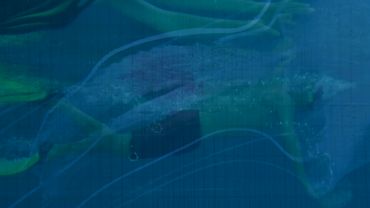
Water, which the diver can easily enter, is an element familiar to us. Its feel and sound are familiar to us, it is essential to life and yet it is not our habitat. The film plays with the mixture of profane and extraterrestrial elements. The turquoise-coloured petri dishes can thus become a swimming pool and the drops of the pipettes take on an almost haptic component. Even with the swimwear models, you can't help but wonder whether the whale songs aren't actually the siren songs of these mermaids who look at us so longingly and intimately.
2 _Bubble-Click_ by Lena Withot and Leonie Feiber
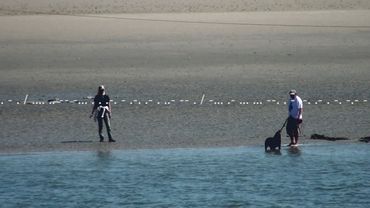
Based on the fascination with the fact that sand does not have to be sand, "Bubble-Click" approaches this phenomenon using a predominantly aesthetic approach. The unknown, misunderstood scientific equipment is juxtaposed with the equally scientific but visually familiar divers - and at the same time the tension between nature and technology is visualised.
3_ kotzende moewen (the horizon is moving)_ by Lucia Schaub
Away from the familiar ... --- ... the Morse code is captured on the horizontal in this film, regardless of what happens around it: actually just the everyday in colour, a homage to the lightness of passion and motivation, with a pinch of sea scent. The highly frequented carpet of sound continues to ring in the viewer's ear for even longer, whereby the content level remains encrypted. The title is the programme, dizziness is not excluded. Nausea due to the feeling of swell. Film can also upset the stomach.
4 & 7_ m[e]er found footage_ by Charlotte Anna Sophie von Harling
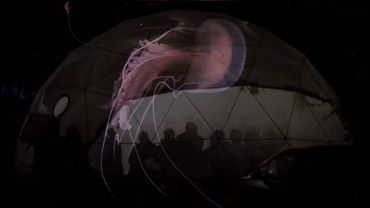
The film m[e]er found footage deals with the exploratory nature of perception by thematising three perceptions that build on each other in terms of form and content. The view through the microscope makes it possible to observe the smallest creatures such as plankton in the most diverse forms and movement patterns: microscopic perception shows reflections in the eye and at the same time directs the viewer's gaze back through the microscope. Research dives show the striving for a direct relationship to the object of research. aqueous perception establishes analogies between humans under water and marine life living in the water. It shows parallels with regard to the types and techniques of movement of humans and animals in the water. In aqueous perception, the plunge pool and the sea are brought together spatially and can no longer be completely distinguished. oceanic perception not only refers to the ocean as a space for research. There are countless things to be explored and which ultimately confront people with the enormous (oceanic) task and motivate them to turn to the underwater world experimentally in the laboratory or in diving equipment. In this sequence, the researching eye brings together all that has been seen and attempts to organise it and bring it into context. How this happens is part and parcel of science, whether in the laboratory or in nature.
5_ Sediment-water interface: Questions of geochemical knowledge and visualisation of oceanic and aeolian data streams_ by Katharina Nölle and Thorge Freidel.
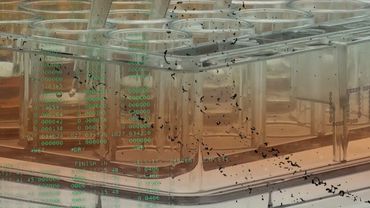
A marine-biological borderline view of sediment and water, which in a scientific context is reflected in measurement data, can be presented in the experimental film through a montage of filmed research processes and computer-generated graphics. The colourful flood of measurement data becomes a visual dissection of the flood of information in the context of the auditory contradictions of the sound of the sea and whale songs and the cheekiness of an echoing pop song. The exploration of the interfaces of sediment and water takes place almost seamlessly within the framework of an analogue film aesthetic
6_ Shaking Science_ by Christine Adamski
The short film "Shaking Science" aims to depict the process of scientificisation of seawater. Various technical procedures are described one after the other in order to show the contrast between the element of water in its liquid natural state, rich in life forms, and its static form in the laboratory, broken up and altered down to the smallest detail.
8_ North Sea_ by Nina Wenzlaff and Christian Sanders
The film shows fully automated processes thanks to artificial entities. You can hear Empress Sissi's homage to the North Sea "Wer hat's Dir wohl verraten..." to the melodic squeaking of a shaking laboratory device. But a day at the beach is never really within reach, not least because of the idiosyncratic visualisation of the spoken word and images that can only be remotely linked cognitively to the sea. Oh yes, if you look closely, you can catch a glimpse of a film star.