We (all) are the people 2017/2025 Hans Haacke
We (all) are the people 2017/2025 Hans Haacke


We (all) are the people at the University of Oldenburg
Since autumn 2025, two banners from the series We (all) are the people by artist Hans Haacke have been displayed on the bridge between buildings A1 and A14. The title of the work can be read in a total of twelve languages on 10 x 1.5 metre panels, each framed on the left and right by blocks of colour with a rainbow gradient. The languages - Arabic, Bulgarian, German, English, Farsi, French, Polish, Russian, Croatian, Kurdish, Tigrinya and Turkish - represent the countries of origin from which most migrants in Germany came at the time of the work's first presentation at documenta 14 (2017).[i] On the banners, the individual translations are arranged in three blocks and - without judgement - in alphabetical order.
Haacke's exploration of the eponymous slogan "We are the people" began as early as 2003, when he proposed projecting the slogan "We are the people", which was already being used by xenophobic groups at the time, onto the Nikolaikirche in Leipzig with the addition "(all)". In the 2010s, the slogan, which originated from the demonstrators in the final phase of the GDR, was given a new right-wing populist boost by the Pegida demonstrations. In 2017, Haacke took up his never-realised proposal from Leipzig again in a work for documenta 14, which took place in Kassel and Athens. The resulting work Wir (alle) sind das Volk (We (all) are the people) was displayed at the Red Palace in Kassel, at bus stops and at the Museum of Contemporary Art in Athens. The choice of languages was adapted to the respective country. For example, the version on display in Athens included a translation of the sentence into Albanian, Greek and Romanian instead of German, Polish and Tigrinya.[ii] The work was later also shown at various other locations: in 2018/2019, art colleges and universities in the eastern German Federal States followed, including the Bauhaus University Weimar, the Academy of Visual Arts Leipzig and the Burg Giebichenstein University of Art and Design Halle. In 2020, the work was a prominent part of Berlin Art Week, where it was presented at the Volksbühne Berlin, the Haus der Kulturen der Welt and the Akademie der Künste. The work has also repeatedly been shown abroad, whereby the languages shown were always adapted to the respective country, such as 2018 at the Khalil Sakakini Cultural Centre in Ramallah, 2018 at the City Hall in Brussels-Molenbeek or 2019 at the New Museum in New York. Haacke explains the history of the work for the press release from the Academy of Visual Arts Leipzig as follows:
""We are the people" was the slogan with which the commanders of the so-called People's Police were overthrown in 1989. In 2003, I was invited to take part in a competition to commemorate these events with a permanent installation in Leipzig. At that time, xenophobic groups had already reinterpreted the liberation lottery for their smear campaign against immigrants and refugees. Against this background, I suggested projecting the proclamation "We (all) are the people" onto the Nikolai Church in Leipzig at night, where the victorious Monday demonstrations had taken place in 1989. The competition jury decided in favour of another artist's proposal. The banner "We (all) are the people" affirms our solidarity with all migrants and refugees who are currently facing virulent xenophobia, racism and life-threatening religious conflicts in many countries around the world."[iii]
The work is also part of a series of other works by the artist in which he explores the concept of the people and concepts of belonging. His design Calligraphie (1989) envisaged, among other things, depicting the slogan of the French Revolution in Arabic and gold lettering on a pyramid of stones in the cour d'honneur of the French National Assembly. Much better known is the work DER BEVÖLKERUNG (2000) in the German Bundestag, which is celebrating its 25th anniversary this year. Here, Haacke takes a critical look at the inscription on the portal of the Reichstag building "Dem deutschen Volke" (To the German People) and relies on the participation of the members of parliament, who are to bring earth from their constituencies to Berlin and pile it up within a wooden frame. This anniversary is also one of the reasons why Wir (alle) sind das Volk can now be seen in Oldenburg. In co-operation with the "Werkstatt DER BEVÖLKERUNG" initiative, which develops projects at the interface of art and politics and was founded to mark the anniversary of DER BEVÖLKERUNG, Timo Merten and Friederike Nastold curated the presentation of the banners, which can be seen on the bridge between the A1 and A14 motorways at the entrance gate to the Haarentor campus.
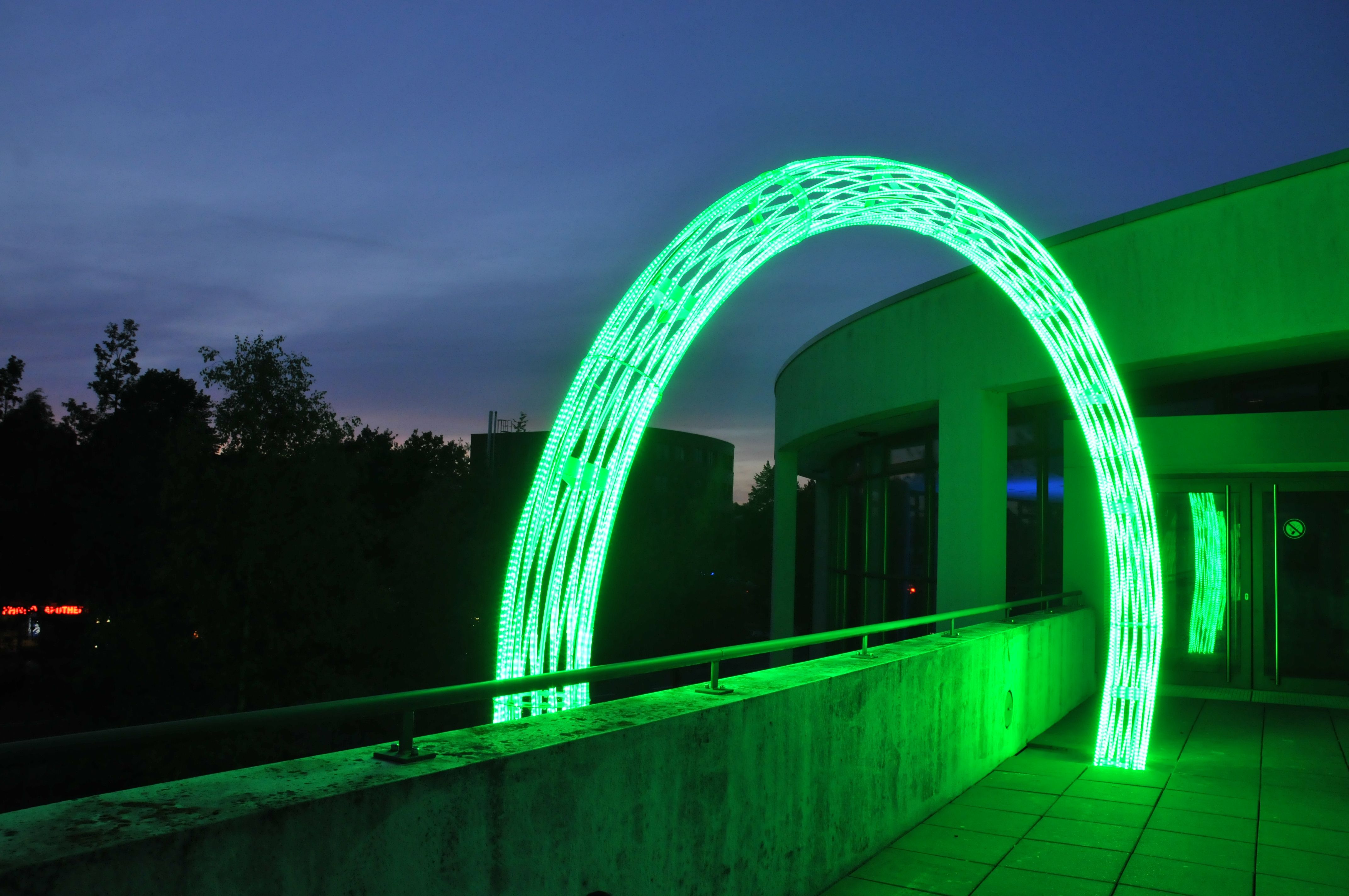
The use of the bridge for artistic works, especially those that deal with social coexistence and politics, is not entirely new. As part of an exhibition to mark the 125th birthday of the philosopher Karl Jaspers in 2008, Peter Weibel and Ólafur Elíasson designed the work Rainbow Democracy, a ring that shone in the colours of the party spectrum. Peter Weibel wrote in the catalogue accompanying the exhibition: "The colour circle around the bridge between two university buildings alludes to the bridging function of parliament and to a democracy in which all interest groups are fairly represented, i.e. all republican parties loyal to the constitution."[iv] Weibel and Elíasson also installed a water sprinkler on a meadow on the Haarentor campus, which watered a ring-shaped strip of lawn. In this work, the artists took up the necessity of participation in political processes: "Therefore, a water sprinkler is installed on a meadow at a greater distance, which also sprays a circle with water. Where the water falls, the meadow is green. Where the water does not fall, the meadow is brown. Democracy must be realised and activated. Democracy is green. Where there is no democracy, where no water is activated, the brown of dictatorship prevails."[v]
Just as the bridge itself, on which both works were or are mounted, connects the comparatively young lecture hall centre with the original university complex A1-A4 and thus refers to the further development of the reform university founded from the teacher training college, Weibel and Elíasson as well as Haacke also take up the function of the bridge as a connecting element in their works. Rainbow Democracy emphasises the interaction of different political positions and participation in political processes as a prevention against fascism. We (all) are the people, on the other hand, refers to the now right-wing populist slogan of the peaceful revolution in the GDR and gives it an inclusive counterpart by adding the word "(all)" and translating it into twelve other languages. The banner shows that all these languages are on an equal footing. Especially at a university whose student and staff body is made up of people with different backgrounds and migration histories and at a time when right-wing narratives are increasingly determining political decisions, the work fulfils a unifying, bridge-building function: Everyone belongs, everyone stands together as equals and all people - regardless of their background - are an important part of the community.
Text: Timo Merten
Concept and organisation: Timo Merten and Friederike Nastold, Institute of Art and Visual Culture
In co-operation with Werkstatt DER BEVÖLKERUNG (Berlin)
[i] Cf. Alberti, Sarah: We (all) are the people - Hans Haacke's contribution to documenta 14, kunsttexte.de, no. 4, 2017, here: S. 6.
[ii] Ibid, p. 6.
[iii] Hochschule für Grafik und Buchkunst Leipzig: Press release: "Wir (alle) sind das Volk - We (all) are the people" Documenta banner by Hans Haacke in Leipzig, Chemnitz and Dresden, 2018, www.hgb-leipzig.de/hochschule/presse/35, last accessed: 29 October 2025.
[iv] Weibel, Peter: Rainbow Democracy. A project for Karl Jaspers by Ólafur Elíasson and Peter Weibel, in: Meyer-Bohlen, Monika (ed.): Wahrheit ist was uns verbindet. Philosophy, Art, Illness, exhib. cat., University of Oldenburg, 22 May - 12 July 2008, Bremen: Hauschild 2008, pp. 164-169, here: S. 169.
[v] Ibid.